Industry

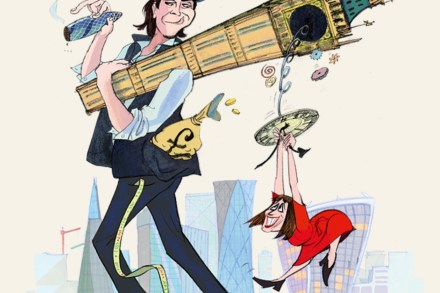
Is Labour too close to the City – with Lionel Shriver & Robert Hardman

35 min listen

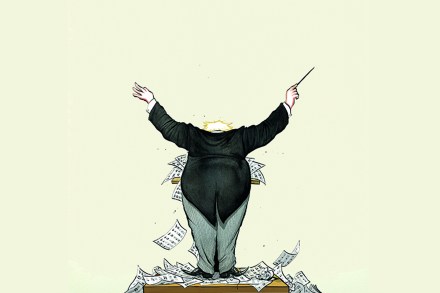
Britain’s banks have a hold over Rachel Reeves, declares Michael Simmons in the Spectator’s cover piece this week. Almost two decades on from the 2008 financial crash, the UK has failed to reform the system and – as ordinary people face a cost-of-living crisis – Labour is in hock to big business. Is the Chancellor too close to the City? For this week’s Edition, host Lara Prendergast is joined by economics editor Michael Simmons, columnist Lionel Shriver, and columnist from the Daily Mail Robert Hardman. As well as Labour’s relationship with the banking industry, they discuss: the hit BBC show Industry; how the Royals have frozen out (former Prince) Andrew – and
Is Labour too close to the City – with Lionel Shriver & Robert Hardman

In bed together: The writers of HBO’s Industry on bankers and politicians

No TV show better encapsulates the nexus between money and power than Industry. The HBO drama sees investment bankers screwing, snorting and slogging their way to the top of English society. Now, in its fourth series, political intrigue is taking centre stage. Think House of Cards – but with more sex and better-remunerated hotties. Mickey Down and Konrad Kay, the co-writers of the show, explain when we chat that they wanted to ‘expand the canvas’ as Industry progressed. It initially focused on the ‘hermetically sealed’ world of the trading floor but has now expanded beyond. ‘Finance is linked to other spheres of influence,’ says Down. ‘Obviously finance and media have

Is Industry the Brideshead Revisited of our times?  

At first glance, there are few similarities between Brideshead Revisited, Evelyn Waugh’s classic 1945 novel – later adapted into an equally classic ITV series – of prelapsarian bliss in Oxford and Industry, the BBC’s adrenaline-fuelled show that exposes the dark iniquity at the heart of the financial industry. The one is a languid examination of (discreetly portrayed) same-sex love and Catholic guilt, and the other is a profane, sexually charged and palpitation-inducing dive into hedonistic self-indulgence. Brideshead is plover’s eggs and Meursault; Industry class A drugs and group sex. They would seem as distinct from one another as chalk and (Comté) cheese.   Yet the continuing appeal of Mickey Down and Konrad Kay’s show, now into its fourth season, is that it has as deep and

Mickey Down, Charlie Gammell, Sean Thomas & Douglas Murray

32 min listen

On this week’s Spectator Out Loud: Mickey Down, co-creator of Industry, reads his diary for the week; Charlie Gammell argues that US intervention could push Iran into civil war and terrorism – warning that there are more possibilities than just revolution or regime survival; false dichotomy at the heart of; Sean Thomas bemoans the bittersweet liberation from his libido; and, Douglas Murray believes Britain has a growing obsession with race. Produced and presented by Patrick Gibbons.

Letters: What we lose when we lose our factories

Chains of command Sir: Matthew Lynn is correct to emphasise the economic dangers of deindustrialisation (‘Not made in Britain’, 25 January). But there are cultural dangers too. It’s now 40 years since Correlli Barnett and I made a television programme called Assembled in Britain, drawing attention to the alarming retreat of manufacturing. No recent government has respected, still less encouraged, manufacturing industry. The result is today’s mess. What can you say about a civilisation that cannot produce the goods it needs, other than that civilisation loses integrity and pride? In 1944 Matthew King wrote a small classic called The Unwritten Laws of Engineering, pointing out that manufacturing civilisations were daily able

Unmade in Britain: we’re becoming a zero-industrial society

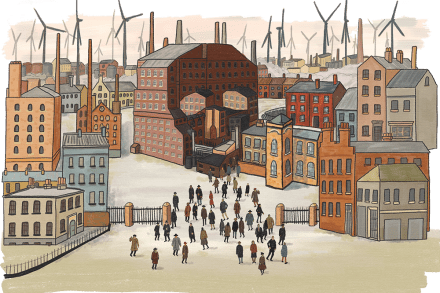
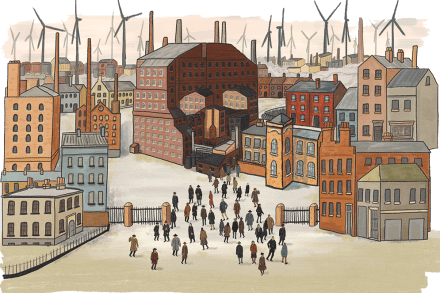
The French sociologist Alain Touraine coined the term ‘post-industrial society’ in 1969. By the 1980s it had become shorthand for the kind of services-based, individualistic economies most major developed nations had created. Today, the UK is moving its economy beyond that. We are creating what might be called a ‘zero-industrial society’. Climate change targets, soaring energy prices and rising taxes on employment are killing off Britain’s small and vibrant industrial base. Last week, Ineos closed its ethanol plant in Grangemouth, Scotland, with its chairman Sir Jim Ratcliffe warning of ‘the extinction of our major industries’. The previous month, Airbus announced it was cutting 500 jobs. In October, JCB cut 230

A hit – but please don’t pretend it's feminist: Disney+'s Rivals reviewed

For most of my adult life, clever, well-read, feminist women have told me how much they love Jilly Cooper. It therefore came as a bit of shock when I finally tried her novels for myself and found what they contained. There is, for example, no mistaking Jilly’s scorn for women who are fat and/or hairy, her belief that all female unhappiness can be cured by a damn good rogering, and the idea that not only is it fair enough for middle-aged blokes to lech after teenage girls, but that teenage girls rather like it when they do. (I was also slightly disconcerted by her favourite word for female genitalia –

After the Olympics, France has to face its grim reality

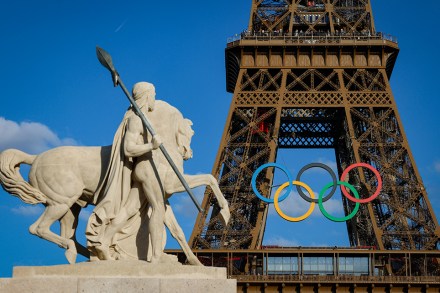
The French television personality Laurent Baffie, interviewed by Le Figaro, came up with a nice phrase for the success beyond most expectations of the Paris Olympics: it had been ‘une parenthèse enchantée’, he said, but parentheses always have to close and ‘la merde va revenir’. I’m guessing he meant France’s brief political truce will end and attention will refocus on economic woes, even after a slight fall in unemployment – to 7.3 per cent, compared with the UK rate of 4.4 per cent – that was announced as another ‘bonne surprise’. Writing from the Dordogne, where lunch is long and markets that matter are not global and financial but local

The important business of idle loafing

In our godless, post-industrial, hyper-competitive world, rest is seen merely as recuperation: it’s when we man-machines ‘recharge our batteries’, as the cliché goes, before dashing back to the factory or work-station. It’s a negative concept. You rest for a reason, which is to avoid burnout. All you should really do to be happy is read light novels or self-help books, advises Montaigne But as this charming and subtle meditation on the subject from a grand French historian shows, rest used to be far more than just taking time off. It is a religious concept. Take the rest enjoyed by Adam and Eve in Milton’s Paradise Lost. In the Garden of

Promethean grandeur: Maurice Broomfield – Industrial Sublime, at the V&A, reviewed

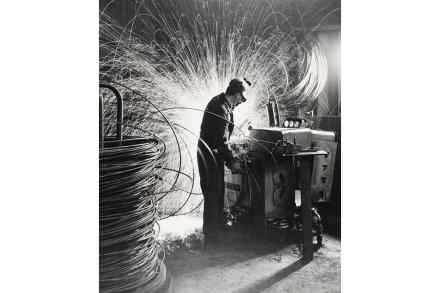
When Maurice Broomfield left school at the age of 15, he took a job at the Rolls-Royce factory, bending copper pipes on a turret lathe. That was what you did in Derby in 1931: Rolls-Royce was the town’s biggest employer, and entire generations expected to pass the best part of their lives behind the walls of its 13-acre plant. But Broomfield didn’t stay. Not long into his new job, he saw a photo of an ageing employee being packed off into retirement with a handshake and a gold watch. This was a person who’d never had any real control over his own life; who’d worked when he was told to,

The rise of the neo-Luddites

Yesterday, a pair of Just Stop Oil protesters glued themselves to a John Constable painting in the National Gallery, covering The Hay Wain with a printout of an alternative vision of England. The cart crossing the River Stour in Suffolk is perhaps Constable’s most famous painting. But instead of a bucolic, biscuit tin Albion, Just Stop Oil’s version shows the Stour tarmacked over, a belching power plant in the distance and a commercial jet overhead. The message is clear: our modern world is sick. I have some sympathy with these student activists, or at least I envy their certainty. Their view of the world is simple: bad things like fossil fuels,