Immigration

Rochdale, revisited

Putting Ed Balls into Home Affairs is like trapping a bee in a jar: he’ll come out furious, and anxious to sting. In his new brief, he has immigration. And he’ll know Cameron’s vulnerabilities. The greatest threat facing the coalition doesn’t come from Ed Miliband. It comes from a deep dysfunction in Britain’s economy: that when it grows, we just suck in more workers from overseas. Balls knows this, and the resentment it causes in affected communities – which is why he was talking tough on immigration during the leadership contest. He knows where the economic bodies are buried: he dug the graves. He also knows that unless Cameron manages

Theresa May the target

I wonder if Theresa May felt faintly apprehensive this morning. It must bad enough to awake and remember that you’re the Home Secretary, held responsible for every immigrant, every strike and every crime committed in Britain. Northern Ireland is more poisoned ministerial chalice, just. Now, she is being shadowed by Ed Balls, a ravening attack-dog liberated by the opposition. Balls has re-invented himself as a traditional Labour politician, casting himself as the champion of the working class. He says, accurately, that the poor are the victims of crime and the victims of unbridled immigration and social dislocation and his opposition will be ardently authoritarian. May will have to cut police

A solution to the immigration cap puzzle

The coalition’s immigration cap is, as several Conservative Cabinet ministers have pointed out privately, flawed. It threatens to cap the kind of immigration that bothers almost nobody, high skilled foreign workers coming to this country to do a specific job. As Ken Clarke has told colleagues, the problem is that Labour — albeit right at the end of their time in office — stopped non-EU low-skilled immigration. So all there was left to cap was high-skilled immigration.   But there is a potential solution that would enable the cap — a Conservative manifesto promise — to remain in place, but also deal with Vince Cable and businesses’ objections http://www.thisislondon.co.uk/standard-business/article-23879244-vince-cables-attack-on-immigration-cap-wins-city-backing.do. One

Boles’ immigration revolution

Nick Boles’ Which Way’s Up? is gaining a quiet cult following in Westminster, and John Redwood has unearthed Boles’ radical approach to immigration. Boles dissents from the view that happiness in Sweden’s utopia rests on pay equality; he observes that it is a homogenous society that has controlled mass immigration. He writes: ‘We will not be able to sustain a social contract in which schooling and healthcare are provided to all citizens free of charge and are funded by taxation if we continue to allow, every year, hundreds of thousands of people from around the world to join the queues at A and E and send their children to British

Cable: interim immigration cap is "very damaging to the UK economy"

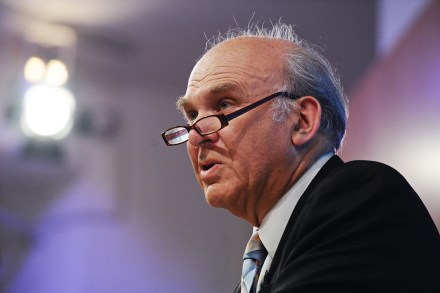
After stumbling in his crusade for a graduate contribution, Vince Cable seemed to go a bit quiet. But this morning he’s roared back into the newspapers with another attack on coalition policy. The target of his anger is, once again, the immigration cap – but he’s being far less equivocal about it this time around. The way in which the cap is being implemented this year, he tells the FT, is “very damaging to the UK economy.” To force the point home, he says he has a  “file full” of companies who are suffering because of it. And, for good measure, the word “damaging” gets deployed once or twice more.

What it is to be British

What is it about the British and flag waving? I ask after watching last night’s superlative BBC Proms, a brilliant end to the best season for years. On HD and wired to the hifi, it was all the better. As the end approached, my Czech mother-in-law asked: if this is Britain’s flagship musical event, why are there so many foreign flags? It’s hard to explain. Britain has a mutating relationship with flags and nationality. Twenty years ago, the Union flag was used in England matches, then devolution came and the St George’s cross made an emphatic comeback. I’m sure I saw a Cornish flag last night, and at least one

The government's transparent approach to worklessness

Sometimes hope lies in the details. Take this morning’s press release from the DWP, for instance. On the surface, it is a response to today’s encouraging employment figures. But what it really is is a new way of approaching the problem of worklessness in this country. And all because of its headline: “Figures reveal five million on out of work benefits as Grayling pledges to make work pay.” This is, as far as I can remember, the first time that the total out-of-work claimant count has reached the summit of an official release. The last government always knew what the figure was, of course, but never drew much attention to

Cable, Cameron and speaking out in public

For the foreseeable, Vince Cable is going to be a political barometer figure: journalists and other innocent bystanders will sift through everything he says to check the temperature of the LibCon coalition. In which case, they’ll find little to excite or worry them in his cool interview with the Newcastle Journal today. The Business Secretary says all the right things about staying his role for the full five years (“that’s my intention, yes”) and about the internal dealings of the coalition (“it works in a very business like way”), even if he does quash the idea of a full merger between the two parties. It’s all unsurprising, uncontroversial stuff. Indeed,

The immigration battle

Why is Vince Cable kicking off about immigration? Sure, to cause trouble – this is what he sees as his role. His ego can’t quite fit in that department. But the pledge to have immigration in the “tens of thousands” was not in the coalition agreement. At the time, David Cameron said this was an oversight and that it was still government policy. But as James said in his political column in the magazine, a great divide has emerged between policies in that bald coalition agreement and those mentioned verbally. The policies in the documents are now deemed sacrosanct, and things not in it – like the extraordinary pledge to

Dave's pageant is all very well, but India wants to talk immigration

In 1690, Thomas ‘Diamond’ Pitt led an opulent delegation of the East India Company’s Madras factors, bearing their wares, to the Nawab of the Carnatic, the richest man in southern India, with the intention of buying him out. They succeeded, but Pitt had nothing on David Cameron’s delegation.  Six cabinet ministers, more than 10 CEOs and God knows how many diplomats are accompanying the Prime Minister. The only person missing is Nick – but that sort of thing is frowned upon by Delhi’s Edwardianly genteel political classes. As I wrote yesterday, pageantry titillates commercial diplomacy, and Cameron is staking everything on this mission. As the Independent reported yesterday, current Anglo-Indian bilateral trade is worth

Too late to save Britain - it's time to emigrate

David Selbourne is a political philosopher and theorist. This article appeared in the magazine last week; it is an edited version of his speech for a Spectator debate on the motion, ‘Too late to save Britain. It’s time to leave.’‘ Part of me feels that those who have helped to bring the country down — venal politicians, false educators, degraders of the media, thieving privatisers of the public domain — need to be fought to a standstill, here on this battlefield, by those with the energy, strength and clarity of mind to do so. For no one wants to believe that the country of his birth, language, upbringing and way

Why we shouldn’t worry about overpopulation

Perhaps the most sinister side of the environmentalist movement is the idea of an “optimal population,” where human life is seen as a menace. The Optimal Population Trust has today said that there are 45 million too many people living in Britain – which, for a country of 60 million, is quite some statement. The peculiar thing is that this “problem” may well have a solution in the form of the human race failing to reproduce. The hands of the world population clock are slowing. The natural population replacement level, 2.1 kids per woman, is achieved by no European country (pdf here). England stands at a respectable 1.75, Scotland at

WEB EXCLUSIVE: Time to leave?

The Spectator’s summer debating season ended with a strident appeal. ‘Too late to save Britain. It’s time to leave’. Proposing the motion, Rod Liddle claimed to have mis-read his invitation. ‘I thought this was a foregone conclusion and we’d come here to arrange the tickets.’ Surging immigration, he said, was ruining the education system and our love lives. ‘By 2029 no one will be having sex, we’ll be so crowded out.’ The recent election had proved nothing but democracy’s impotence. ‘The poverty gap keeps widening, financiers still get bonuses and schools support Lesbian Gay and Trans-gender History Month.’ Soon he predicted that the definition of disability ‘will cover everyone except

Billionaires for Immigration

I guess Michael Bloomberg and Co aren’t necessarily the most sympathetic folks out there. But here, via Dave Weigel, is what Rupert Murdoch has to say about immigration: “We’re just going to keep the pressure on the congressmen,” Murdoch said. “I think we can show to the public the benefits of having migrants and the jobs that go with them.” Sure, he’s talking about the United States but the gist of the argument is the same here. Perhaps he could have a word with the editor of the Sun? Sure too, immigration is a non-runner given the current economic climate. But at some point we’re going to need more workers.

Whither America?

At the beginning of The Ask, Horace sits with Burke and proclaims that America is a ‘run down and demented pimp’. At the beginning of The Ask, Horace sits with Burke and proclaims that America is a ‘run down and demented pimp’. Horace is not Quintus Horatius Flac- cus; and Burke is not Edmund Burke. The two men are employees of the fundraising department of a mediocre university in New York, whose job is to approach the rich families of former students and solicit donations. This is, of course, a peculiarly American job, where the super-rich are relied upon to finance academe in exchange for favours bestowed on their offspring.

The waltz never got going

I was expecting drama when the Labour leadership circus called at Newsnight yesterday. Alas, the show whimpered and wheezed to a halt. A contest to determine the party’s future continues to gaze into the past. Assessing failure is essential to renewal, but the candidates are yet to offer anything substantively new.   Ed Balls and David Miliband shared one telling exchange. Balls has presented himself as the traditional candidate, and he would have you believe he speaks the language of Mrs Duffy. Gordon Brown’s hideous solecism in Rochdale revealed that he and his government were out of touch on issues such as housing and immigration. David Miliband is the centrist

The Malignancy of Ed Balls

I’ve only just got round to reading Ed Balls’ piece in the Observer in which he argues that Britain should be more protectionist in europe. Of course that’s not quite what he says, but “revisiting” the question of the free movement of peoples across the EU is essentially a protectionist measure. Anyway it reminded me of Evelyn Waugh’s response to the news that Randolph Churchill had successfully had a benign tumour removed: “It was a typical triumph of modern science, to find the only part of Randolph that was not malignant, and remove it.” This is a little unfair on Labour since it had other achievements to boast of. Nevertheless,

How the coalition makes room for Labour

Whoever wins Labour’s leadership, whether it’s a breed of Miliband or Balls, its future will be dominated by its understanding of how it found itself on opposition benches. Philip Gould, Tony Blair, Gordon Brown and the other progenitors of the New Labour project – were wrong. Their fatal assumption was that their core vote, the working classes, had no-where else to go. Labour, therefore, could reach out the middle classes, broadening their support and thus New Labour was born. At first their calculations were correct. Two slogans, “Education, Education, Education” and “Tough on Crime, Tough on the Causes of Crime” brought together the two separate demographics to create a powerful

Balls: we have to be more bigoted

Meet Ed Balls, the candidate for Mrs Duffy. As the race for nominations closes, the Labour leadership candidates are beginning to focus on party members. With varying degrees of conviction, the contenders have identified immigration as the issue the party must address if it is to reconnect with those voters who spurned it. Ed Balls is that analysis’s most fervent advocate. He devoted an article in the Observer to the subject.  Balls argued that there has been too much migration from Eastern Europe, and it has caused economic and social ills in communities such as the one he represents. In hindsight, Britain should have accepted the transitional controls during the eastern bloc’s accession in 2004. Labour rejected

Immigration: A Question of Patriotism

Ben Brogan’s column in the Telegraph urges David Cameron to get tough on immigration and act quickly. He need have no fear on that front. Since Labour seemed to have decided – erroneously – that immigration cost them the election the Conservatives and Labour are racing one another to see who can be beastliest about and to folk born outside the United Kingdom. He writes: It [immigration] fell [from 233,000] to 163,000 in 2008, but only because more people left the country. The number of people entering Britain that year actually rose, from 574,000 to 590,000. Even now, they keep on coming, drawn to a country that offers more opportunities