Gordon brown

British jobs for British workers…

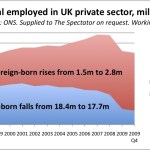
Did you know that there are fewer British-born workers in the private sector than there were in 1997? I'd be surprised if so: these official figures are not released. The Spectator managed to get them, on request from the Office of National Statistics. We use the figures in tomorrow's magazine, but I thought they deserves a little more prominence here. See the graph above, which shines a new light on the boasts Gordon Brown has been making. He said his Glasgow speech last month that: "If we had said twelve years ago there would be, even after a global recession, 2.5 million more jobs than in 1997 nobody would have believed us.

Clegg blows a golden opportunity

Nick Clegg won't get many opportunities to sell himself to voters and he has just been demolished on the Today programme. All things to all men, Clegg was all over the place. He couldn't give an exact answer when questioned about the size of the deficit, and the Lib Dems' shifting position on the depth of cuts was exposed once again, recalling his autumn wobble on 'savage cuts'. He also refused to rule out a VAT rise. Similarly, he could not expand on his plans for parliamentary reform beyond labels such as 'radicalism', 'renewal' and 'the old politics'. Caught between defending himself from the Tories and attacking Labour, Clegg panicked. The Lib Dems oppose Trident, surely?

Inauthenticity, meet skewer

We're not even one day into the election campaign proper, and already the internet is fulfilling its role as the Exposer-in-Chief of spin, deceits and slip-ups aplenty.  I direct you towards Guido's post on Brown's – ahem – impromptu support at St Pancras station earlier.  Or Left Foot Forward's account of the omissions from Cameron's list of The Great Ignored.  Or Sam Coates's tweets about the #stagemanagedelection.  And there's plenty more where they came from. In a campaign where inauthenticity is going to get skewered at every turn, politicians clearly need to go about things differently.  But there are all too many signs that they're stuck in the old, familiar grooves of elections past.

A burnt out case

Freeing Manchester United from the Glazers is not what I envisaged when Ed Miliband promised ‘a radical manifesto’. But the Guardian reports that a fourth Labour government will legislate so that football fans can buy their beloved clubs. Clearly Brown's granite is plastic to the touch. I’ll reserve judgement until the manifestos are published, but, as Alex notes, the feeling is that New Labour's zeal is exhausted. Budget initiatives on stamp duty and the retirement age originated in Tory press releases and the Queen’s Speech regurgitated policies dating back to the 2007-08 sitting. I suspect the manifesto will offer the same gristle. We should be thankful for small mercies because so few bills have made it onto the statute book.

The Tunnel Ridge Fault election

At times the chasm between Britain’s political parties is as great as the San Andreas Fault. Sometimes the difference is more like a small rift, a matter of tone not policy. In this year’s election, the difference between the parties is somewhere in between, like the lesser-known Tunnel Ridge Fault in Eastern California. In part, the appearance of only minor differences may explain why the polls are showing such different things; some predict that Labour will hang on to power, others that the Tories will be able to win.

Behind enemy lines

Well, well Gordon Brown has started his election campaign in a constituency that is notionally a Tory seat. Rochester and Strood is being fought for the first time at this election but the invaluable UK Polling Report tells us that the Tories would have just won this seat in 2005. I suspect that Brown has headed to Kent on the first day of the campaign in an attempt to show that Labour haven’t written off the south east despite coming fifth there in the European elections and that Labour is still a national party. David Cameron is off to Birmingham and Yorkshire and the shadow Cabinbet are fanning out across the country in an attempt to hit every TV region in Great Britain, evidence that for all the talk of this being the first internet election TV remains the dominant medium.

Oh, and the Lib Dems too…

Nick Clegg – who he?  According to a poll this morning, that's what two-thirds of the country will be thinking when they see the Lib Dem leader on their screens over the next few weeks.  But, regardless, he and his party are worth paying attention to.  Most importantly, of course, because of the possibility of a hung parliament.  But there's also the matter of the leaders' debates, in which Clegg will have a bigger platform than he's ever had before.  You sense that Lib Dems activists think they really matter this time around. So all eyes on Cowley St, where Clegg kicked off his party's election campaign earlier.  Two things came out of it.

The Inter-Generational Election

Geoffrey Wheatcroft has kicked off the election campaign with possibly the most depressing article I have ever read about British politics. Jetting off to the States for an academic engagement, the old curmudgeon says he feels no regret at missing an election in which he has lost interest.  This say more about the author of the piece than the election, which promises to be the most fascinating in my adult life. But then I am nearly twenty years younger than Mr Wheatcroft. His central argument is that the Labour and Conservative messages are uninspiring. The Labour government will admit that the situation is dire, but claim it would be worse under the Tories; the Tories will call for change, without having much to offer.

Now’s the time

If there's anything we don't already know about today, then I'm struggling to find it.  The election will be declared for 6th May.  Brown will make a pitch which bears close resemblance to his interview in the Mirror today: "We have come so far. Do we want to throw this all away?"  Cameron will say that the Tories are fighting this election for the "Great Ignored".  Clegg will claim that the Lib Dems represent "real fairness and real change".  A hundred news helicopters will buzz around Westminster.  A thousand blog-posts (including this one) will have headlines to the effect of "And so it begins...".

The true cost of Brown’s debt binge

When Alistair Daring admitted last week that there would indeed be job losses arising from the proposed National Insurance hike, it would have struck Gordon Brown and Ed Balls like root canal surgery. This blows wide open the main part of Brown's election deceit: asking the public to look at the advantages of the borrowing, and not contemplate the flip side to the debt coin. Not to ask where the repayments will come from, or the impact of those repayments on the jobs of the future. No wonder Darling is today being made to claim the opposite. The grim truth is that every job "protected" now, due to debt, will be more than balanced out by money taken away from the economy in the form of the interest needed to serve that debt.

Brown helps Cameron to define his Big Idea

Gordon Brown has walked straight into George Osborne’s trap. After bleating that the national insurance tax cut is unaffordable, he has decided to make this a massive election dividing line – claiming that this teeny (1 percent of state spending) tax cut somehow poses a mortal danger to an economic recovery.  Please, God, let him keep on this message through the campaign. “The Tories are proposing to cut your taxes and make you better off – stop this lunacy, and vote Labour”. But Alastair Darling has taken it further, with a significant piece of language on the radio this morning. The Tory tax cut, he says, is “taking money out of the economy” at a vulnerable time. As he said at 7.

Tory wars are history

In lighter moments, Gordon Brown is alleged to imagine that he is John Major and David Cameron is Neil Kinnock. Now, I think the Tories will win outright, but would Cameron resign if Brown’s daydreams became reality? ‘No,’ Cameron tells the Mail on Sunday. Despite the bravado, Cameron must fear a challenge hot on the heels of failure – emasculated backbenchers have threatened as much in private recently. By reputation, Tories romance in intrigue and excel at regicide; yet few credible usurpers exist. William Hague’s low campaign profile denotes spent ambition as much as it does proximity to Lord Ashcroft.  Liam Fox is admirable but has never commanded sufficient support anywhere beyond his immediate coterie.

A bad news day for Labour, as the Tories get positive

Oh dear.  Today's frontpages form the most eclectic set of damaging headlines for Labour for quite some time.  On the front of the Mail and the Times: allegations that the government – specifically, Ed Balls – "interfered" with a report on the Baby P tragedy.  On the Independent: a claim that Brown "misled" the public over waiving VAT on a charity single for Haiti.  And on the Telegraph: news that more business leaders have backed the Tories' national insurance policy.  Even the Guardian wades in with the headline: "Labour and business fall out". Of these, the first story is potentially the biggest scandal.  But it's the latter two which more immediately threaten to alter the political mood music.

The joke’s on Brown

It took a while, but I spotted Labour’s April Fool trick: an attack document on the Tory economic agenda. It looks real at first, but when you go through it the con becomes transparent. APRIL FOOL ONE: “The Conservative Party wants to face two ways at this election, promising extra tax cuts and spending commitments while at the same time claiming they would reduce the deficit further and faster than Labour’s plan to halve it in four years.” REALITY: Labour pretends to be unaware of the basic economic concept that if you have a lower tax rate, business grows faster – generating more revenues. There is such a thing as a self-financing tax cut, which is why the top rate of tax has fallen around the world over the years.

Gordon Brown claims his inheritance tax policy recognises marriage

Despite what the headline might make you think, this item is not an April Fool. In a web chat with Saga magazine, Brown said: “We made it possible for people to transfer their allowances so…between husband and wife…and that means widows for example can have the full benefit of the husband’s previous allowance, and that meant for a large number of people the effective point at which they started paying inheritance tax was above £600,000.

There’s a serious message behind the Tory April Fools’ campaign

Most press releases don't really catch the eye.  But when one hits your inbox from The Department of Government Waste, you can't help but take notice.  In it, the Secretary of State for Government Waste, Robin Ewe (geddit?), celebrates 13 years of "waste-maximisation," and there are links to a departmental website, complete with reports and videos. No surprises that it's a Tory campaign.  And to up the fun quotient, CHHQ have even managed to plug it via a cheeky advert in the Guardian.  But although there's a comic tinge to it all, and although it's rather straightforward, this is still a smart message for the Tories to get out there.

A new Brownie Buster

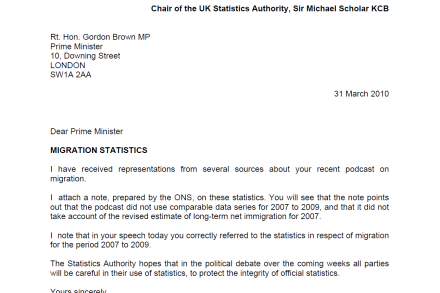
Michael Scholar: hero. The newish head of the UK statistics authority is finally coming to the aid of the statistics nerds who have been protesting that Gordon Brown makes things up. Normally, the ONS do not censure Mr Brown when he misrepresents their data: that's not their job. But as head of the Statistics Authority, Sir Michael has - wonderfully, inspirationally - written an open letter to the Prime Minister telling him not to lie. Well, not quite in so few words, but this is the plain implication. What is significant is that Sir Michael is using his job to protect  the integrity of statistics in Britain. One of my favourite ever facts is that "65 percent of the UK population do not believe statistics".

Whitehall’s hung parliament contingency plans vindicate Tory alarm over the economy

There it is. The Tories' premier weapon emblazoned across the front pages of the Guardian and the Telegraph: Brown could stay on as PM in a hung parliament, even if the Tories win more seats. To be fair to Brown, the headlines are misleading. It is his duty to remain in office until it is clear that David Cameron or another politician commands the confidence of the House, which may take weeks in current circumstances. Mandarins are drawing up radical contingency plans to ensure that some modicum of economic stability is maintained during that period. These measures include temporarily proroguing parliament for 18 days after the election (rather than the usual 6) and allowing the Chancellor to remain in office for that period even if he has lost his seat.