Gordon brown

And so to Brown…

Haven't we been here before?  Investment versus cuts, I mean.  Because that appears to be the main message of Labour's press conference this moring.  Gordon Brown set about the Tories' Big Society, claiming that it "means big cuts in public services".  Hm. It's certainly a punchier, if similar, message to the "agenda of abandonment" one that Labour roadtested last week.  But will voters listen?  Well, amid all the excitement about Clegg and the Lib Dems, it's easy to forget that Labour are now polling third – with a vote share which recalls the days of Michael Foot's leadership.  They seem to be in a pretty desperate position themselves. This may suit Labour, so far as the chances of a hung parliament are concerned.

How Whelan & Co. exploit Britain’s libel laws

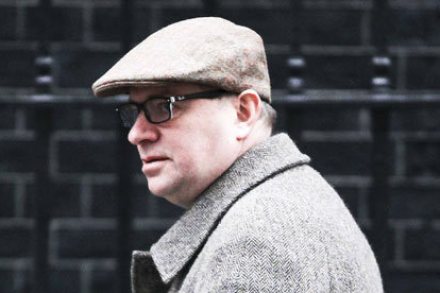
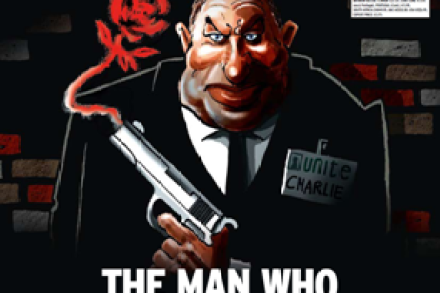
The Charlie Whelan problem is intensifying for Labour, with more revelations in the Mail on Sunday today taking on from our cover story in this week’s magazine. Whelan’s behaviour may be no worse than that of Ed Balls and Gordon Brown – but he is more careless. Like McBride, he was actually caught: and his tactics documented in a formal seven-page report. Not the sort of document you want surfacing during a campaign. So it's little wonder why Whelan used Carter-Ruck to try and deter The Spectator from any further investigation in the bullying case: it threatens to expose Gordon Brown’s entire modus operandi and the methods which he uses to control the party. And, for that matter, run the country.

Brown’s mindset on full display

Labour high command will be very satisfied with Brown’s performance on Marr this morning. There was far less of the tetchiness that we usually see from Brown in interviews and by being invited to talk about the ash cloud and the government’s response to it at the beginning, Brown was able to assume some of the aura of his office as Prime Minister. The interview saw the debut of Brown’s latest rewriting of history. Apparently he has always been for bringing in the liberals (exact quote to follow when the BBC release the transcript) and a ‘progressive consensus’. This will come as a shock to anyone who has read Paddy Ashdown’s diaries or talked to those involved in the discussions between the two parties in the mid to late nineties.

Time for a National Government?

Gordon Brown should have done it at the beginning of the recession. He and David Cameron should be thinking very seriously about it now. Perhaps national government is an idea whose time has come. Again. With the prospect of a very close election, in which people are clearly sick of the conventional two-party system, there is every reason to imagine a genuine government of all the talents after the election, with ministerial posts given to senior figures from all three parties. Is there any reason that Nick Clegg shouldn't be prime minister in a national government? It would seem he is the people's choice.  The obvious objection is that a national government would be anti-democratic.

Where Did Labour’s Funniest Line Originate?

I must say I had a chuckle at Alastair Campbell's tweet during the leaders' debate: "Clegg done well on style, Cameron clear winner on shallowness, GB winner on substance".  I had another chuckle when Alan Johnson used the line in the post-debate analysis and now I see David Miliband congratulating Alan Johnson for using it and  Miliband's comments being recirculated by eager Labourites. So who stole it from whom? For we socialists all property is theft and everything should be owned in common so I guess it doesn't really matter. But it is amusing to see how pleased everyone is with this one-liner.

So what’s changed?

The question is: how much has really changed after last night?  And the answer is hard to pin down.  There are the plastic, surface changes, of course.  Nick Clegg may now be recognised by more that one-third of the nation.  His party will probably come under greater scrutiny from the media and his opponents.  And the leaders' debate is here to stay; a defining feature of this election which will become a standard feature of future contests. But what about deeper change?  Well, I can understand the argument – made punchily by Gideon Rachman here – that this will increase the likelihood of a hung Parliament.  That's probably true.  But there's also a chance that it might help the Tories pull clear of their opponents.

The Leaders’ Debate: Well Done Chaps

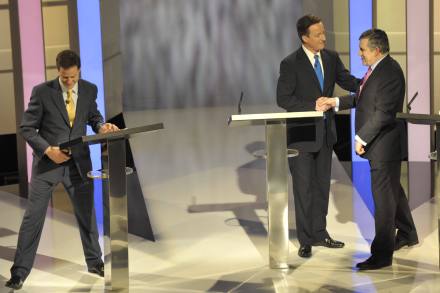
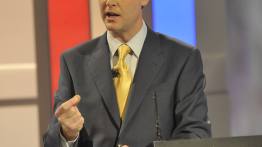
Shall we stop being cynical for a moment and congratulate Brown, Cameron and Clegg for being the first political leaders in Britain to take part in a televised election debate? Indeed, we should particularly congratulate Gordon Brown for agreeing to this. He had by far the most to lose. There is absolutely no doubt that Nick Clegg won this. He faltered from time to time, but was the only one confident enough to take thoughtful (if sometimes stagey) pauses.  I thought Gordon Brown also did surprisingly well. He kept his cool and showed that he is an accomplished debater. His jokes were over-prepared and characteristically dreadful, but he warmed up through the 90 minutes and challenged Cameron very effectively on several occasions, especially over police spending.

The novelty of Clegg wins it for him

“I agree with Nick”, said Brown – and, as it turned out, so did most of the people YouGov polled. Brown lived right down to expectations, Cameron lived up to them (but didn’t exceed them). Few would have had any expectations from Clegg: what we political pundits know to be his clichés will be heard for the first time in many living rooms tonight. Each used tactics we’re familiar with. Brown opened his verbal machine gun, and sought to mow down the audience (they surrendered early on). David Cameron was fluent, articulate – as anyone who has followed politics had come to expect. But dazzling? No. He was subdued, seemed to be biting his tongue at times. He didn’t attack Brown, which seemed to be deliberate.

Nick Clegg triumphs – and Cameron gains – in the first TV debate

So, who won?  Well, hold your horses, dear CoffeeHouser.  First, it's worth noting that that was a good shade more compelling than I thought it would be.  There were moments of heat, drama and political tension, of course.  But there was also a sprinkling of light as well.  I suspect anyone watching that would have picked up a working sense of the differences and similarities between the parties and their leaders. So, who won?  Well, it depends what you mean by "won".  Nick Clegg certainly gained most from the evening.  He was confident, coherent and had a strong line on almost every policy area, whether you agreed with those lines or not.

Leaders’ debate – live blog

2207, PH: Well, we've just been through all that - and guess what's leading the News at Ten.  Yep, the ash cloud... 2205, PH: And that's it.  I'll be writing a verdict post shortly. 2203, PH: And Cameron has pre-empted Brown's statement well.  He says that the other two have tried to frighten the audience about the Tories - but "put hope before fear".  His key message after that is about national insurance.  A solid closer from the Tory leader. 2201, PH: Classic Brown. He points the finger at the Tories, saying that they can't match Labour's guarantees and that they'd risk the recovery. I'm not sure this negative approach will come across so well. 2200, PH: Here we go: the closing statements.

Show him the door please

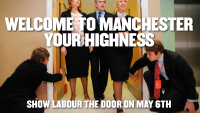
In a move designed to take advantage of everyone’s need to fill air time before the debates, the Tories have launched a new ad spoofing that picture of Brown walking through a set of double doors while two aides squat on the ground holding it open. The ad is just up here in Manchester but the Tories will be hoping to get it onto the news broadcast and in to tomorrow’s paper. This is another example of how the Tory cash advantage is helping them.

A night to remember?

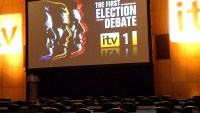
I’ve just arrived in the press room in Manchester where the media will be watching the debate; the hotel lobby is full of hacks and spin doctors. The question being asked is whether this is the moment that the electorate begins to engage with the election. Although I know that some in CCHQ worry that tonight’s debate could be so he said, she said that it deepens the public's cynicism about politics. Today’s extreme weather has added an intriguing angle to tonight’s proceedings. Douglas Alexander, who along with Peter Mandelson will be working the spin room after the debate, has already claimed that Brown is concentrating more on the lines at the airports than lines for tonight’s debate.

Brown’s signature parade

Only 58? Labour's last letter attacking Tory spending cuts this year had 60 economists' signatures attached to it. Their latest, released today, has only 58. Number 10's signature-marshalling skills are clearly on the wane. I sincerely hope that the Tories don't marshal some economists of their own. The last time that happened, back in February, we witnessed the low point of the fiscal debate – with both sides using a bunch of academics as a substitute for a proper conversation with the public. And, lest we forget, Guido's handy graph reminds us just what those economists were and are quibbling over anyway. This is a phoney war, so it's little surprise that Brown has resorted to it once again. Thankfully, signs are that Tories won't pay heed to the bait.

Brown demolishes himself with untimely ‘admission’

Sorry is the hardest word and Gordon Brown stil hasn’t said it. But, everyday brings surprises. His ‘admission’ about his errors is the first time I’ve ever agreed with his economic analysis. In short, even Brown knows he’s not what he’s cracked up to be. Making such an admission at this stage of the election cycle is extraordinary. The intention may have been to make Brown look human. In which case, he’s succeeded, but to his detriment. Brown looks Biblically fallible. Labour’s campaign rests on one deduction. Gordon Brown built an era of prosperity; then Gordon Brown saved the country from a recession that originated in America; therefore Gordon Brown is the man to lead the country back to prosperity.

How Charlie Whelan killed New Labour

Last summer, The Spectator received a letter from Charlie Whelan's solicitors complaining about this post - where we mention their client's spot of bother with his colleagues at Unite. Carter-Ruck were instructed on one of the no-win-no-fee deals: it cost Whelan nothing to sue, but could cost us £thousands to defend. So the lawyer's letter is, by itself, an effective form of intimidation. A magazine with a small budget obviously faces huge pressure to do what he wanted: apologise, pay up and (suspiciously) undertake not to pursue the story any further. Under the circumstances, The Spectator could do only one thing. Our full investigation into Charlie Whelan is the cover story of tomorrow's magazine (see image, left).

Brown will fear the foreign policy debate most of all

The Tories’ Invitation to join the Government was never going to dwell on defence. (You can listen to the brief chapter on defence here.)  But that doesn’t mean defence isn’t an election issue. It is, and it's one that the Tories will win. Brown’s defence record is abysmal even by his standards. Former service chiefs have described how Brown ‘guillotined’ defence budgets whilst fighting two wars, and field commanders in Afghanistan have made constant reference to equipment shortages. These accusations were corroborated by facts that Brown then tried to distort before a public inquiry. That’s not all.

Voting blues

One of the key questions in any election is turnout: whose voters will turn up and whose won’t. People are clearly disappointed in the political class - on a scale from 0 to 10, trust in politicians and parties is hovering around 3 points - but does it mean that they will stay at home, spoil their ballots or opt for fringe parties and single-issue candidates? What about the talk of a hung parliament ? Will it make voters believe that their vote counts - and so bring them to the polling stations -- or make them stay at home, giving up on the idea that any change is possible? In the last three elections turnout was low, relatively speaking: 59 percent of the electorate voted in 2001 and 61 percent went to the polls in 2005.

What Brown really offers Britain…

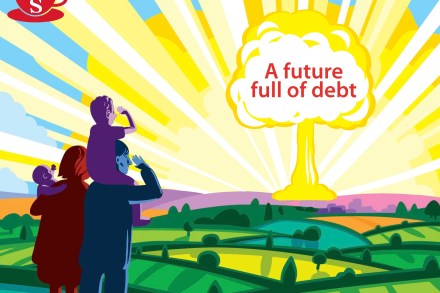
Labour's manifesto cover has been the cause of much merriment online - creating what the Americans call "subvertisments". ConservativeHome has already lined up some spoofs. We asked Carla Millar, who has done quite a bit of work for The Spectator, to do a version with a mushroom cloud of debt in the middle and the family shielding their eyes. This is the result.

Adam Boulton’s damning verdict

We've already collected some of the general blogosphere response to Labour's manifesto launch, but this addendum is worth making separately.  In a post describing the hostility of the Labour crowd towards the gathered media, Adam Boulton writes (with my highlights): "The crowd, including some cabinet ministers, booed and shouted at questions they didn’t like. Nick Robinson, the BBC’s political editor, had his question interrupted by jeering and Graham Wilson of the Sun was booed just for identifying his newspaper. Labour did not behave like that in the last three elections when the Sun backed them. Gordon Brown was happy to join in this confrontational mood. It was the most substantive aspect of the manifesto event.