Gordon brown

The spotlight turns on Labour

It's the story which has been simmering throughout the election campaign, and now it has has boiled over onto the front pages: fear and loathing in the Labour ranks.  After rumblings in the Sunday Times yesterday, its sister paper splashes with the headline "Labour in turmoil as pressure on Brown grows".  And, inside, Francis Elliot and Suzy Jagger report on the "jockeying to replace Gordon Brown".  Meanwhile, the front of the Independent speaks of "growing recriminations in senior Labour ranks over a lacklustre campaign that has seen the party relegated to third place in opinion polls."  The spotlight is finally turning, white-hot, on to Labour - after ten days of near exclusive illumination on the Lib Dems.

Labour’s Catch 22

The sole current political certainty is that Nick Clegg will not prop-up Gordon Brown. Clegg holds Brown personally responsible for 13 years of failure and not even political marriages can be built on enmity.  Labour’s choice is clear: remove Brown to accommodate Clegg. The Sunday Times reports plots are afoot to kill Gordon ‘with dignity’. But euthanasia is messy. Two options are being discussed. First, Brown would be given a year to make a final indelible mark on Britain before shipping himself off to Westminster’s version of Dignitas. I think we can all see the problem with that cunning scheme, and Nick Clegg certainly will.

Just whom will the Lib Dems work with, then?

Two noteworthy entries, today, in the will-they-won't-they game of coalition government.  The first from Nick Clegg in the Sunday Times: "You can’t have Gordon Brown squatting in No 10 just because of the irrational idiosyncrasies of our electoral system." And the second from Paddy Ashdown speaking to the People: "Nick Clegg cannot work with David Cameron ... We could not go into a coalition with the Tories, it wouldn't work." So, assuming both are true, it sounds as though Clegg would only work with a Labour party headed by someone other than Brown.  But don't count on it.

Brown Must Manage the Next Twelve Days With Dignity

Let's not forget that the Labour Party should not have been able to lose this election. I am still convinced that Cameron came to the Tory leadership with a two-election strategy. The swing needed to win a clear majority was always huge. Part of the reason that the party leadership has found it so difficult to retain the lead in the polls is that they could never quite belive their luck at the collapse of Labour support.  Likewise, the Lib Dem surge has happened partly because no one is quite convinced that the Tories are ready for government. But the real story of the next week and a half will be how Gordon Brown deals with the draining away of Labour support.

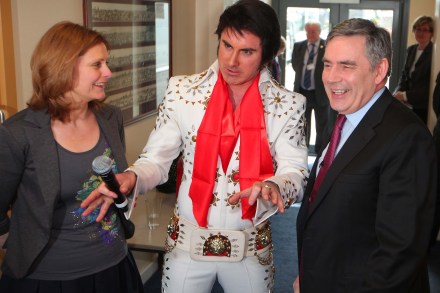
When the going gets weird, the weird hire an Elvis impersonator

Really, what's happened to the Labour campaign?  You know things are taking a turn for the worse when you read that Gordon Brown is taking a more high profile role to save his party from a third-place finish.  But then you see that high profile role in action, and, well ... First there was an event which incorporated some deliciously ironic innuendo about the Tories' spending cuts.  The PM lamented the fact that Jeremy Paxman didn't press the Tory leader on claims that there is "too much" public spending in Northern Ireland and the North East, concluding that "there is no part of the United Kingdom that is safe from what the Conservative party would do.

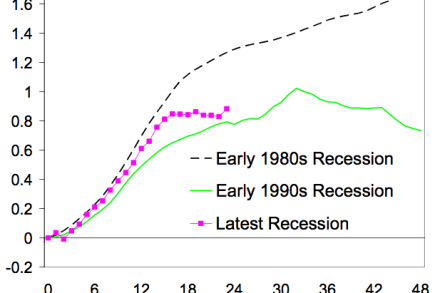
No, Gordon, this recession hasn’t been milder than others

Today’s new economic data gives a handy piece of ammo to the Conservatives.  It is untrue that, as Gordon Brown says, this recession was somehow milder than others. The economy contracted by 6.3 percent this time – it was 3.8 percent in the 1980s recession and just 2.4 percent in the early 1990s recession. I feel confident that the Conservatives will get this point across clearly, next time that Brown boasts that this recession has been somehow milder, thanks to his decision to “intervene” (ie, double our national debt).

Brown, behind the scenes

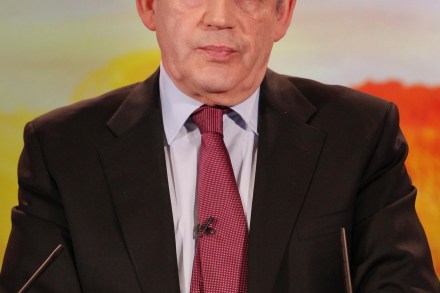
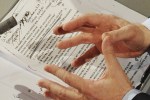
A neat election-time spot from the Guardian's Haroon Siddique, who brings us the above photo of Brown's speaking notes from the TV debate last night.  Turns out - surprise, surprise - that the "two boys squabbling" line was prepared in advance.  As were a few other clunkers that we thankfully didn't hear.  I mean: "You can phone a friend, you can ask the audience, you can go 50-50 with Nick." Really?

The morning after the debate before

So, like last week: what's changed?  And, like last week, it's probably too early to judge.  The insta-polls may have Cameron and Clegg on level footing, but, really, we need to wait for voting intention polls before coming to any firm conclusions.  As we saw the day after the first debate, they can work in quite surprising ways. My instinct, though, is that things will remain relatively steady.  The Clegg surge of last week was, at root, a cry for change from the electorate – any change.  So it will probably take more than a solid Cameron victory in one TV debate to have voters flooding back to the Tories.  And it will probably take worse than a decent enough performance from Nick Clegg to shoot down the yellow bird of liberty.

Cameron starts to pull the Tory campaign out of the fire

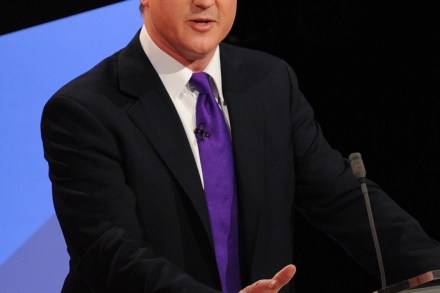
The headlines will be "score draw", but I’d say Cameron won – and comfortably. I write this as someone who could have happily have sunk a few pins into a voodoo doll of David Cameron earlier on this evening – for taking the Conservatives (and Britain) to this appalling point where he may yet lose the election. But he raised his game, substantially. At best, he spoke with passion and authenticity. This time, he looked like he was fighting for his political life, which (of course) he is. Things are looking up. Here’s my participant-by-participant verdict: Brown Brown was his normal automaton self. He does tend to mangle his words, and his attempts at simplification backfire.

Cameron is much improved – but the Lib Dem bubble hasn’t burst

It seems that the general election of 2010 will turn on 90 minutes next Thursday. David Cameron was far better tonight than he was last week. This time he managed to bracket Brown and Clegg together and had the moment of the debate when he called Brown out on Labour’s leaflets claiming the Tories would scrap various things that pensioners currently get free. If there was a YouTube moment in the debate, it was that exchange when Brown said he didn’t authorise the leaflets making these claims. The Tory press team then delighted in pointing to a Labour party political broadcast where they had suggested the Tories would take away these things. Nick Clegg came under far more fire than he did in Manchester.

Cameron’s evening – as he and Brown fight back against the Clegg surge

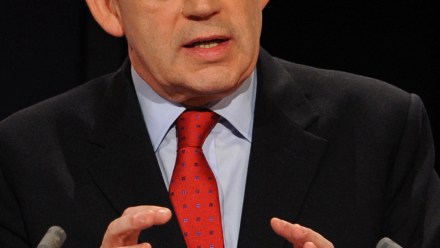
Well, one thing was clear: Brown and Cameron have both been at the textbooks, staying behind for extra classes, and learning the lessons of last week.  They came into this TV debate prepared.  Not just for the very fact of Nick Clegg, but with strategies and soundbites to slow his advance.  The result was a more passionate and confrontational show than I expected. Brown was the biggest surprise on the night.  Sure, you have to apply the usual caveats and parameters: he is Gordon Brown, and being disingenuous and deluded is what he does.  But, all that considered, he was uncharacteristically sprightly, I thought.

Tonight’s tactical battle

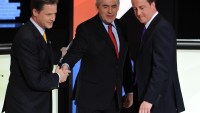
If seven days ago, anyone had suggested that the first debate would propel Nick Clegg and the Lib Dems to the top of the polls we’d all have thought that their lunch had gone on rather too long. But that’s what happened. Tonight, the questions are whether Gordon Brown reprises his ‘I agree with Nick’ routine or tries to check Clegg’s momentum and whether Cameron can turn in the kind of performance that begins to turn things round for him.   Cameron shouldn’t be angry tonight. But he does need to bracket Brown and Clegg together at every opportunity.

Team Brown playing the same old tunes

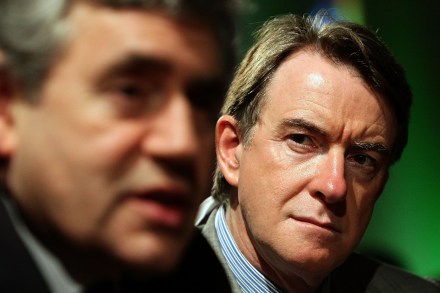
The strange thing about last week's TV debate is that, for all its transformative power, it doesn't seem to have changed Labour's campaign strategy in any fundamental way.  Team Brown were hoping for a hung Parliament, and courting the Lib Dems, before last week.  And, as Peter Mandelson demonstrated earlier, they're still doing the same now.  The only difference is that it's more likely their wishes will come true. But this creates problems for Brown so far as tonight's TV debate and the rest of the election are concerned.  His instinct may well be to repeat the "I agree with Nick" positioning of last week.  But this has already been heavily lampooned - and was batted away quite comprehensively by Clegg the last time he tried it.

Inflation is the price of Brown’s recklessness

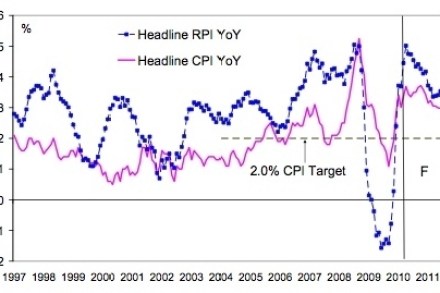
Who would have thunk it? Inflation has again “surprised” on the upside – 3.4 per cent against a 2.0 percent target. Why so high? Even the return of 17.5 percent VAT does not justify this bounce. Might it have something to do with all those bank notes which were being printed by the Bank of England? Might interest rates be going up now to control this inflation – and, if so, what impact would this have on a UK economy which is already the most indebted of any major economy in history? The March figures show Britain has, by some margin, the highest inflation of any major European economy: it’s way higher than that of France (1.7 percent) Spain (1.5 percent) Italy (1.4 percent) or Germany (1.2 percent). And in America, 1.1 percent.

A bumpy ride for Brown on Radio One

Gordon, meet disillusionment.  Disillusionment, the Prime Minister.  Ask him questions on whatever you want: the economy, jobs, immigration, expenses - the ball is in your court.  Make him squirm, if you like.  Confront him.  He is, after all, here at your pleasure. For that was the set-up of Radio One Newsbeat's interview with Gordon Brown earlier this afternoon.  It was one of those impossible situations for the PM.  He could hardly decline to be quizzed by a group of first time voters, aged between 18 and 28.  But it put him at the mercy of some pretty disgruntled members of the public.  And they took full advantage. The questions were direct and drew blood.  On the economy: "Where are the cuts going to come from?

Brown’s leadership back under the spotlight

Things have clearly moved on since I wrote this back in March.  From Rachel Sylvester's column today: "...those close to Mr Clegg have made it clear to senior Labour figures that it would be difficult for the Liberal Democrats to do a deal with a Labour Party led by Mr Brown. 'The whole notion of change is so important to Clegg and Gordon doesn’t represent change,' says one Labour strategist. 'It’s hard to see how they could prop up Brown in a hung Parliament.' With Cabinet ministers openly discussing the prospect of coalition, the question of the Labour leadership is back on the agenda.

Labour Cheery About Lib Dem Surge

Labour's press conference this morning was a surprisingly cheery affair. Peter Mandelson was very much in control of proceedings and the media mob was clearly feeling benevolent on a lovely spring morning. I'm not sure it was entirely wise to run a spoof post-election news broadcast on the double-dip recession caused by Tory economic policy. It felt too much like the Labour high command has already accepted the inevitable. However, the focus wasn't really on the Tories but the Lib Dem surge. The Labour Party has the right strategy on this: hug them close and emphasise how much common ground there is. They know the Tories stand to lose most from a Lib Dem poll boost.