Google

Mr Bear is back: sit tight because he may be with us for a while

From our UK edition

Like Leonardo DiCaprio in The Revenant, we’ve just been savaged by a bear but we’ll probably survive. Leading UK-listed stocks have fallen 20 per cent from last April’s peak after a six-year climb, and the FTSE100 chart has taken on a saw-toothed downward trajectory that suggests, to those who rely on such indicators, that there are further falls to come. The end of quantitative easing and the US Federal Reserve’s first interest-rate rise in almost a decade set the direction of travel. The sinking oil price, combined with worries about a global debt build-up, darkened the mood. Repeated bouts of mayhem on the Shanghai bourse, though little or nothing to do with western investors, have provided a news peg.

PMQs: Corbyn misses his chance over Google’s tax deal

From our UK edition

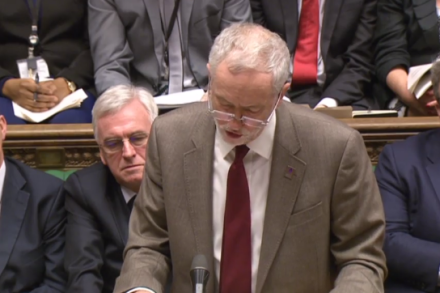
Today’s PMQs was an opportunity for Jeremy Corbyn to embarrass the government and align himself with public anger over how little tax some multinationals pay. But he missed this opportunity. By going on HMRC’s deal with Google in isolation, he allowed Cameron to point the finger of blame at the last Labour government. Indeed, Cameron even dragged Corbyn into defending the record of the Blair and Brown governments on corporate taxation. A far more effective tactic would have been to contrast the British deal with the French and Italian ones. Why have these governments managed to get more tax out of Google than our own? Another problem with Corbyn at PMQs is that he doesn’t pick up on Cameron’s hostages to fortune.

Google plays the global tax game – and charitable moves aren’t common

From our UK edition

When George Osborne announced at the Conservative Party conference in 2014 that he would force companies such as Google, Facebook and others to pay more tax in the UK, some of those firms were privately incandescent. As a Daily Telegraph journalist covering the conference at the time, I was witness to a rare example of usually conciliatory American firms eager to critique government policy in robust Anglo-Saxon. Why, they asked, didn’t the UK see the wider benefits of having major digital employers based here, and didn’t ministers understand that they were paying their due taxes where they were founded, in America? In public, technology-friendly commentators suggested the announcement was all politics and no practicality.

MPs hammer Treasury ministers on ‘completely unacceptable’ sweetheart deal for Google

From our UK edition

Even though, as Fraser argued last week, Google has done nothing wrong in agreeing to pay £130 million to settle its UK tax claims, MPs were in a furious mood about the agreement when they discussed it in the Commons this afternoon. John McDonnell asked an urgent question on the deal, and found, unusually, that he had support from across the House. It wasn’t just Labour MPs who stood up to condemn what they saw as one standard for their constituents, who are hounded by the taxman over relatively small claims, and another for big powerful multinationals like Google. Tory MPs joined in, too, with Steve Baker telling David Gauke that the deal was ‘at once derisory, substantial, lawful and completely unacceptable to the public’.

Google obeys tax laws, and gives us awesome services for free. Why complain?

From our UK edition

If Google hoped for some good PR in offering £130 million to settle UK tax claims dating back to the Labour years, it was a miscalculation: Labour regards the offer as "derisory" and the BBC is leading its news bulletins the better to sock it to its rival. Why did Google bother? It has run up against the standard anti-business narrative: that the social worth of businesses can be measured only by how much cash they give to the government. In fact, Google provides its services to millions of Britons (worth at least £11 billion, by some estimates) at no cost at all: this is its contribution to society. As for its contribution to the government's coffers, Google has - from the offset - been following the rules. And for this, it has been lambasted.

Thomas Heatherwick

From our UK edition

Thomas Heatherwick is the most famous designer in the United Kingdom today and has an unquestionable flair for attention-grabbing creations. Before 2010 he was mostly known for a splashy public sculpture in Manchester, ‘B of the Bang’ (2005). Within weeks bits started to fall off. In 2009 it was dismantled. This was his most celebrated failure. But he has had others. An even earlier commission, ‘Blue Carpet’ (2002), a showy repaving of a miserable part of Newcastle city centre, lost its colouring completely within a decade (despite assurances from Heatherwick that its colour would last for a 100 years). He was propelled to global celebrity in 2012 when an audience of a billion watched his Olympic cauldron light up.

The end of secrecy

From our UK edition

Gordon Corera, best known as the security correspondent for BBC News, somehow finds time to write authoritative, well-researched and readable books on intelligence. Here he explores the evolution of computers from what used to be called signals intelligence to their transforming role in today’s intelligence world. The result is an informative, balanced and revealing survey of the field in which, I suspect, most experts will find something new. He starts with an event that took place 101 years ago next month, when the British dredger Alert set off from Dover in the early hours to cut the German undersea telegraph cables.

Why is big business so interested in left-wing politics?

From our UK edition

Numerous commentators have noted how the Irish marriage referendum was influenced by big business, especially Californian-based companies like Google. It's one of the curious trends of recent years that big business, once considered the enemy of ‘the Left’, is now its greatest proponent; or at least the dominant strain of Leftism, social justice liberalism. Silicon Valley is the most extreme example of this, an industry that is young, dynamic and universally socially liberal; but elsewhere most politically interested billionaires in the West tend to be more liberal than the population, whether it's George Soros funding various social justice causes or other Democrat-supporting moguls.

Do Google and Facebook threaten the free press?

From our UK edition

What are newspapers for? The answer, of course, is not just to tell us what's going on and explain the implications, but also to select the most important items from the background noise. Over the last few years, though, we've started to get our news in a different way: through Google, where selections are made on the basis of a constantly evolving algorithm, and through social media sites where news stories are recommended by friends. Throughout this change, Google has argued vociferously that it is not a publisher. Particularly in Europe, issues such as privacy, copyright and the right to be forgotten have led it to claim that it's simply a platform, and no more involved in the content it hosts than is a newsagent.

Telescopes in contact lenses: a brilliant idea after the fiasco of Google Glass

From our UK edition

Yesterday at SXSW, the world's grooviest 'interactive festival', the head of Google X – the company's mysterious research lab – finally admitted it. Google Glass was one gigantic embarrassment. Or, as Astro Teller put it, 'We allowed and sometimes even encouraged too much attention for the programme'. You don't say. For a glimpse of the sort of attention Google didn't want, just look at the photograph above – some poor sap on the subway using Google Glass and a smartphone. It went viral on Twitter. The guy was dubbed 'the glasshole', a pun that works in both American and English accents. Google Glass has given wearable tech a bad name: it's raw material for standup comics.

This new crowdsourcing site allows anyone to use their skills to advance basic human rights

From our UK edition

One of the questions I most often get asked is: ‘What can I do?’  If you agree that actual liberals are the only palatable future in authoritarian societies and also recognise that they are a beleaguered minority, is there anything you can meaningfully do to help? Western governments are generally too busy doing business with authoritarian governments to focus on actual human rights abuses.  Meanwhile many groups at home which claim to care about human rights around the world are too busy attacking the world’s only democracies or defending extremists to have much time left for the real fight. But I have recently been introduced to an initiative which stands a good chance of providing an answer to that difficult readers' question.

Exciting new ways of not writing a novel

From our UK edition

I read that Damon Runyon, in New York in the 1930s, would get up at 1 p.m. for a breakfast of ‘fruit, broiled kidneys, toast and six cups of coffee’. Then he would read all the newspapers. Then he would bathe, shave, dress and go out for a long walk which would probably include some shopping — one of his favourite activities. (‘He wanted to buy prize fighters, and racehorses, and great houses, and stacks of clothes and jewellery for his lovely [second] wife.

Who on earth does Margaret Hodge think she is?

From our UK edition

Most people, when they hear the word populist, will think of Marine Le Pen going mad about Muslim immigrants or a Ukipper saying he wouldn't want an Albanian living next door. But yesterday we witnessed a different kind of populism: the deceptively right-on variety, which aims its black-and-white moralistic fury not at cash-starved people at the bottom of society, but at wealthy individuals at the top. The purveyor of populism this time was Margaret Hodge, panto queen of the Public Accounts Committee, her target was some HSBC suits, and it made for an unedifying spectacle. https://www.youtube.com/watch?v=zNdu-ueG78o Hodge has in recent years become Parliament's poundshop Robespierre, a one-woman mopper-up of moral rot in the establishment, the purifier of the political realm.

The real reason GPs are grumpy: the robots are coming for them | 15 January 2015

From our UK edition

There’s something wrong with the relationship between patients and their GPs. I’ve spent much of this winter in my local surgery, what with one thing and another, sitting among the stoic and snivelling, drifting between different doctors. They’re pleasant, if perfunctory, but with each visit I became more sure that something fundamental is awry. The docs seem ill at ease, as if their collective nose is out of joint, and I don’t think it’s overstretching or underfunding that’s the problem. My unprofessional diagnosis is that there’s a change under way in the balance of power between patients and medics; the status of GP as unimpeachable oracle is under threat, he feels the first tremors of what may be a seismic shift, and he doesn’t like it.

The real reason GPs are grumpy: the robots are coming for them

From our UK edition

There’s something wrong with the relationship between patients and their GPs. I’ve spent much of this winter in my local surgery, what with one thing and another, sitting among the stoic and snivelling, drifting between different doctors. They’re pleasant, if perfunctory, but with each visit I became more sure that something fundamental is awry. The docs seem ill at ease, as if their collective nose is out of joint, and I don’t think it’s overstretching or underfunding that’s the problem. My unprofessional diagnosis is that there’s a change under way in the balance of power between patients and medics; the status of GP as unimpeachable oracle is under threat, he feels the first tremors of what may be a seismic shift, and he doesn’t like it.

Why Cabinet Exec won’t ‘poo in the pool’

From our UK edition

If you hear any government officials talking about blue rivers in the coming days, it’s down to Google. Steve Vaughan, the head of media monitoring at the Home Office, has just spent a week with Google to develop his digital skills. The reason we know this, is that he has written a government blog about it. In it, Vaughan reveals the 17 things he has learned from the experience. While Steerpike dares not bore you with all the details, Vaughan does urge civil servants to refrain from being a ‘poo in the pool’ and instead try 'jumping into the pool of creativity,' as well as urging staff to ‘greenhouse your ideas’.

What techies are actually doing when they fix your computer

From our UK edition

Just before Christmas I achieved something so totally, incredibly amazing that I think it probably ranks among the greatest things I have ever done. In terms of danger, raw physical courage and menace overcome, it was at least on a par with cage-diving with great white sharks or taking on the ‘Breastapo’ the other week over that incident in Claridge’s. As far as personal satisfaction goes, it felt like getting into Oxford, teaching my children to read, bagging a Macnab and climbing Everest blindfold on the same weekend. What I did was this: there was a problem on my computer — and I fixed it. All by myself! When I took to Twitter to broadcast the fantastic news it didn’t go quite as viral as I’d hoped.

Alan Turing’s last victory

From our UK edition

‘So were you levitating with rage by the end?’ I asked her. She — a veteran of Bletchley Park — and I were discussing The Imitation Game, the new film about the mathematician and code--breaker Alan Turing, featuring Benedict Cumberbatch and a host of historical inaccuracies. But she remained sanguine: ‘Not at all, I really enjoyed it a lot. A little dramatic licence here and there, but that’s what you get with films.’ Indeed. Still, the film didn’t take the biggest dramatic liberty of them all, thank goodness — that of suggesting that Bletchley’s triumphs were entirely down to the Americans.

George Osborne’s fact-finders come up trumps in the Autumn Statement

From our UK edition

Osborne got his chance to audition for Number 10 today. He hasn’t the fluency and the synthetic chumminess of Cameron. And his emotional range is far narrower than the PM’s. He’s like Nigel Lawson, cool, uneasy, watchful. His brain-power is more than his head can bear and there’s a detached, arrhythmic otherness about him. He’s uncongenial, in the way a good Dr Who should be, but he can’t ad lib at the despatch box. If he’s interrupted he glances upwards, (with worried eyes and Nixon conk), and stares out, bewildered and a little frightened. With a script, and plenty of rehearsal, he has authority even though his basic mode is, ‘I told you so’. He does a good line in swotty, schoolboy scorn.

Podcast: Geeks vs spooks, a three-way Tory split and Theresa May’s manoeuvrings

From our UK edition

Are the nerds of Silicon Valley responsible for harbouring terrorists? On this week's View from 22 podcast, Hugo Rifkind and James Forsyth debate their articles on the battle between the geeks and spooks. Has the government forgotten that online media should have the same rights as print outlets? Or are the technology companies acting irresponsibly over battling terrorism? Damian Green MP and Isabel Hardman also discuss the Tory battles already being fought over the EU. If the Conservatives are victorious at the next election, is the party on track to split three ways: the inners, outers and reformers? Does this growing split show that the Cameroon modernisation project has failed? And what is Theresa May up to this week?