Germany

Is it time for me to renounce the Devil?

As I spent much of January in dry dock in Tommy’s hospital (‘dry’ being doubly appropriate), other avocations were needed. One friend said that it sounded as if I had spent much of the time gazing at the glories of Barry and Pugin, reading poetry or teasing pretty nurses: all pleasant activities. But there was one disappointment. Geoffrey Elton helped to introduce the civilisation of the Rhineland to East Anglia Assuming that hospital wards were good stalking grounds for chaplains, I would have been happy to discuss the Trinity, the meaning of the first verse of St John’s Gospel, or whatever. But only one clergy creature appeared. There is a

The citizens of nowhere adrift in the West

We all know that an Englishman’s home is his castle, or at least it was. Looking back, it is easy to see how the castle walls were breached – first by mobile phones and wifi, then by the smart speakers and other gadgets that help and also harvest us. The idea that our homes are inviolate seems quaint nowadays. We know there are many other ways in which we are being uncastled, not least by government agents acting with impunity. And if you think that’s a problem, wait till you read the other home truths delivered by Ece Temelkuran in a book you’ll ignore at your peril. Temelkuran is a

The Kremlin’s plan to create a new wave of Ukrainian refugees

What is the limit of Ukrainian civilians’ endurance? In nearly four years of relentless war, Ukraine’s people have faced summary executions, ‘drone safaris’ where unmanned aerial vehicles hunt people down city streets and constant bombardment of cities by swarms of drones and missiles. This winter their remarkable resilience faces its severest test yet as Russian forces reach a tipping point in their systematic attempt to knock out the country’s energy infrastructure. In each of the past three winters, Vladimir Putin has attempted to render Ukraine’s cities uninhabitable by plunging them into darkness and cold, without success. But this time it looks like the Kremlin’s campaign to weaponise winter may be

European countries are expanding their militaries. Why aren’t we?

Following America’s extraordinary raid on Venezuela last week, Donald Trump has pointed to Greenland, which belongs to the Kingdom of Denmark, as the territory he plans to turn his attention to next, staking a claim he has made repeatedly since his return to the White House. Trump said this week that America needs Greenland ‘for national security. Right now’. He told reporters he is ‘very serious’ in his intent. The US President might be claiming Greenland in the name of peace and stability, but there is every chance his neo-imperial attempts to see off the threat from China and Russia will backfire. Will his actions herald the return to a

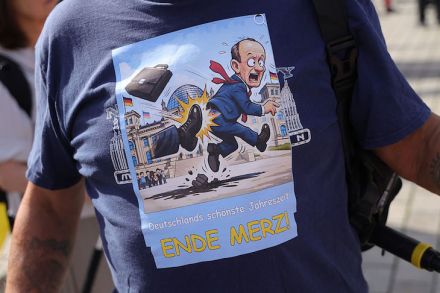
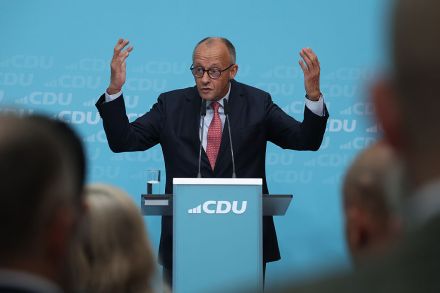
Why can’t Friedrich Merz just say sorry?

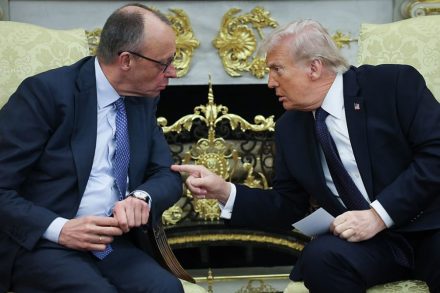
‘We live in one of the most beautiful countries in the world,’ began a seemingly innocuous speech by German Chancellor Friedrich Merz last week. The words that followed earned him the wrath of the largest state in South America. Just back from the Cop climate summit in Belem, Brazil, Merz declared that his delegation had been ‘glad to return from that place’. When he’d asked the accompanying journalists if anyone would like to stay, ‘nobody raised their hand’. Appearing to compare their country unfavourably to Germany, Merz’s remarks offended many of Brazil’s leaders. President Lula hit back by suggesting Merz should have gone out to a bar or dancing in Belem before passing judgment

The catastrophic dumbing down of German education

German teachers are a privileged species. Most of us enjoy the status of a Beamter, a tenured civil servant. We can be dismissed only after a serious criminal conviction, we are exempt from social insurance contributions, and even our mortgage rates are lower. Such comfort discourages dissent. Yet, after more than 25 years as a pampered Beamter, I find myself overwhelmed, not by the teaching load or the students, but by the accelerating erosion of academic standards. Having taught English, history and Latin at four different Gymnasien, the equivalent of a grammar school, I have learned that challenging students is frowned upon by both bureaucrats and politicians. Nearly all my

Tim Shipman, Ian Williams, Theo Hobson, Lara Prendergast & Lisa Haseldine

34 min listen

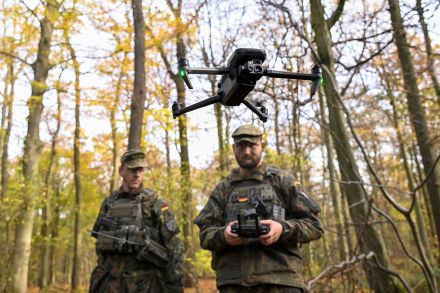
On this week’s Spectator Out Loud: Tim Shipman says that the real war for the right is yet to come; Ian Williams examines the farce over the collapses China espionage case; Theo Hobson argues that the Church of England is muddled over sex and marriage; Lara Prendergast reads her letter from America; and, Lisa Haseldine goes on manoeuvres with the German army, the Bundeswehr. Produced and presented by Patrick Gibbons.

Cigarettes and currywurst in Big Berlin

I’m standing at a bar in a car park on the rooftop of a shopping centre. I ask the bartender if the beer on draught is big or small. ‘That depends on your definition,’ he says. ‘What is big? What is small?’ The oonce-oonce of German trance music makes it hard to hear, and I’m distracted by the solitary figure on the dance floor wearing all black and contorting her body into the shape of a pretzel. ‘Is the beer groß or klein?’ I shout. The bartender – who is well over 50 and has the fashion sense of a Green Day groupie from 2005 – just smirks and says,

Never date a German man

Call me unpatriotic but, although I’m German, nothing could ever have persuaded me to date a German man. I married an Englishman, finding Teutonic attitudes towards romance unbearable. Dating can go on for years, often ending in a quiet, dry dissolution after a decade. If you’re lucky, the relationship will limp on towards marriage, driven more by the need to save on taxes than any belief in what many Germans consider an antiquated institution. Two hundred years ago, we had the tragic intensity of Goethe’s The Sorrows of Young Werther, a cornerstone of the Romantic movement. It was so wildly popular that it sparked one of the first waves of

Why France hates Macron

One of the pleasures of spending the summer in France is that I can turn aside from our national problems and concentrate on those of our neighbour. They are similar but gratifyingly worse. You have to know someone quite well before they will open up about their own politics to a semi-outsider. I used to feel the same way when our own politics were chaotic in the aftermath of the EU referendum and French friends would approach me with that characteristic note of smug condescension to ask what on earth was going on. Emmanuel Macron is the ablest President of France since Charles de Gaulle. Yet he is hated across

Clerical skulduggery on the far borders of 1830s Germany

Königsberg is no more. Now known as Kaliningrad, it forms part of a small Russian exclave surrounded by Lithuania and Poland. It is probably here that the third world war will start. Before it was bombed flat and ethnically cleansed, the historic Baltic city formed one of the main centres of the German province of Prussia. Old Königsberg was a port and a -meatballs-and-potatoes kind of place, but also one of the battlefields of the Enlightenment. The philosopher Immanuel Kant was born, lived and died there. One of the questions he struggled with was how to reconcile the claims of human reason with the need for faith in the divine.

Border lands, 200 years of British railways & who are the GOATs?

38 min listen

First: how Merkel killed the European dream ‘Ten years ago,’ Lisa Haseldine says, ‘Angela Merkel told the German press what she was going to do about the swell of Syrian refugees heading to Europe’: ‘Wir schaffen das’ – we can handle it. With these words, ‘she ushered in a new era of uncontrolled mass migration’. ‘In retrospect,’ explains one senior British diplomat, ‘it was pretty much the most disastrous government policy of this century anywhere in Europe.’ The surge of immigrants helped swing Brexit, ‘emboldened’ people-traffickers and ‘destabilised politics’ across Europe. Ten years on, a third of the EU’s member states within the Schengen area have now imposed border controls.

There was no escaping the Nazis – even in sleep

Soon after Hitler came to power in 1933, Charlotte Beradt, who as a Jewish journalist and a communist had been barred from publishing, found her sleep wracked by nightmares that unmistakably reenacted the terrors of the Nazi regime. Deprived of her regular employment, her own dream experiences prompted the subversive if dangerous idea of recording the dreams of her fellow citizens. ‘I began to collect the dreams that the Nazi dictatorship had, as it were, dictated,’ she wrote. Citing a dictum of a Nazi official that in Hitler’s Germany no one has a private life except while asleep, the material she collected demonstrated how dreams ‘as minutely as a seismograph’

How governments gaslight

The posters now plastered around German public swimming pools are so hilarious that you may have seen them already. Keeping up my entertainment end of things, I’ve forwarded the pictures to multiple correspondents myself. See, news stories have been accumulating – and many similar stories doubtless remain unreported – about Muslim immigrants harassing and sexually assaulting native Germans trying to cool off. In response, some helpful bureaucrat has generated a series of images whose crudely drawn cartoon format makes light of the problem while wilfully, defiantly misrepresenting it. Below ‘Schubsen ist nicht lustig!’ (‘Shoving is not funny!’), a white boy and vaguely brownish boy push a terrified black girl towards

Can freedom of movement survive Europe’s migrant crisis?

Freedom of movement in the EU received another nail in its coffin yesterday after Poland became the latest European country to introduce checks along its shared borders with fellow member states. As of next Monday, Warsaw will start enforcing border controls at crossings shared with Germany and Lithuania.  The Polish Prime Minister Donald Tusk said that he felt compelled to introduce border checks in particular to ‘reduce the uncontrolled flows of migrants across the Polish-German border to a minimum’. The source of Tusk’s angst is the tougher border regime introduced by new German Chancellor Friedrich Merz less than two months ago. Under the new measures, German border guards have been

Germany’s Bundeswehr bears no resemblance to an actual army

Confusion abounded this week when the new German Chancellor Friedrich Merz said that Ukraine could use western missiles to hit targets deep within Russia. ‘There are no more range limitations for weapons delivered to Ukraine. Neither from the Brits, nor the French, nor from us. Not from the Americans either,’ he said. The problem was twofold. Firstly, that is not the official policy of western allies. Secondly, Germany has not provided Ukraine with any long-range missiles. Partly that is a political choice by Germany, but there is also the fact of the inherent weakness of the Bundeswehr itself. Merz’s new government has recognised the limited nature of his military, vowing

What was the first cyber attack?

19th-century cyber crime M &S and the Co-op have suffered cyber attacks. Cyber crime didn’t quite begin with the internet. The first record of an attack on a communications network was in the city of Tours in 1834, where the Blanc brothers traded government bonds in Bordeaux and bribed the operator of the country’s telegraph system. He placed extra characters in the telegraphs before they were sent on to Bordeaux, providing secret messages that could be read by the Blancs watching the receiving station in Bordeaux. Unlike the M&S and Co-op attacks, however, the ‘hack’ went unnoticed for two years.  All change Friedrich Merz should become only the 11th Chancellor

Texas is the perfect holiday destination

Business travel isn’t quite the perk it is cracked up to be. For one thing, you have no say about where you go or when (New Yorkers are rude about London weather, but their own city is uninhabitable for four months of the year). Even when the weather is perfect, you often have no opportunity to extend your stay, so most of your time is spent in airports and meetings. The taxi from the airport may be the cultural highlight of the whole trip. Nothing has a worse effort-to-reward ratio than staying in a hotel for a single night. And, worst of all, while you are awake at 3 a.m. watching

Orphans of war: Once the Deed is Done, by Rachel Seiffert, reviewed

In Rachel Seiffert’s searingly beautiful fifth novel, the author returns to Germany, 1945 – ground she previously explored in The Dark Room, her Man Booker-shortlisted debut. Once the Deed is Done opens with a boy, Benno, looking out of his window at night, having been woken by sirens from the munition works. Elsewhere in the town, Hanne and Gustav discover a runaway woman and young child sheltering in their shed. In the morning, the woman has fled, leaving just ‘the winter child’. Hanne decides to care for her, in secret, ‘because she was a child – just a child – left behind in this cold time… What else could she

Can German cars survive Donald Trump?

In 2003, Donald Trump took delivery of a Mercedes-Benz SLR McLaren, a $450,000 German supercar that blended precision engineering with Formula 1 bravado. Photographed grinning over its bodywork in Manhattan, he looked every bit the unabashed playboy flaunting a new toy. Two decades on, he’s threatening to hammer the very firm that built it – and Germany’s car industry as a whole – with a 25 per cent tariff on European auto imports. Germany’s post-Cold War boom was built on a single assumption: that ever-deeper globalisation was here to stay. As we explore in our book Broken Republik and its German sibling Totally Kaputt?, the country’s carmakers made an all-in