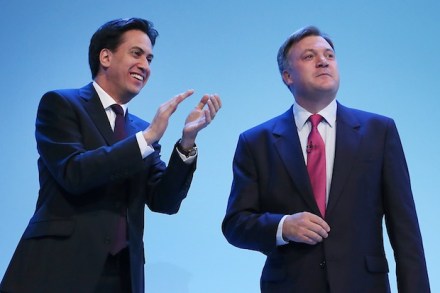
George osborne

Welfare cap will change the way cuts are made

From our UK edition

The Sun's report that pensioner benefits will be included in the overall cap on welfare spending highlights an interesting shift that this policy will cause. George Osborne will set out the detail of the cap on Annually Managed Expenditure in the budget in a few weeks' time. It will put pressure on all Work and Pensions Secretaries to keep future welfare spending under the limit, meaning there will be internal pressure within the department for cuts, rather than the battle for savings between the DWP and the Treasury that we've grown used to. Instead of the Chancellor bearing down on DWP with a package of cuts, the DWP will be working constantly on finding cuts that stop it reaching that AME cap.
Coffee Shots: Ministers visit Scotland to point at things

From our UK edition

Today's Cabinet meeting in Aberdeen, now underway, has given ministers plenty of opportunity to stare earnestly at Scottish things while trying to make the case for the Union. Here are some of Mr Steerpike's favourites. [caption id="attachment_8719911" align="alignnone" width="620"] Image copyright The Cabinet Office[/caption]   All captions gratefully received in the comments...

Today’s borrowing figures are bad for the Tories, but they’re not good for Labour either

From our UK edition

Today's borrowing figures are, on the surface, not good for the Tories. The surplus on the public finances in January 2014 was lower than for the same month in 2013, at £4.7 billion compared to last year's £6.0 billion figure (although it's worth pointing out that the difference could get even smaller with subsequent revisions). That disappointing figure means that over the year, Osborne has borrowed just £4 billion than at the same point last year:- These figures give Labour the opportunity to remind voters that George Osborne has failed to meet his own targets.

Want to make welfare a ‘moral mission’? Stop toting it as a weapon.

From our UK edition

Quite naturally, a piece from the Prime Minister claiming that welfare reform is 'at the heart… of our social and moral mission in politics' is provoking hilarity from those who've never backed that moral mission in the first place. David Cameron is writing in the Telegraph as a response to the Archbishop of Westminster Vincent Nichols' comments in the same paper at the weekend that the government's welfare reforms were a 'disgrace'. He argues: 'Of course, we are in the middle of a long and difficult journey turning our country around. That means difficult decisions to get our deficit down, making sure that the debts of this generation are not our children’s to inherit.

Revealed: the Salmond-Osborne Tapes

From our UK edition

A recording of a conversation between Alex Salmond and George Osborne has been leaked* to The Spectator. An edited extract follows: Alex Salmond: Scotland and England are different countries. So different, in fact, that we should no longer live together. Our interests have diverged and so must our futures. George Osborne: I do not think that is the case. Nor, by the way, do I hope it is. Alex Salmond: But it is! George Osborne: [wearily] Perhaps you are right. Very well; if our interests and futures diverge then perhaps, as you suggest, present arrangements will no longer prove as satisfactory as once we thought they were. Alex Salmond: I knew you would see the light.

What is Alex Salmond’s plan for the currency now?

From our UK edition

Alex Salmond is now a man without a plan. He is offering Scots a future of uncertainty and instability. Threats of a debt default leaving Scotland and Scots with a bad credit rating. No idea which currency we would be transitioning to. By contrast if Scots want to know the benefit of remaining in the UK, they need only reach into their pockets and pull out a pound coin. We have one of the most trusted, secure currencies in the world. We have the financial back up of being part of one of the biggest economies in the world. The pound means more jobs, smaller mortgage repayments, cheaper credit card bills and lower prices in the supermarket. Why would we gamble that for an unknown currency? This morning’s interview with Alex Salmond on BBC Radio Scotland was instructive.

Cheat sheet: George Osborne’s speech on the pound

From our UK edition

‘If Scotland walks away from the UK, it walks away from the pound’, the Chancellor said this morning. In a speech aiming to blow a hole in the SNP’s campaign, George Osborne has set out why sharing the pound isn’t on the cards for an independent Scotland. Here are the key points from his speech, the reactions and why a currency union with the rest of the UK won’t happen 1. The Tories, Lib Dems and Labour have united on a technical fight It’s very rare that George Osborne, Ed Balls and Danny Alexander can find something to agree on. The fact they’ve publicly united against a currency union with Scotland shows how pressing the matter is.

Osborne is serious. An independent Scotland won’t be keeping the pound

From our UK edition

Could it be Bodie and Doyle? Perhaps Starsky and Hutch? Morse and Lewis? Whoever provided the inspiration, someone in Downing Street has clearly been watching too many old TV cop shows because what George Osborne's performance today was the final part of an old-fashioned good cop, bad cop routine. Last week David Cameron stayed in London to 'love-bomb' the Scots (as the Nats described it).'Please, please don’t leave,' was his message, 'We really love you lots.' That was part one, the good cop routine. Today we had part two, the bad cop bit. The Chancellor didn’t stay in London. He came to Edinburgh and was hard, nasty and belligerent.'Go independent if you want to,' was his message, 'But you can’t have the pound, so forget it.

Osborne nixes currency union; Salmond hops around claiming it’s only a flesh wound

From our UK edition

An interesting day, then. As I suggested yesterday, George Osborne has ventured across the border on a punitive raid. Nothing like a spot of rough wooing to get you through the winter. The reaction from Scottish nationalists has been interesting, to say the least. Some seem most affronted. Who the hell does George Osborne think he is, anyway? He'll no be telling us what currency we may use. Perhaps not but he - or Ed Balls - is certainly entitled to set out his view of what may be in the best interests of the rest of the United Kingdom. And if that view differs from the Scottish view then tough. Be that as it may, it never ceases to amaze me that nationalists, having declared war upon the British state, are so shocked or appalled when the British state fights back.

George Osborne’s speech on whether Scotland could keep the pound – full text

From our UK edition

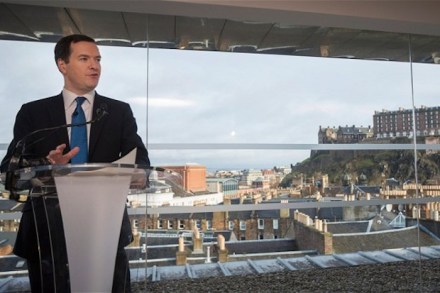
In a speech in Edinburgh today, the Chancellor launched an attack on the ‘yes’ campaign's intention to keep the pound as the currency of an independent Scotland. Here's what he said:- In just over 7 months people in Scotland will decide whether or not to walk away from the United Kingdom. The stakes couldn’t be higher, or the choice clearer. The certainty and security of being part of the UK or the uncertainty and risk of going it alone. At the very heart of this choice is the pound in your pocket. Why? Because the currency we use is about so much more than notes and coins. It’s about the value of our savings. Our power to purchase the everyday things we need and how we make the wheels of trade and commerce turn.

Britain is doomed – even if Salmond loses September’s independence referendum

From our UK edition

Last Thursday’s cover story makes alarming reading, Alex Massie arguing that Alex Salmond may come close to achieving victory in September’s vote. Alex wrote: ‘It is beginning to be appreciated, even in London, that Alex Salmond might just win his independence referendum in September. The break-up of Britain will have begun, David Cameron will have to contemplate being Prime Minister of a rump country — and HMS Britannia will be sunk, not with a bang but a whimper. It will be due as much to English indifference as Scottish agitation.’ I would still put my pound sterling on a No vote, and current odds for independence are around 7/2; but I suspect that ultimate victory will probably go to the SNP. There a number of reasons why the union is doomed.

George Osborne gives Alex Salmond a lesson in power politics

From our UK edition

Politics is about power. It is surprising how often this is forgotten. Power and the application of power. Sure, there's policy too and noble aspiration and all that happy-clappy stuff but, in the end, politics is a question of who gets to wield the big stick. Lyndon Johnson knew this; so does George Osborne. In the long and sometimes unhappy history of these islands that has more often than not meant power has resided with the English. As Osborne is reminding us, it still does. Osborne, who has little to lose in the popularity stakes north of the border, is being quite brutal. The idea, much insisted upon by Alex Salmond, that an independent Scotland could enter a currency union with the remaining parts of the United Kingdom is fanciful. Poppycock. Daft. Not happening.

Nick Clegg: Rob Wilson is as good a wingman as Icarus was

From our UK edition

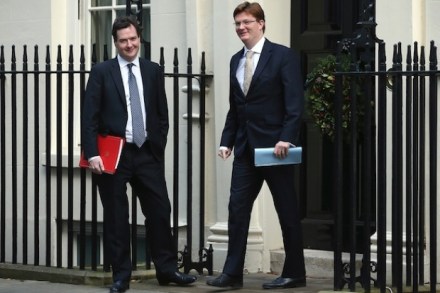
That Danny Alexander struggles with appearing to have gone native in the Treasury has been well known in Westminster for a long time. He gets on well with George Osborne on a personal level, and I reported in December that he'd been rebuked for accidentally using the Tory term 'global race'. Today Nick Clegg was asked about some rather amusing quotes by George Osborne's PPS Rob Wilson (who described himself as the Chancellor's 'wingman' in an event with party members last night) that the Deputy Prime Minister himself thinks that Alexander has gone native. The Huffington post has the full report here but here's the key quote: 'I think Nick Clegg complains quite often that Danny Alexander has gone native in the Treasury.

George Osborne: Housing crisis will still be here in 10 years’ time

From our UK edition

George Osborne's evidence to the House of Lords Economic Affairs Committee was dispiriting for a number of reasons. The first was that he told the peers that the chances are that politicians will still be struggling to ensure that housing supply keeps up with demand in 10 years' time. He said: 'I imagine if we were all assembled again in 10 years' time we'd still be talking about the challenge of making sure that our housing supply kept up with housing demand and we're all legislators here and we all have a responsibility to the next generation.' listen to ‘George Osborne: Housing crisis will still be with us in 10 years' time.

Why Osborne’s recovery might not be based on debt

From our UK edition

Is George Osborne’s recovery a credit-driven illusion? Many of his critics says so, and ask – as this magazine did two weeks ago – why we still have emergency interest rates at a time when the economy seems to be booming. One thing we learned from the crash is that cheap debt and housing bubbles can end in disaster, and with his interventions in the mortgage markets, it looks like Osborne could be blowing a bubble now. But striking research suggesting otherwise was released today by Citi’s Michael Saunders, Coffee House’s favourite economist:- Citi’s research found that the economy's growth has happened while the private sector has been paying down its debt.

Ed Balls’s secret: he doesn’t care whether his tax plan makes sense

From our UK edition

There were a million people who voted Labour in the 2005 general election but not in 2010, when the party fell from a 66 majority to 48 seats behind the Tories. Thanks to the Lib Dems’ spiteful rejection of boundary changes that would have helped their coalition partners, the 2015 poll is already rigged in Labour’s favour by about 30 seats, so the number of floaters who have to be won over to give Miliband and Balls a working majority is likely to be well down in six digits rather than seven. No doubt Labour’s pollsters know how many to the nearest thousand, and have them segmented and profiled to the last housing estate. Not many are likely to be business leaders, wealth creators, tax economists, Today listeners or Spectator readers.

George Osborne: Labour is ‘anti-the British people’

From our UK edition

Quite naturally, there were rather more Conservative than Labour MPs in the House of Commons for Treasury Questions this morning. And quite naturally, George Osborne and colleagues on the Treasury front bench spent most of the session goading their Labour opponents about this morning's growth figures. Deputy Chief Whip Greg Hands and Ed Balls had a wonderful extended session of heckling one another across the Chamber as the exchanges went on, with Hands mocking Balls' flatlining gesture. Other MPs, though, were kept waiting rather longer to do what they'd turned up to do: jeer the Shadow Chancellor when he eventually stood up. But when he eventually stood up, 50 minutes into the session, the Conservative benches went wild with roars.

Today’s GDP figures are useful ammunition for the Conservatives

From our UK edition

That the UK economy grew by 0.7 per cent in the final three months of 2013, leading to the fastest growth annually since the financial crisis, is obviously very good news for the Coalition. The quarter-by-quarter figures have zig-zagged, but the overall growth for 2013 is 1.9 per cent over the year, which is the most important figure. These GDP figures from the ONS, published this morning, enable David Cameron to say that this is further evidence of the Coalition's 'long-term economic plan' succeeding, and use the new Tory buzzword,‘security’. And though the economy is still 1.

Labour and the Conservatives are both wrong about income tax

From our UK edition

Never interrupt your opponent when he is making a mistake. On the other hand, when your opponent has made a mistake try not to match him by making an equal blunder of your own. That's not how Westminster politics works, of course. For reasons that presumably make sense to the respective parties, Labour and the Conservatives have each managed to cock-up their tax policies. Specifically, they are both wrong on the politics of the 50% rate of income tax. That is, the Tories should never have cut the rate of tax paid by those few Britons earning over £150,000 and Labour should not be promising to restore the 50% rate. This is not an argument about finances but about signalling.