George osborne

Why Larry Summers is wrong about the British economy – and why George Osborne is right

From our UK edition

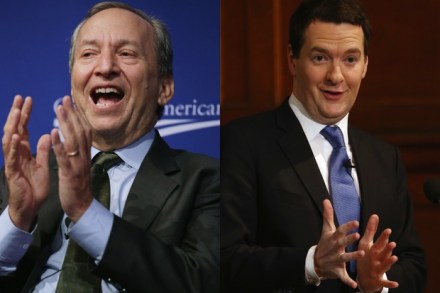
There was a spat at Davos this morning between George Osborne, the Chancellor, and Larry Summers, ex-US Treasury Secretary (and very occasional Ed Balls adviser). The gist of it was that Summers is not a fan of Osborne's austerity, and implied America's stimulus had allowed it to get back to peak GDP more quickly that austerity-struck Britain. Osborne was too polite to tell him what nonsense this is, but I’d like to show Coffee Housers two graphs that make the case. First, the stimulus. It was an abject failure, as readers of Nate Silver’s book, The Signal and the Noise, will know. US unemployment was running at 7.3 per cent at the time and White House economists said that, without a stimulus, it would go to 9 per cent. But with the stimulus, it would peak at 8 per cent.
Explaining the IDS vs Osborne split on welfare

From our UK edition

‘Do you know what they used to call us?’ asked Theresa May ten years ago. ‘The nasty party.’ No one used that phrase, but ‘they’ had a point. The Conservatives seemed to be a group of efficient mercenaries, useful for fighting the economic war that broke out in the 1970s. But in the good times they seemed robotic, Spock-like and heartless. The message was: if you work, we’re with you. If you shirk, you’re the enemy. This was summed up by Peter Lilley’s infamous ‘Little List’ skit, above. ANd again in George Osborne's 2012 Tory conference speech, where he invited his audience to imagine the anger of a worker passing "the closed blinds of their next door neighbour sleeping off a life on benefits".

Any other business: How François Hollande let France miss the global recovery train

From our UK edition

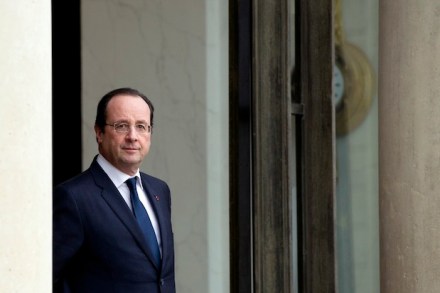
I’ve always respected stationmasters, but that sentiment is not universally shared. A distinguished friend of mine across the Channel described François Hollande the other day as ‘un chef de gare, sans aucune dignité’ — and it’s not difficult to picture the little president, peaked cap awry, trousers unbuttoned, haplessly waving his whistle as the last train à grande vitesse departs for the Eurotunnel laden with talented compatriots who see no future in France. As modern socialist leaders go, Hollande is beginning to make Gordon Brown look statesmanlike. Nicknamed ‘Flanby’ after a cheap custard pudding, he has left decision-making to his ragbag of ministers and done nothing to steer France towards economic recovery.

The Spectator’s Notes: George Osborne’s personal recovery

From our UK edition

Now that the economic statistics are looking better, people are beginning to rediscover the once-fashionable thought that George Osborne is a great strategist. Things are coming together before the 2015 election in a way which makes life uncomfortable for Labour. I am not sure that ‘strategist’ is the right word, but I do think Mr Osborne deserves praise for something else. If you compare this government with the last, you will see that it is not dysfunctional in its internal relations. The coalition has constant frictions, but these are, as it were, built into the system. After nearly four years, there is no serious split or even known personal hatred at the top of the government.

The top level of government isn’t riddled with personal hatred – thanks to Osborne

From our UK edition

Now that the economic statistics are looking better, people are beginning to rediscover the once-fashionable thought that George Osborne is a great strategist. Things are coming together before the 2015 election in a way which makes life uncomfortable for Labour. I am not sure that ‘strategist’ is the right word, but I do think Mr Osborne deserves praise for something else. If you compare this government with the last, you will see that it is not dysfunctional in its internal relations. The coalition has constant frictions, but these are, as it were, built into the system. After nearly four years, there is no serious split or even known personal hatred at the top of the government.

Jobs figures suggest Cameron and Osborne have survived their 364 economists moment

From our UK edition

What is Ed Miliband going to ask David Cameron about at Prime Minister's Questions today now that the latest employment figures show the biggest quarterly increase since records began, and the biggest quarterly fall in unemployment since 1997? Actually, there is quite a lot that he can talk about that means he can entirely avoid the subject - Nicky Morgan's warning to the Tories about 'hate', Aidan Burley, the row between Number 10 and Home Office about stop-and-search and Syria - but the Prime Minister will make jolly well sure that he shoehorns it into any question that's asked of him, even if it's a backbench one about the welfare of horses in Cumbria. Here are the figures. Unemployment fell by 167,000 between September and November to 2.32m (7.1%).

Does it matter if Tories don’t know what it’s like to be poor?

From our UK edition

I have this theory that the reason why the British public is so hugely in favour of cutting welfare to the bone, and the British media so hostile, is that many (maybe most) journalists still depend on financial support from their parents well into their 30s. Since most media folk come from the sort of backgrounds where home ownership is expected, and yet work in an industry where the typical salary makes living anywhere near London extremely difficult, they feel too ashamed to opine on ‘scroungers’ because, well, they are scroungers. Anyway, maybe that’s what’s called projection. Most people in politics, like those in the media, tend to come from fairly privileged backgrounds, and this seems to be the crux of Labour’s counter-attack on welfare.

A minimum wage rise will show the Conservatives are a party for all working people

From our UK edition

The Chancellor’s announcement that he’s recommending an above average increase in the minimum wage is very welcome news. It’s something Renewal has been campaigning for since our launch in July. Wages have fallen behind prices for almost a decade now. The prosperity of Blair’s boom didn’t reach the low paid and it was the working poor who were hardest hit by the recession, meaning that the minimum wage is worth £1,000 less now than it was in 2008. Now that the economy is firmly on the road to recovery it’s the right time to raise the minimum wage. We have to ensure that prosperity and the benefits of the free market reach everybody in society and this increase is an important step towards that goal.

Osborne backs minimum wage hike as fundamental to a ‘recovery for all’

From our UK edition

George Osborne’s decision to back an above inflation increase in the national minimum wage is his most politically significant decision since his decision to cut the 50p rate. It also makes that decision far less harmful politically. Reducing the top rate of tax might have been the right thing to do economically but it hurt the Tories politically. It enabled Labour to claim that this was a government for the rich and that the recovery was only benefitting the few. By contrast, this decision allows the Tories to emphasise that, in Osborne’s phrase, this is ‘a recovery for all.’ There will be those on the dry right who don’t like this policy. They’ll argue that it’ll cost jobs.

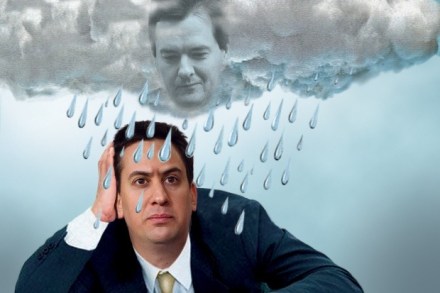
Osborne rains on Miliband’s parade with wage announcement

From our UK edition

What an odd coincidence that on the eve of what's being billed as a major economic speech by Ed Miliband, George Osborne sticks up his periscope and makes a big fat announcement on the minimum wage. The Chancellor and his colleagues have been mulling this increase for months, and have been making confusing but supportive noises over the past few weeks, and this evening would have seemed an odd time for the Chancellor to give an interview to the BBC on the subject if Osborne weren't famed for being such an enthusiastic strategist.

George Osborne: Britain is better off in a reformed EU

From our UK edition

George Osborne's speech to the Open Europe conference this morning was billed as the Chancellor taking a tough guy stance with European leaders, demanding that they reform or see their project crumble. It sounded, from the overnight briefings, as though Osborne was trying to cheer up his backbenchers during their current round of banging on about Europe as much as he was trying to make the case for European reform. But when he delivered the full address, it had as much pro-European thinking in it as it did threats. Osborne was focusing on making the case for the whole of Europe to reform, for Europe to create better conditions for and to not discriminate against non-eurozone members, and for Britain's continued membership of the European Union.

A credit boom before each bust

From our UK edition

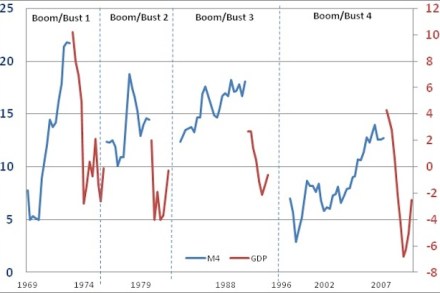
Here is a graph that shows the four economic downturns Britain has been through (red lines) over the past forty years. What I find strking is that each downturn was preceded by the same thing: a surge in the growth of money (blue line). In other words, the bust followed an unsustainable credit-induced boom. The motives and justification behind monetary policy leading up to each boom/bust might have been different. In the early 1970s, monetary policy was shaped by Competition and Credit Control (CCC) reforms. In the late 1980s, those who decided monetary policy wanted to shadow the Deutschemark, then join the Exchange Rate Mechanism (ERM). After that unhappy experience, monetary policy was made in order to target inflation.

Welfare wars

From our UK edition

George Osborne is refreshingly uninterested in his public image, believing that he will be judged by the success (or otherwise) of his economic policies. So when the Chancellor pops up to give a speech, he spends little time trying to mask his underlying aim — which is usually to sock it to Ed Balls, his opposite number. He is a Chancellor-cum-strategist who weighs every policy for the damage it could inflict upon his opponents. And on the issue of welfare, he sees an opportunity to strike. Introducing a benefits cap has been the single toughest policy introduced by this coalition government. It is also the most popular with the public, and the Chancellor seems to find this intoxicating.

George Osborne: Minimum wage rise must not cost jobs

From our UK edition

Amid continuing confusion on what on earth the Tories do think about raising the minimum wage, George Osborne has had a go at clarifying things. He has just told Sky News: 'Well look, I think everyone wants to see an increase in the minimum wage. I'd like to see an increase in the minimum wage, but it has to be done in a way that doesn't cost people their jobs, because that would be self-defeating and we have the Low Pay Commission as a body that exists to make exactly that judgement, and what we've got to do as a country is get that balance right between supporting business, growing our economy and making sure it's a recovery for all and that is what our long term plan is all about delivering.

Boris Johnson sides with George Osborne over more cuts…or does he?

From our UK edition

George Osborne's speech on the need for £25 billion more cuts has opened up some strange dividing lines in Westminster. Labour has done exactly what the Chancellor wanted and questioned the need for the cuts. Nick Clegg has also fallen into place as Osborne hoped and moaned about them being unfair. But Clegg has found an unlikely ally in Iain Duncan Smith, who has let it be known that he does not much like the idea that Osborne could cut a further £1 billion from the welfare bill. So who did Boris Johnson cosy up to this morning when he had his say?

Britain is booming. So do we still need ultra-low interest rates?

From our UK edition

Car sales are up 11pc, making the FT splash this morning. House prices are soaring again, up 8pc last year. And the British Chamber of Commerce has this morning released its Q4 survey showing a startling surge in investment, orders and employment (graph, above). Good news for George Osborne’s plan for a ‘balanced’ recovery: manufacturers' capacity use, confidence and employment difficulties are at the highest since the survey began in 1988. The upshot, as Citi says (pdf) is that the UK economy will likely grow far faster this year than Osborne’s cautious official expectation. He will most likely have another healthy upgrade to announce in his next budget. Citi expects growth of more than 3 per cent this year.

Fisking George Osborne’s ‘hard truths’ speech

From our UK edition

Today, George Osborne used a speech to administer what he called ‘hard truths’ about the economy. But in some cases, the truth was even harder than he let on. Here is a Fisk of his speech... 1. Size matters — ‘Government is going to have to be permanently smaller – and so too is the welfare system.’  This phrase — 'permanently smaller' — is designed to appeal to Conservatives. But in isolation, it's pretty meaningless: smaller than what? The Brown peak? The below graph tells the story. The size of the British government (in red) used to be around average for a developed country (in blue).

New Year blues for back to school Tories

From our UK edition

The Chancellor is scaring the horses up in Brum with his ‘hard truths’ speech on the economy. Meanwhile, the troops in Westminster have that ‘back to school’ feeling. Mr Steerpike has been asking Conservative MPs, ranging from loyalists to rebels and from old timers to young scamps, for their New Year predictions. Many of the answers followed a similar theme. ‘UKIP will wipe the floor with everyone in the European elections, followed by a wide ranging ministerial reshuffle which doesn’t include me afterwards,’ said one noisy backbencher. This feeling was echoed by one junior government figure: ‘Big changes to Cabinet in early spring, poll lead by mid-year and minority Tory government by end of 2014.

Osborne sets clear welfare challenge to Labour – and his coalition partners

From our UK edition

We already knew that the Chancellor would focus on welfare as a field ripe for further cuts in his speech in Birmingham today. When he delivered that speech, George Osborne announced that the Treasury's current forecasts suggest that £12 billion of further welfare cuts are needed in the first two years of the next Parliament, and framed this as a challenge to all parties not to let voters down by refusing to cut benefits. He said: 'So when you see people on the telly who say that welfare can't be cut anymore - or, even worse, promising they will reverse the changes we've already made and increase housing benefit - ask yourself this: way public services would they cut instead? What taxes they would put up in their place?