Film

Gorgeous and electrifying: And Then We Danced reviewed

The film you want to see this week that you mightn’t have seen if you weren’t stuck at home is And Then We Danced, a gay love story set in Tbilisi, Georgia, and it is truly wonderful and gorgeous. Every cloud and all that. However, in my area the demand on broadband is so high that all I get is buffering, buffering, buffering, like it’s 1996, so the only way I could watch this in its entirety was by getting up at 5 a.m. And if it was an absolute pleasure then, it’ll be an absolute pleasure anytime. It passed the 5 a.m. test, you could say.

Foreign language TV is without the political correctness spoiling English drama

Every cloud has a silver lining. Never again are you likely to have a better opportunity to catch up with those classic TV series your friends have been banging on about but which you've not had time to see. I'm not saying my own list is definitive, only that if you're not blown away by all of the below, you really need your taste examining.  There isn't space to give my recommendations in one go, so this week I will cover War and Drugs (Pt I): Band of Brothers If you like war movies then this is at least as exciting as the first twenty minutes of Saving Private Ryan, only spread out over ten, often nail-bitingly tense, visceral, grimily authentic episodes.

The director of Persepolis talks about her biopic of Marie Curie: Marjane Satrapi interviewed

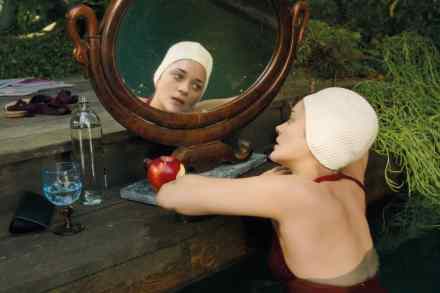
The problem with making an accurate film about science is that science is rarely exciting to watch, explains director Marjane Satrapi. Movie convention tends to insist on the climax of the eureka moment and the fiction of the solitary male genius, who doggedly closes in on his discovery in the same way that a detective might doggedly close in on a killer. ‘It doesn’t happen this way,’ says Satrapi. ‘It’s a result of lots and lots of work, which most of the time is repetitive and most of the time you know you don’t know where you’re going, and it’s lots of collaboration.’ Satrapi studied mathematics in her birthplace of Iran, and has a scientist’s intolerance for dramatic licence.

Catherine Deneuve at her most Deneuve-ish: The Truth reviewed

To tell you the truth about The Truth, even though it stars Catherine Deneuve at her most Catherine Deneuve-ish (i.e. campily grand) and I was so looking forward it — it’s the first non-Japanese production from Hirokazu Kore-eda, who made the very lovely Shoplifters — it is now quite hard to concentrate on anything in films beyond the fact that they already feel like social history. My God, there was a time when people just went out and about willy-nilly? And they hugged and kissed and weren’t always washing their hands while singing ‘Happy Birthday’? So that gets in the way, as does having to watch films at home rather than on a big screen, now that cinemas have closed. But we will try our best — here to serve and what have you.

The best sci fi films on Netflix

From serious sci-fi to spoofs in space, here are films and TV to watch on Netflix if you’re after some futuristic entertainment… Annihilation https://www.youtube.com/watch?v=89OP78l9oF0 One of Netflix’s in-house productions, Annihilation sees Natalie Portman play a biologist leading a rescue mission into a mysterious zone on the US coastland known as The Shimmer. It’s an area hit by a meteorite that is expanding and doing bizarre stuff to any living things that come into its orbit. What unfolds is a tense and imaginative sci-fi adventure that chucks plenty of other genres and film references into the mix.

Astonishing to think Miss World ever existed: Misbehaviour reviewed

Misbehaviour is a film about the 1970 Miss World contest that was disrupted by ‘bloody women’s libbers’ — that’s what my dad always called them, anyhow — throwing flour bombs and shouting ‘we’re not cattle!’ as Bob Hope fled the stage in a panic and our televisions temporarily blacked out.Marvellous, I think now, although at the time I was probably as annoyed as my dad. I loved this show when I was growing up and wouldn’t have known there was anything amiss, as it was all so normalised, watched by a global audience of 100 million. Great family entertainment, I’d have said, now get out my way so I can see the contestants parade with actual numbered discs on their wrists as Michael Aspel pervs all over them.

The best underrated shows on Netflix

With over 160 million subscribers – which ranks somewhere between the population of Bangladesh and Nigeria – Netflix’s biggest shows command staggering audiences worldwide. But the streaming platform has also snapped up the rights to hundreds of lesser known series, some of which are just as good. Here’s our pick of the undiscovered gems: Rectify https://www.youtube.com/watch?v=rd0_nNkdi0c When it comes to sheer critical acclaim, few shows can match Rectify. From the moment this slow-burn crime drama debuted in the US in 2013, it was praised to the hills by television aficionados. Yet even after four successful seasons, and an excellent finale, the show remains relatively unknown compared to the likes of Breaking Bad and The Wire.

Slight: Steve McQueen at Tate Modern reviewed

Steve McQueen’s ‘Static’ (2009) impresses through its sheer directness — and it’s very far from static. A succession of helicopter-tracking shots around the Statue of Liberty, it’s the first film you encounter in this quasi-retrospective from the Turner Prize-winning conceptual artist-turned-Oscar-winning film director. Shot shortly after the monument reopened after the 9/11 attacks, it offers the eye an exhilarating whirl of light and colour, while the mind — given the potency of that historical context — goes on an equally dizzying train of associations through the notion of American liberty. While you bring these associations yourself, they seem to emanate naturally and directly from what you’re seeing.

In this instance, greed isn’t good: Greed reviewed

Greed is Michael Winterbottom’s satire on the obscenely rich and, in particular, a billionaire, asset-stripping retail tycoon whose resemblance to any living person is purely intentional. (Hello, Sir Philip Green.) Plenty to work with, you would think. Low-hanging fruit and all that. But as the characters are so feebly sketched and the ‘jokes’ — ‘jokes’ in quotation marks; always a bad sign — are so heavy-handed it drags (and drags) rather than flies. Greed is good, greed works, Gordon Gekko famously said in Wall Street. But in this instance it isn’t. And doesn’t. Greed is good, Gordon Gekko famously said in Wall Street.

I’ve found the perfect family film (eventually)

As a member of Bafta, I get sent about 75 ‘screeners’ during the awards season, which is always a treat at the end of the year. I was particularly excited about it this time because of the makeshift home cinema I’ve set up in our playroom. I had fantasies of sitting in there with Caroline and the four kids, munching popcorn as we worked our way through the Bafta hopefuls. However, getting everyone to agree on a film to watch is always tricky in the Young household. On Christmas Eve, my recommendation was a French animated feature called I Lost My Body, which charts the adventures of a hand that’s become separated from its owner.

Gripping, immersive and powerful: 1917 reviewed

Sam Mendes’s 1917 is the first world war drama that this week won the Golden Globe for best film and also best director and there is no arguing with that, ha ha. In fact there has been plenty of arguing with that. Some critics say that it feels like a videogame. ‘Turns one of the most catastrophic episodes in modern times into an exercise in preening showmanship,’ says the New York Times. I don’t know what film they were watching. True, 1917 is formulaic — it’s your archetypal man-on-a-mission story — but it is also gripping, immersive and powerful. It isn’t the closest you will get to experiencing the Great War, as there is nothing to beat Peter Jackson’s They Shall Not Grow Old, but it’s as near as damn it. (Or so you imagine.

Alfred Dreyfus is being erased all over again

In London to promote a book, I received an invitation to a secret screening of An Officer and a Spy, Roman Polanski’s new film about the Dreyfus affair. I boarded public transportation to a clandestine destination, somewhere in England, to view what recalled for me the samizdat literature once produced in Communist eastern Europe. I looked over my shoulder several times to see if anyone was watching me; if the possibility of exposure wasn’t real, my anxiety certainly was. My emotional reflexes still echo the trip I took to Prague in 1983 to meet dissident writers during which I was followed. But why all the cloak-and-dagger dramatics now? Why can’t I reveal where I went? An Officer and a Spy is untouchable in the Anglo-Saxon world.

I’ve never seen a film like it: Ordinary Love reviewed

Ordinary Love stars Lesley Manville and Liam Neeson as a long-married couple whose lives are disrupted when she is diagnosed with breast cancer. Not very Christmassy, you might think, but it’s not a ‘cancer story’, as has been said in some quarters, it’s a love story, told profoundly and beautifully and honestly rather than cloyingly or sentimentally. Chances are, it may even stay with you longer than any Richard Curtis film. I can’t guarantee it, but am quietly confident this will be so. The screenplay is by the Northern Irish playwright Owen McCafferty whose own wife, Peggy, underwent breast cancer treatment, and the film is directed by Lisa Barros D’Sa and Glenn Leyburn.

Wildly entertaining Pope-off: The Two Popes reviewed

The Two Popes stars Anthony Hopkins and Jonathan Pryce — that’s two reasons to buy a ticket, right there — as Pope Benedict XVI and his successor Pope Francis I, and it is wildly entertaining, so now you have a third reason too. True, it does, as others have noted, shy away from directly tackling the most difficult questions currently facing the church. But is that really the film you want to see? Rather than this affectionate and literate bromance that does, in fact, nudge us towards the bigger picture, but slyly? Also, it is brilliantly comic. Pope Benedict, for instance, doesn’t get jokes but does try to tell one, which no one else gets. ‘It’s a German joke, so it doesn’t have to be funny,’ he then explains. I laughed my head off.

Detailed and devastating: Marriage Story reviewed

Noah Baumbach’s Marriage Story is a drama about the breakdown of a marriage and it is, at times, devastatingly painful. ‘Divorce,’ says a lawyer at one point, ‘is like a death without a body.’ It’s certainly not the most fun you’ll ever have at the cinema — although it is witty and there are some brilliantly comic lines — but you will see something riveting, detailed, authentic and excellent. Plus it also marks the return of Scarlett Johansson as an interesting actress — remember Lost in Translation? — rather than the one who hangs out with Iron Man and Thor and just does sexy kicks. I’d even forgotten she could be as interesting as this, frankly. Johansson plays Nicole while Adam Driver plays Charlie.

Scorsese at his most leisurely, meandering and engrossing: The Irishman reviewed

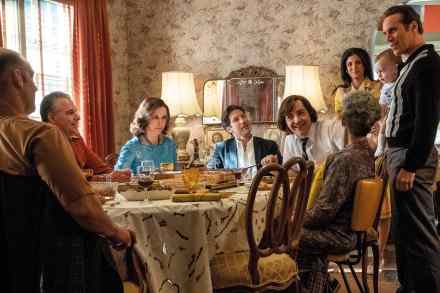
The Irishman is Martin Scorsese’s three-and-a-half-hour epic — a mobster-a-thon, you could say — starring Robert De Niro, Al Pacino, Joe Pesci and a light sprinkling of Harvey Keitel (he’s only in a couple of scenes). It’s based on the true, late-life confession of Mafia hitman Frank ‘The Irishman’ Sheeran and, while gangster flicks can often leave me cold and sometimes baffled — he was dispatched to sleep with the fishes for why? — this is magnificently engrossing. I wasn’t bored for a single minute which, given there are 210 of them, has to be a triumph, surely.

Scooby Doo with better CGI: Doctor Sleep reviewed

Wheeeere’s Johnny? Nearly 40 years ago Jack Nicholson went berserk in a snowbound Rockies hotel, smashing an axe through a bathroom door behind which a pop-eyed Shelley Duvall cowered in terror. It is one of cinema’s truly iconic scenes, once voted the most petrifying in movie history. Now award yourself points if you remember that the family in The Shining were called Torrance. They had a son, Danny, a psychic little boy haunted by apparitions as he pedalled on his trike along the corridor’s hallucinogenic carpets. Danny has now grown up into Dan Torrance and assumed the form of Ewan McGregor who stars in the sort-of-sequel Doctor Sleep.

The most uplifting film ever made

New York   Should art mirror the world as it is, or does an artist fail the public if the work looks back to a time before the grotesqueries of the present? Back, back, I say, but that’s to be expected. I’m such a fan of the past that if I could have one wish granted by The Spectator it would be for a review by Deborah Ross of the most uplifting movie ever, Ladies in Black, directed by the great Australian Bruce Beresford. My, my, what memories of Australians and Oz it brought back.

The best Terminator film since the first: Terminator Six reviewed

The first Terminator film, which came out in 1984, was a high-concept sci-fi serial killer thriller. You can just imagine its director, James Cameron, pitching it to the suits: ‘Arnold Schwarzenegger arrives from the future. He’s naked. We haven’t decided why, but he’s definitely going to be naked. And there’s only one thing on his mind, which is to tear some chick to pieces.’ Yet as sequel followed sequel, it became clear that this franchise about a dystopian war between humans and machines was really a metaphor for the war taking place within Hollywood itself. The machines won. Cinematically speaking, we now inhabit that post-apocalyptic landscape so often glimpsed in Terminator films. The grim perma-dusk is streaked with laser gunfire.

The Disney sequel that no one wanted is finally here – what a relief! Maleficent: Mistress of Evil reviewed

Maleficent: Mistress of Evil is the sequel to the 2014 film Maleficent, and it will certainly come as a relief to all those who, in the interim, have been worried that Disney might let a potential franchise go unexploited. Did that keep you awake at night, as it did me? Well, now we can all sleep easy, knowing that the sequel no one was clamouring for (yet may still make a ton of money even though it’s crap) is finally here. Phew. So, once upon a second time, Angelina Jolie reprises her role as the evil fairy in the giant horn wig who cursed Sleeping Beauty. The first film was, in effect, an origins story. It wasn’t an especially good origins story, but at least it had a point, as it asked: how did Maleficent become so dark and wicked and twisted. Whereas this time out?