Europe

Get ready for “Clameronism”

Since the Lib Dems starting surging there has been no shortage of speculation about the possible coalitions that may emerge after the election – Lab-Lib, Lib-Lab, Con-Lib. There has also been breathless speculation about what posts Nick Clegg might demand, including by yours truly.  But none have been as cleverly-written as Hugo Brady’s. A think-tanker for CER, Brady is predicting the rise of “Clameronism“: ‘Buoyed by a huge increase in the Liberal vote, Clegg at first opted for opposition. He bet that a swift second election was likely and that the Liberal Democrats would again double their seats. But the threat of a new financial crisis later that year spelt

Where will Clegg meet his Waterloo?

The FT’s Jim Pickard writes: ‘Cameron will be cursing the order of the debates. He’d much prefer to be attacking Nick Clegg on domestic issues than foreign affairs on Thursday.’ I’m not so sure. Foreign Policy is the arena where the Tories are concrete, populist and accessible. The same is not true for the Lib Dems. Along with Iain Martin and John Rentoul, Pete noted that Ed Davey is vague on the Lib Dem Trident replacement policy. Davey’s vague with good reason: the policy is hopelessly confused. The manifesto says: ‘Rule out the like-for-like replacement of the Trident nuclear weapons system. At a cost of £100 billion over a lifetime

No clear winner in the foreign affairs debate

Only defuse.  That seemed to be the approach of all three participants in the Daily Politics’ foreign affairs debate this afternoon.  The frequent questions from Andrew Neil and Mark Urban put David Miliband, William Hague and the Lib Dems’ Ed Davey on the collective back foot.  It was all they could do to take some of the sting out of proceedings. In Miliband’s case, that meant Iraq and defence spending.  On the former, he started with one of the bluntest statements we’ve heard from any government minister on the issue: “If we knew then what we know now,” he said, “we wouldn’t have gone into Iraq.”  You can see the

A world without planes

In the book a World Without the West, the authors invite the reader to imagine the non-Western world where South-to-South grow so strong that they bypass the traditional Euro-Atlantic powers. Stuck in southern Europe because of Eyjafjallajokull’s eruption, I have begun thinking about life without airplane travel.   The last 15 years have not only seen an explosion in cheap airline travel – spawning new tourist industries in once-forgotten European cities – but there has been an increase in the use of air transport for goods, mail, soldiers and much else besides. What would happen if this is ground to a halt in Europe not for a weekend or weeks

Greece’s deferred crisis

I am sitting in a busy café in Athens’s fancy Kolonaki district, watching the city’s elite stroll by in their well-fitting couture jeans, as the afternoon sun shimmers off the dusty streets. The women are weighed down by that most delightful of burdens — shopping bags from the local FENDI shop — and the latte I have just ordered comes at the recession-defying price of five euros.   The regular demonstrations, which block the city centre and bring the police out in force, are now greeted with resignation rather than concern. It may take a little longer to travel home when the shops close -– which they do mid-day on

Don’t mention ze Europe

The Conservative Party’s departure from the European People’s Party came down to a choice of expediency over principle. If you are inclined to accept that Britain will stay in the EU and that membership helps this country – even if it requires some compromises – you will likely find the move unfortunate. If you are more concerned about the principles at stake – and feel that Britain’s loss of sovereignty has gone too far – and do not care about the loss of influence on the legislative process, you are likely to be in favor of the Tory move.   David Cameron is keen to keep the issue of Europe

Polish tragedy

Polish President Lech Kaczynski, his wife and a number of top Polish officials, including the Central Bank president, the Polish ambassador to Moscow and an Army chief, were killed when the presidential plane crashed near an airport in western Russia.  The tragedy – the worst in modern Polish history – ends an extraordinary career for the actor-turned-politician who, alongside his twin brother Jaroslaw Kaczynski, upended Poland’s political system when they founded the conservative party Law and Justice, and in 2006 controlled both the presidency and the government. The brothers first found fame as child actors, with angelic faces in a film version of the popular children’s book The Two That

The case for voting Conservative

Why vote for Cameron? The reasons for voting against Gordon Brown are so numerous that the positive pro-Tory reasons for voting are often lost. This week’s Spectator gives you all the ammo you need to win around wavering friends, colleagues and family. We have restricted ourselves to the ten most compelling points. I summarise them below: 1. School reform. In itself, it’s enough reason to vote Tory. Gove has specifically promise that within four years of a Tory government everyone will have an independent school offering to educate their kid for free. This should have been a 1981 Tory proposal, but Keith Joseph lost a battle with the civil service

Are the Tories ready for joined-up government?

The Civil Service is readying itself for a new government. The BBC has already reported a discussion of efficiency savings among senior officials. In another part of Whitehall, work is a foot on how to set up a National Security Council should the Tories win. I have in the last few weeks been interviewing ex-ministers and senior officials as research for a RUSI paper, due out soon after the election, on how to improve the government’s security set-up. Traipsing around various departments, a number of interesting conclusions have come to light: – Conservative ideas for an NSC are not the same as the government’s NSID committee, however much ministers say

Woolas on the rack

Phil Woolas has just been confronted on Daily Politics about immigration figures which we uncovered on Coffee House yesterday, showing 99 percent of new jobs since 1997 are accounted for by immigration. His response is (unintentionally) hilarious. He is immigration minister, yet appears not to know what immigration figures mean. Here’s the transcript: Phil Woolas: I think that the Spectator’s analysis, perhaps not surprisingly, is confusing two completely separate things Andrew Neil: These are Office of National Statistics figures.which we checked this morning. Do you accept that there are 1.7 million new jobs for people of working age between 16 and 64, correct? PW: Yes AN: And according to the

Europe as a campaign message ... for Labour

As I said earlier, today’s PMQs was all about giving the various parties’ campaign messages a walk around the block.  Cameron’s questions reduced down to “They’ve failed – give us a go”.  Clegg pushed the Lib Dem’s Labservative prospectus.  And Brown droned on about “£6bn being taken out of the economy,” as well as about Lord Ashcroft and “securing the recovery”. In which case, it’s striking that Denis MacShane used a question to denounce the Tories’ alliances in Europe.  Indeed, Peter Mandelson did exactly the same in a speech this morning.  Here’s how he put it: “David Cameron chooses to sit alongside the xenophobes and homophobes in the European Parliament.

Goodbye world, see you in a few weeks (for a proper EU dust-up)

With plenty of domestic issues to debate, the election campaign promises to see little intrusion from the outside world – barring Russia invading a small neighbouring country, a terrorist attack or another financial meltdown. Nor will Britain say much to the world in the next couple of weeks; ministers will be be represented at international meetings, for example in NATO, by senior officials, and Britain’s diplomats have been told to keep quiet. As soon as the election is over, however, there will be plenty of action. The Cabinet Office is busy planning a quick update of the National Security Strategy, and then will come a slightly longer Security and Defence

Clegg blows a golden opportunity

Nick Clegg won’t get many opportunities to sell himself to voters and he has just been demolished on the Today programme. All things to all men, Clegg was all over the place. He couldn’t give an exact answer when questioned about the size of the deficit, and the Lib Dems’ shifting position on the depth of cuts was exposed once again, recalling his autumn wobble on ‘savage cuts’. He also refused to rule out a VAT rise. Similarly, he could not expand on his plans for parliamentary reform beyond labels such as ‘radicalism’, ‘renewal’ and ‘the old politics’. Caught between defending himself from the Tories and attacking Labour, Clegg panicked.

For the Tories, finding "good" EU issues gets harder

I recently sat down with a European foreign minister to discuss the EU’s enlargement strategy and how it would deal with those applicant countries, like in the Western Balkans, who want to join the Union but whose chances of integration in the next ten years or so are limited. We tried to write down those of his ministerial colleagues who could be brought together for a regular discussion of the issue; we stopped at five names.  Only five EU foreign ministers out of 27 could be counted on to join an unscheduled discussion about enlargement policy. That’s a problem, including for the Tories. Here is why. The Tories are not

A battle with the EU may be closer than you think

Euroscepticism is David Cameron and Gene Hunt’s sole shared attribute. But, bequeathed a poisoned chalice at home, the EU is not a future Tory government’s immediate priority. Set-piece battles over rebates, defence procurement and the CAP can be avoided for a time, but skirmishes will be a regular occurrence. And some of these will be bloodbaths. The first test comes in June, when EU finance ministers will consider hedge fund and private-equity firm regulation. There is no more contentious a topic. Recent European regulatory initiatives have impeded British financial services to the extent that even Brown and Miliband have taken note. It may be tempting to perceive a grand conspiracy against Britain, but

Honouring the righteous

In Britain, a lot of people think Parliament has either become useless, venal or both. Few would look to it for moral guidance. Not so in Serbia, where the nation’s legislature has condemned the 1995 Srebrenica murder of 8,000 Muslims in Bosnia-Herzegovina – Europe’s worst atrocity since World War II – for the first time. In 2004, I was involved in getting the Bosnian Serb authorities to admit their role in the crime. Reluctantly, they admitted that their forces participated in the killings, but many condemned the resolution at the time. So the Serbian move is significant. But the road to reconciliation in the Balkans is still long. Although some

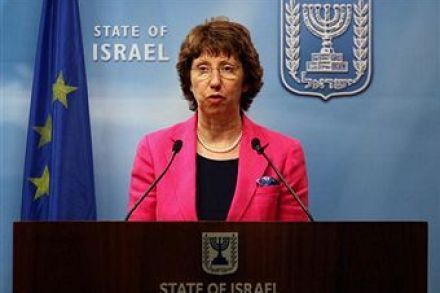
Who will be Cathy Ashton’s Sir Humphrey?

The fight for the most powerful job you’ve never heard of is being fought by people who you’ve probably also never heard of. For EU foreign policy “czar” Cathy Ashton has published her plans for Europe’s diplomatic service, which is meant to oversee the EU’s multibillion-pound annual development budget and have a diplomatic staff of about 7,000 people. Her proposals can be found here. The proposals have commentators are split. Dan Smith and Mark Leonard are in favour, but a couple of MEPs have called me expressing their frustration with the plans. European legislators are particularly concerned about the powers given to the Permanent Under-Secretary type figure, the Secretary-General of

The Euro is so great – let’s have two of them

European leaders have now agreed to bail out Greece in a coordinated affair, involving the IMF and bilateral assistance. The Times has written this up as a grab for more centralisation of policy-making by European Council President Herman Van Rompuy, but even the Tories know that’s not true, as judge by William Hague’s calm remarks. Trying to understand the problems of the euro has sent me back to my undergraduate economic textbooks and Robert Mundell’s work on optimum currency areas. As Spectator readers (many of whom are bankers) will know, the US economist theorised that a group of countries will benefit from a common currency like the euro if three

Germany to the EU: no more integration

A Conservative Party article of faith has been the belief that other Europeans are innately more pro-EU than the British. In the past, this has undoubtedly been the case. Poll after poll has shown that Britons see the EU differently than most other Europeans. But as I have argued before, times are changing on the continent. In an article in the Frankfurter Allgemeine Zeitung (not a Europhile newspaper by any stretch), Germany’s new politics is explained. Nikolas Busse argues that the Greek crisis and failure of EU leaders to cobble together a plausible bail-out is the first major manifestation of Germany’s new role in Europe – that of a country

Entente nouvelle?

Could Britain and France share defence assets? Julian Glover’s column in the Guardian concludes: ‘As for the new carriers, they are, unlike much defence equipment, adaptable and manoeuvrable. They could sail to the rescue in Haiti or feed the hungry in Mogadishu as easily as obliterate Tehran. We should build and deploy the first, and persuade the French (whose own grandiose carrier doesn’t work) to complete and equip the second: a shared fleet for two European nations that have yet to reconcile themselves to their more modest place in the world.’ Politicians on both sides of the Channel speak eagerly of deeper entente. But there is not always a way