Eu

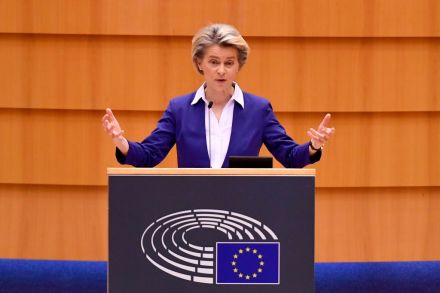
Ursula von der Leyen has always left a trail of disaster

From our UK edition

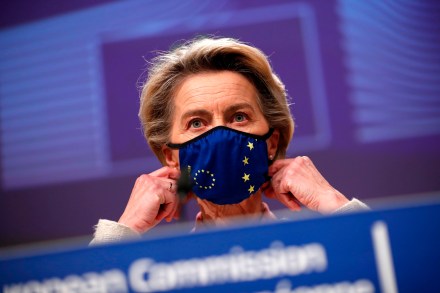
The German Army had to join a NATO exercise with broomsticks because they didn’t have any rifles. It’s special forces became a hotbed for right-wing extremism. Working mothers were meant to get federally-funded childcare, to help fix the country’s demographic collapse, but it never arrived, and the birth rate carried on falling. Every child was supposed to get a hot lunch at school every day, but somehow or other it didn’t quite happen. There is a common thread running through the career of Ursula von der Leyen, the President of the European Commission. A series of catastrophic misjudgements, and a failure to deliver.
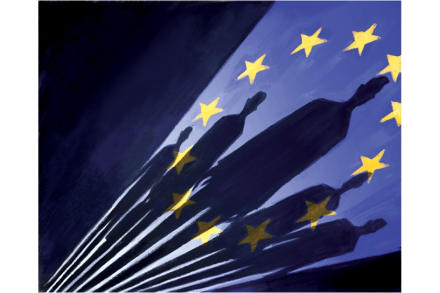
It’s time for Ireland to stand up to the EU

From our UK edition

Ireland’s political class is facing a moment of truth. Following yesterday’s extraordinary events — with the EU temporarily triggering Article 16 of the Northern Ireland Protocol as part of its desperate effort to manage its self-made vaccines crisis — the Dublin elites have some serious soul-searching to do. They must now ask themselves if they are willing to be members of this institution that has just treated them with such contempt; which has just signalled in front of the entire world that it does not take Irish sovereignty or Irish democracy very seriously at all. Contempt is not too strong a word for what the EU has just done to Ireland.

Can Spain’s faith in the EU survive Covid?

From our UK edition

According to ancient Moorish legend, when the world was created each land was given five wishes. Spain’s first four wishes – for clear skies, seas full of fish, good fruit, and beautiful women – were all granted, but the fifth, for good government, was denied on the grounds that to grant that too would create a paradise on earth. Certainly over the last couple of centuries, good government in Spain has tended to be conspicuous by its absence. Philosopher Ortega y Gasset summed up Spain’s tragic history and its desire to become more like the liberal democratic European countries in his famous phrase: 'Spain is the problem and Europe the solution.' It seems that many Spaniards agree: the European Union is widely regarded as an unquestionably good thing for Spain.

The EU’s vaccine opportunism will not be forgotten

From our UK edition

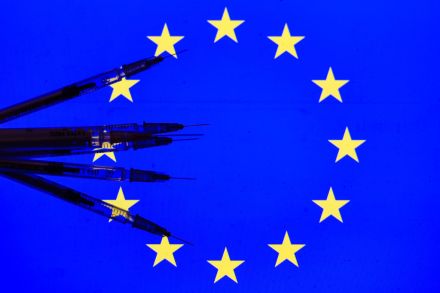
At first, it sounded like empty rage. The European Union had spent all week making wild statements about controlling vaccine exports — even challenging the notion of contract law. On Friday, it has started to act on its words and announced it will introduce controls on vaccines made in the EU — potentially giving itself the power to stop Pfizer sending Britain the vaccines it has paid for. Worse, when it made the announcement, it included Northern Ireland. The EU was set to use the ‘last resort’ mechanism in the recently-agreed Northern Ireland Protocol, Article 16, that can unilaterally impose a land border: something both the UK and EU spent years trying to avoid.

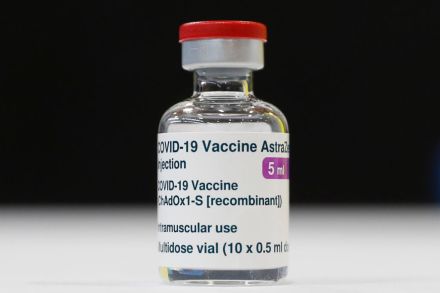
EU accidentally un-redacts AstraZeneca vaccine contract

From our UK edition

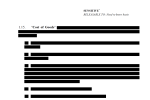
Oh dear, can the EU do anything right at the moment? This morning, the bloc escalated its battle with the pharmaceutical company AstraZeneca by publishing its vaccine purchase contract with the company online. The EU was hoping the move would bolster its demands for AstraZeneca to hand over vaccine doses meant for the UK, to make up for shortages at the firm’s European factories. As you would expect with such a sensitive document, large portions were redacted when the contract was published by the Commission.

Can the EU win a case against AstraZeneca? I’m not convinced

From our UK edition

The contract between AstraZeneca and the EU has now been published. It confirms my view, expressed on Coffee House, that the EU does not – despite its claims – have any form of ‘strong case’ or way to jump a queue to speed up its vaccine rollout. Both contracts (the one, published previously, which I used as an example in my last post, and today's) are what the EU calls advance purchase agreements, or APAs. The latest contract has slightly different wording in some places. But the differences are not substantial. This, then, appears to be bad news for the EU if it is serious about taking action against AstraZeneca. The words ‘Reasonable best efforts’ remains in the contract and is the cornerstone of the obligation AstraZeneca is under. Clause 5.

Britain gets a boost to its vaccine programme

From our UK edition

As the blame game gets underway in Brussels over the EU's sluggish vaccination programme, the UK government has fresh reason for cheer: a new coronavirus jab. The Novavax vaccine has successfully completed its phase three trials — finding it to be 89 per cent effective in large-scale UK trials. This data will now be passed to the MHRA to assess whether the vaccine can be approved for UK use. While the vaccine is thought to be highly effective against the Kent strain of Covid, it is less effective against the South African variant. While it still offers some protection, Novavax is following Moderna's lead in developing a booster shot to tackle this.

The EU vaccine debacle poses a dilemma for Remainers like me

From our UK edition

There is no question about it, at least if you want to evaluate things objectively: the UK has handled Covid vaccine rollout well (at least so far) and the EU has dealt with it badly. For a Remainer like me, this raises a difficult question: does this prove that Brexit was a good idea after all? Compared to the EU27, the UK has been able to act nimbly in vaccine negotiations. While Brussels has been held up by various delays and supply issues, these have not affected the UK. This is thanks in large part to the fact that its contract with AstraZeneca was signed three months before the EU vaccine deal. The UK also took a gamble, betting on a vaccine that had not yet passed clinical trials.

This is just the start of the Brussels-Britain bust-ups

From our UK edition

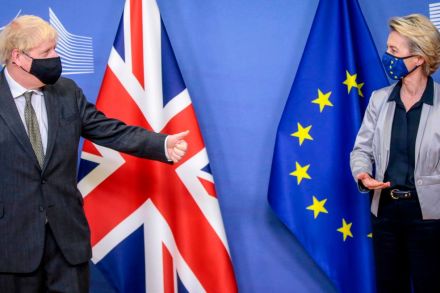
This is a crucial year for the UK’s two most important relationships, I say in the magazine this week. If the Johnson/Biden diplomatic relationship has got off to a better start than expected, the same cannot be said of the post-Brexit UK/EU one. The alignment between Johnson and Biden on climate change, Russia and China is helping the alliance. This relationship should become closer still given the two side’s agreement on China, the most important geo-political issue of the decade. The EU will attempt, often in not particularly edifying ways, to assert itself as the bigger partner.

The vaccine row shows the EU doesn’t understand contract law

From our UK edition

The EU rejects 'the logic of first-come first-serve,' said the EU's health commissioner Stella Kyriakides. 'That may work at the neighbourhood butcher's but not in contracts, and not in our advanced purchase agreements'. Contract law is an area of law I know well. And it is not a political comment to say the commissioner is wrong. We don't know precisely what the contract between AstraZeneca and EU member states says. But the EU did publish another vaccine supply contract here. All this makes it very difficult to see what case the EU has In any would-be-case involving this contract, the EU has two massive hurdles to jump. Firstly, contractors undertake to use their 'reasonable best efforts' to manufacture enough supply.

The EU goes to war over the vaccine

From our UK edition

German politics is backing Brussels in the ongoing dispute between the EU and AstraZeneca over Covid vaccine shipments. The European Union alleges that the pharma firm, which is producing the Oxford-developed vaccine, is planning to supply the UK faster and while failing to fulfil its contract with Brussels. A meeting on Wednesday between officials and representatives from the Cambridge-based company was described as 'constructive' but no solution was found. Meanwhile, Martin Schulz, the former president of the European Parliament and prominent German Social Democrat, called for hard action against AstraZeneca. ‘This company is heavily dominated by the Brits and has apparently clear priorities as to which countries it supplies,’ he said.

Britain will prove more Biden-friendly than the EU

From our UK edition

This is a crucial year for the UK’s two most important relationships. The Anglo-American alliance, our strongest diplomatic and security partnership, now needs to adjust to a new president in the White House. Meanwhile we are also starting our new relationship with the EU. The question is: can the two sides move on from the wrangling of the Brexit negotiation? To great relief in British diplomatic circles, the new US administration and the UK have got off to a good start. Joe Biden has shown that he is keen to move on from the Donald Trump era.

How the EU vaccine row could escalate

From our UK edition

The EU is now insisting that AstraZeneca use vaccine produced at its UK site to make up for a shortfall in its supplies to the EU. This is likely to kick off a major row as the UK went to great trouble to ensure that it had first refusal on all the Oxford vaccine produced in the UK. Indeed, AstraZeneca’s willingness to accept that condition is a major reason why Oxford ended up partnering with them. It is not hard to see how this situation could escalate. The EU is already saying that companies should notify them before exporting vaccine out of the bloc, and the German government is going further, calling for full on export controls on vaccines.

The EU is blaming everyone but itself for its vaccine debacle

From our UK edition

Something has gone badly wrong with the EU's rollout of the Covid vaccine. Yet in its response to this debacle, Brussels seems determined to double down, engaging in behaviour of the pettiest kind as it blames everyone but itself for what has happened. 'The companies must deliver', Ursula von der Leyen, the EU commission's president said this week, as she announced the launch of a 'vaccine export transparency mechanism'. In reality, this plan to oblige companies to notify the commission when vaccines leave the EU (into Britain, for example) is an attempt to pile pressure on the pharmaceutical firms who have given us the only way out of the situation we find ourselves in.

Is the EU to blame for AstraZeneca’s vaccine shortage?

From our UK edition

The important difference between AstraZeneca's relationship with the UK and its relationship with the EU – and the reason it has fallen behind schedule on around 50m vaccine doses promised to the bloc – is that the UK agreed its deal with AstraZeneca a full three months before the EU did. This gave AstraZeneca an extra three months to sort out manufacturing and supply problems relating to the UK contract (there were plenty of problems). Here is the important timeline. In May AstraZeneca reached an agreement with Oxford and the UK government to make and supply the vaccine. In fact, Oxford had already started work on the supply chain.

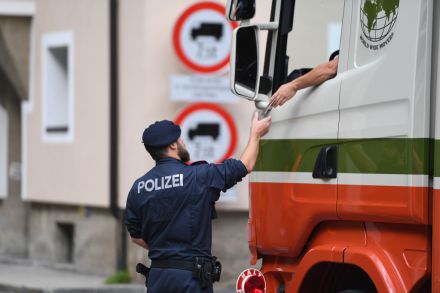
Has Covid killed the EU’s dream of open borders?

From our UK edition

‘All non-essential travel should be strongly discouraged both within the country and of course across borders,’ Ursula von der Leyen, head of the European Commission, has said. As a result of the Covid crisis, the dream of open borders across the continent of Europe has never seemed so imperilled. Meanwhile, a post-Brexit Britain has the ability to flex its borders as much as it chooses. To some Brexiteers, this alone makes Brexit worth it. The Schengen agreement was signed in 1985 and became pan-EU in 1999, meaning that, from then on, any country without an opt-out needed to allow free movement of people from any other signatory country (almost all of the rest of the European Union).

Britain is right to play tit-for-tat with Brussels over the EU ambassador

From our UK edition

It is petty, small-minded, mean-spirited, and childish. It is certainly not difficult to think of a few adjectives to describe the UK’s decision to refuse diplomatic status to the European Union’s mission in London. Diplomats, and European ones in particular, take matters of status, protocol and etiquette very seriously, and the snub looks, on the surface at least, designed to diminish our closest neighbour. The ambassador for, say, Mozambique, or Honduras, has full diplomatic recognition, but not the person representing the 440 million strong trading bloc on the other side of the English channel. Wars have been started over lesser slights.  But hold on. Sure, you can argue that the UK is being silly. But so is the EU.

Britain’s copyright law is a mess

From our UK edition

Copyright often seems like a joke. Most of us infringe it constantly, and publicly, without a second’s thought. With the advent of the internet, the public uploads countless videos, music, photographs, art, and a whole host of other things without the permission of the creators. Even large organisations get away with it. A few years ago, for example, the National Trust posted a picture of an unusual, heart-shaped honeycomb to social media, claiming it had been made by bees at one of their properties. It went viral, but it wasn’t actually theirs. Luckily for them, the beekeeper who took the photograph didn’t press the issue. Even creators, whom the system was created to benefit, are often blissfully unaware of the rules.