Eu

Herman van Rompuy’s revelatory Downing Street lunch

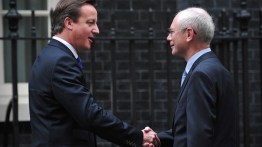
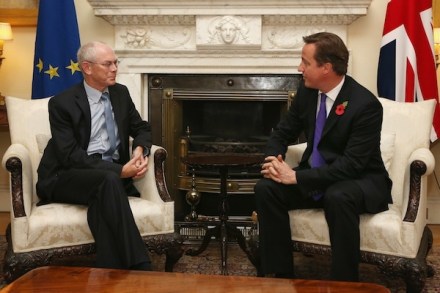
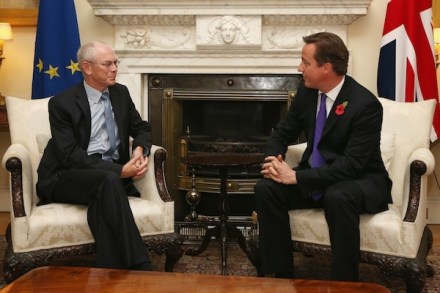
David Cameron had lunch with Herman van Rompuy in Downing Street today to discuss the UK’s position on the EU budget. Despite the Prime Minister’s tough talking in public about his determination to veto any real-terms increases in the money available for the multi-annual budget, the Downing Street spokeswoman refused to confirm that there was in fact any mention of this threat at today’s meeting, which Nick Clegg apparently popped into briefly. She said: ‘Discussions focused on the multi-annual budget. Both the Prime Minister and the Deputy Prime Minister made clear the Government’s position that we do not support a real-terms increase in the EU budget. They reiterated that at

The View from 22 — BBC in crisis, a Major problem for the Conservatives and Lost in Europe

What is going to happen next with the BBC Jimmy Salvile saga? In this week’s magazine cover, Rod Liddle blames institutional problems within the organisation and predicts there will be plenty of buck-passing to come. Fraser Nelson says in this week’s View from 22 podcast that although he sympathises with the decision the BBC took, he believes there are more scalps to come: ‘As an editor myself, I know that if you are to come up with a story that makes an explosive allegation it has got to be absolutely nuclear-proof nowadays and if it’s not, if there is a slightest bit of chink in your armour, it could sink

Cameron irked on Europe as backbenchers rattle the referendum cage

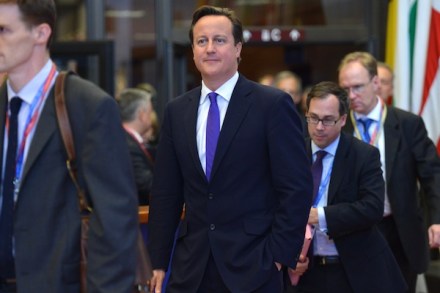
Throughout his statement on the European Council, David Cameron seemed slightly irritated. One sensed that the headlines of the last few days have rather got under his skin. Cameron began by declaring that the Council meeting had made ‘limited progress’, which is hardly much to report to the House. He also was unable to resist another pop at Chris Bryant; complaining that he still hadn’t apologised to him when the Labour MPs asked a question. It was striking what a pro-European tone Ed Miliband took in his response to Cameron. It was all about how Cameron was losing control of his party over Europe and needed more friends there. When

The EU commissioner who resigned on the grounds he was innocent

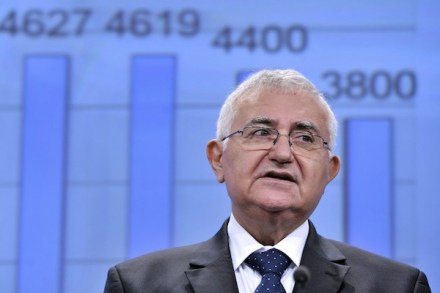
I don’t suppose too many Coffee House readers will have noticed, but the EU is currently without a dedicated health commissioner. This is because the holder of that important office, a nondescript former Maltese politician called John Dalli, resigned last week in connection with an alleged lobbying scandal. So, until they can find another nondescript Maltese politican to replace him (the country’s foreign minister looks as if he is to be the lucky guy), our health needs at euro level are in the acting hands of one Maros Serfcovic, a Slovak, who is also the Commission’s commissioner for administration. This makes him the EU-equivalent of Jim Hacker, the Minister for Administrative Affairs,

David Cameron’s EU dilemma

David Cameron is determined to renegotiate the terms of Britain’s EU membership. But to get a good deal and to show his own eurosceptics  – let alone UKIP voters  – that he’s serious about this, he is going to have to be prepared to say that he would be prepared to leave if the rest of the European Union doesn’t play ball. (This poker game is why the other northern European countries that Cameron is relying on to help him secure a better deal have been quick to suggest that they wouldn’t mind Britain leaving that much.) Cameron, though, is highly reluctant to do this. Not only does he think

The Home Office hokey-cokey on EU law and order opt-outs

Yvette Cooper was in a stern mood this afternoon when she responded to the Home Secretary’s announcement about plans to opt-out of 130 European law and order measures and then re-adopt those which it fancies. Her main gripe was that she hadn’t been sent Theresa May’s statement about the plans until 45 minutes before it was delivered in the Commons, but she was also peeved about the content. The Shadow Home Secretary argued that ministers ‘haven’t actually told us anything today at all’, arguing that the different limbs of the coalition were doing entirely different things on this matter. While David Cameron had spoken about an opt-out, Nick Clegg had

David Cameron’s big European week

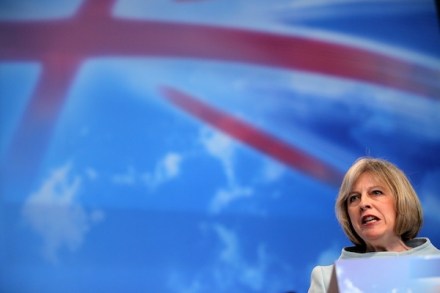
David Cameron’s plan for this autumn was to largely avoid the topic of Europe at his party’s conference, then to focus on the issue later in the year. It’s only a few days since the Tories gathered in Birmingham, and the Prime Minister is already facing a big week on Europe. Home Secretary Theresa May will kick things off by announcing today that she wants Britain to opt out of more than 130 European Union measures on law and order, including the European Arrest Warrant. The opt-out itself, which the Home Secretary is expected to say Britain is ‘minded’ to do, is not the tricky bit: it’s which measures to

The Nobel Prize’s EU joke prompts questions about the nation state

The award of the Nobel Prize to the European Union is a tremendous joke; and like all great jokes it has brought people together. Commentators of left and right are united, for the most part, in condemning the Nobel Committee’s revision of history that claims the EU, a body that has only existed since 1993, deserves credit for securing ‘60 years of peace’ in Europe. Iain Martin and the legal commentator David Allen Green give the fullest accounts, rightly commending America’s enormous contribution to Europe since 1945. The timing of the award adds to the general mirth because there can be little doubt that events in the Eurozone are threatening

Governing the world – an interview with Mark Mazower

‘People begin to feel that… there are bonds of international duty binding all the nations of the earth together.’ This quotation, which resonates so clearly as yet more blood is shed in Syria, belongs to Guiseppe Mazzini, the 19th century Italian nationalist whose vision of a ‘Holy Alliance of peoples’ underscores much of Professor Mark Mazower’s Governing the World: The History of an Idea. Mazower’s book is an account of the ideas and institutions of international relations from the Concert of Vienna in 1814 to the present day United Nations. It is, then, the story of how Western hegemony has shaped the international sphere; this period of hegemony is soon to end

The EU wins the Nobel Peace Prize

Today is not April the first; but the European Union has indeed won the Nobel Peace Prize. It is a bizarre decision given what is going on in Europe right now. Watching the reaction of the Greek crowd to Angela Merkel on her visit there this week, it was hard not to worry that the European project was now a threat to peace and stability on the continent. To be sure, France and Germany have not gone to war again since 1945. But to chalk that up solely to the European Union is a profound misreading of history. I suspect that the decision to award the prize to the European

Conservative conference: William Hague doesn’t want a minimalist Europe

When it came to the passage in his speech on Europe, William Hague was clearly building up to a crescendo. He thundered out the lines ‘which will require the fresh consent of the British people’, and then paused for what he expected to be a rapturous round of applause from a Tory audience thrilled to have received more red meat on Europe. The applause certainly came, but it wasn’t exactly full of enthusiasm; more a perfunctory round of clapping. The first thing holding back the cheers was that everyone in the hall had already heard this line. The promise had been that there would be more details at autumn conference

Labour conference: Blank sheets of paper are all the rage on EU policy

It’s no secret that the Conservative party is in a bit of a pickle about Europe at the moment, and Douglas Alexander quite wisely chose to exploit the ravine that is ever growing between eurosceptic backbenchers and the Prime Minister in his speech this morning. But where does Labour stand? Well, that’s still not entirely clear. This is what the shadow foreign secretary said about the Tories and Europe this morning: ‘Just two years into Government and that’s David Cameron in a nutshell: out of touch at home; out of his depth abroad. But what’s the Conservatives’ strategy for the EU? Nothing, it’s a blank page. What’s the Conservatives’ strategy

What the BAE merger says about UK relations with the US and Europe

The merger of British BAE Systems with French giant EADS finds the government at a tricky crossroads for the future of the UK’s defence industry. Although merging with EADS threatens to rip the heart out of Britain’s largest defence firm, BAE has little choice. The firm has suffered from spending cuts on both sides of the Atlantic — 98 per cent of BAE’s business originates from the defence market and orders are in decline. Therefore a merger appears to be the obvious solution, allowing BAE to diversify and secure its future. But as the world’s third largest defence contractor, any kind of dilution of BAE has security and strategic implications.

What Barroso should have said

José Manuel Barroso gave his annual ‘State of the Union’ address in Strasbourg yesterday. If you are a glutton for punishment, you can read the full speech here, but in this week’s Spectator, Quentin Letts offers the president of the European Commission a transcript for the speech he should have given. Here is a snippet of what Barroso should have said: For years we have dreamed of a Europe with level economies, a Europe with equality of outcomes. Our patience will soon have its reward, for all our economies will soon be equally knackered. Our Union thus becomes truly egalitarian. Let us salute the blue stars on our federal flag.

Cameron’s odd behaviour over Europe

Europe, as everybody knows, is one of those issues on which a Tory leader needs to pay particular attention to the words he uses. This makes David Cameron’s behaviour in recent weeks all the odder. First, we had that Brussels press conference in which Cameron sounded rather too enthusiastic about the EU for his own side’s tastes. This was followed by his Sunday Telegraph piece in which he stressed that ‘the two words “Europe” and “referendum” can go together’ for him. Now, those close to Cameron complain that the two positions were perfectly compatible and that in the first instance he was quoted selectively. But given the importance that it is attached

Cameron shows his hand on Europe

David Cameron’s interview with the Telegraph today reveals that the Prime Minister would not campaign for an ‘out’ vote in a referendum on Britain’s membership of the European Union. This will confuse some Conservatives, who had hoped that the ‘fresh deal and a fresh settlement’ that the Prime Minister described in the chamber earlier this month would either lead to a successful renegotiation followed by a referendum in which the government pushed for a ‘yes’ vote, or a failed attempt at renegotiation followed by a referendum in which the government pushed for a ‘no’ vote. But Cameron told Robert Winnett that he would never campaign for an ‘out’ vote. He adds: ‘It comes back

UK exports more outside EU for first time since 1970s

Ministers will be taking heart today that they seem to be finally breaking into buoyant markets outside the European Union. Figures from the Centre for Economics and Business Research show that for the first time the UK is exporting more to non-EU countries than it has been to its traditional main export market within Europe. Over the past three months, 51 per cent of British exports went outside the EU. Exports outside the EU have risen 13.2 per cent, while exports within the EU have fallen by 7.3 per cent. It is the first time since the 1970s, according to the CEBR, that non-EU exports have overtaken those inside the

The EU amuse-bouche

Tory MPs clamouring for a new relationship between Britain and Europe were given an amuse-bouche today when William Hague announced a review into the impact of the EU on everyday life. The Foreign Secretary told the House of Commons earlier that the review, which will report towards the end of 2014, ‘will present the evidence and analysis’, adding that it would be ‘for political parties to decide on their own policy recommendations’. The Foreign Office is briefing that the audit was not about identifying powers to grasp back from the EU, but many in the Conservative party certainly hope it’s the start of that process if nothing else. A study

Cameron hints at Coalition split on EU review

Yesterday the Prime Minister made a point of showing his backbench how very willing he was to listen to their concerns about the European Union. Today, as he gave evidence to the Liaison Committee, David Cameron made a point of suggesting his Liberal Democrat coalition partners are a little less willing when it comes to reviewing the EU’s powers.  Asked when he would launch the balance of competencies review, which will examine the impact of EU law on Britain, the Prime Minister said: ‘I hope that we will be able to start the process before the summer, but we need to seek full agreement before we launch it.’  He added:

A fresh deal and a fresh settlement

Pressure has been building all weekend for the Prime Minister to give some form of concession to his eurosceptic backbenchers in his statement on the outcome of the Brussels summit. James blogged shortly before David Cameron stood up in the Commons that Tory MPs were being reassured that they were going to like what they would hear him, which a pro-European MP suspected would be ‘feeding a beast with an insatiable appetite’. This is the meat the Prime Minister threw to the eurosceptics: ‘Far from ruling out a referendum for the future, as a fresh deal in Europe becomes clear, we should consider how best to get the fresh consent