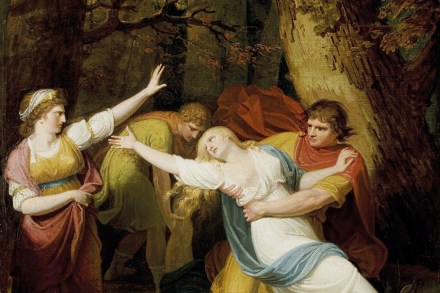
Edward III

Even Shakespeare was a slow starter

Are Shakespeare’s early plays terrible? Rory Loughnane seems to think so, which is perhaps surprising, given that his new book is an account of Shakespeare’s writing life until the age of 30. The playwright starts out in 1588, aged 24, with The Two Gentlemen of Verona, which is mostly remembered for an unpleasant subplot about rape. ‘The treatment of the female characters is dreadful,’ writes Loughnane, while the ending is ‘underdeveloped and therefore somewhat dissatisfying’. Next up, Titus Andronicus, which was popular with audiences but less so with Loughnane, who gives a summary of the demented plot, quotes some long-dead scholars being mean about it (‘I wish I had never read it’), and concludes: ‘The end, phew.
It seemed like the end of days: the eerie wasteland of 14th-century Europe

In the early 1370s, Louis I of Anjou, the second son of the French king, commissioned a vast series of tapestries, now on display at the Château d’Angers, representing the Book of Revelation. In the middle of the narrative is a group of men on horseback wearing distinctively English armour; one wears pheasant feathers in his helmet – another mark of English soldiery. As for the Apocalpyse itself, its horsemen were led by Edward III. Edward’s 50-year reign dominated 14th-century England. But, as we see in Sceptred Isle, Helen Carr’s gripping narrative account of the period, Edward himself was dominated by the dream of taking the French crown. It led him to launch two great invasions, one in 1346 and the other in 1359.