Education

When did English A-level become a science?

From our UK edition

Now that my youngest has got her A-level grades, I’m finally free to say just how much I have loathed the past 20 or so years I have spent helping my children with their English homework. This is a sad admission. After all, I studied English at university and still love reading classic literature and learning poetry by heart. But when I read that the number of 18-year-olds taking English A-level has plummeted to its lowest level since 2001 I wasn’t at all surprised. If I were that age, I’m not sure I’d choose to do English either. The first taste I had of just how grisly English has become was when I helped the Rat with his GCSEs. I don’t think at any stage he was required to complete an actual book.
Letters | 15 August 2019

From our UK edition

God Sir: In his defence of Christianity (‘Losing our religion’, 10 August), Greg Sheridan writes as if Christianity and religion are interchangeable terms. His claim that the vast majority of people who have ever lived have believed in God may be true, but most of them were or are not Christians. And when he mentions that Christianity is the most persecuted religion, he fails to observe that much of this persecution is from adherents of other religions. As a non-believer, I look at the harm done by followers of different religions fighting each other — and at the years of sexual and emotional abuse of children by religious orders. I cannot feel that all this is outweighed by the few virtues claimed by Mr Sheridan.

Do unconditional offers really help A-level students?

From our UK edition

I know what it is like to receive an unconditional offer for university. In 1984, when I took the Cambridge entrance exam, if you passed, you then only had to meet the matriculation requirements of the university, which were two Es at A-level. For someone predicted straight As (virtually all Oxbridge candidates), that wasn’t asking a lot. It was hard not to slacken off a little, to take a mental gap year, or six months at any rate, for the last two terms of the sixth form. I slipped to a B in further maths, which seemed an embarrassment at the time, though I know others who took a bigger plunge. What with a real gap year, too, I never really did get back into numbers.

A-levels vs BTECs is the story of British politics

From our UK edition

Exam question: what percentage of 17 and 18-year-olds sit A-levels? The answer – I’ll come to it in a bit – might just be the most important fact in British politics that most people in British politics don’t know. I ask because this is A-level results week, the annual festival of photogenic teenagers jumping joyously to mark their results and annoying celebrities sharing think-positive truisms about failing your exams not being the end of the world. It’s all lovely and familiar and predictable and utterly missing the big picture.

Girl’s gone to Magaluf and it’s hard not to worry

From our UK edition

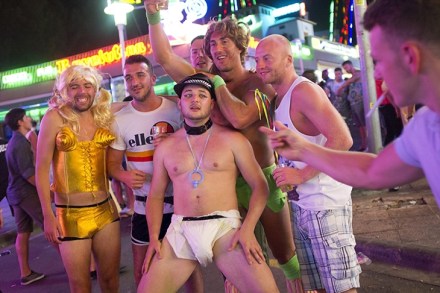
At the Leavers’ Ball held to mark our daughter’s last day at boarding school, there were only two topics of conversation among the anxious parents. How early could we decently slope off without being rebuked by our girls? And the dreaded Leavers’ trip to Magaluf. Magaluf — Shagaluf as the kids all call it — is the post-A-levels destination of choice for what seems like every school leaver in the country. If you’ve seen The Inbetweeners Movie you’ll know what it’s like: charmless, garish avenues of overpriced bars and clubs with pushy greeters, expensive party cruises, grotesque drunkenness, epic hangovers, sunburn, STDs and gallons of vomit. Quite how much Shagaluf lives up to its nickname I don’t know and I don’t want to know.

The fanatical thinking that’s on its way to Britain

From our UK edition

For anyone who isn’t following the long march of racial self-flagellation through America’s institutions, last week’s revelations about the excesses of New York City’s education tsar will come as a shock. Schools chancellor Richard Carranza has introduced mandatory ‘anti-bias and equity training’ for the city’s 75,000 teachers at a cost of $23 million a year. During these ‘workshops’ the teachers are told that ‘worship of the written word’, ‘individualism’ and ‘objectivity’ are all hallmarks of ‘white supremacy culture’ and that it is better to focus on middle class black students than poor white ones.

False history from Naomi Wolf and Marc Lamont Hill

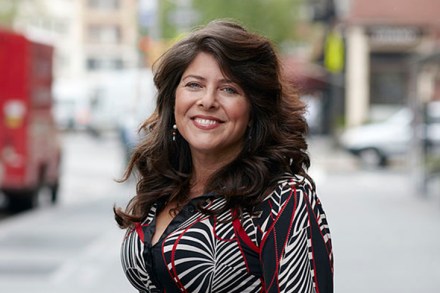
Did the Victorians execute dozens of men for sodomy? Yes, according to Naomi Wolf, who has a PhD from Oxford and a vivid imagination. Are Mizrachi Jews an ‘identity category’ of ‘Palestinians’? Yes, according to Marc Lamont Hill, possessor of an intellect so powerful that he professes at Temple University in two specious fields, Media Studies and Urban Education. The correct answers are no, and no, so see me after class. Last night, old people across Britain choked on their cocoa as Wolf plugged her book Outrages on BBC Radio. Wolf, having visited the archives of the Old Bailey, London’s chief court, claims to have discovered ‘several dozen executions’ of gay men in Victorian Britain, and has written a book about how awful the Victorians were.

naomi wolf

Out in the cold

From our UK edition

Children have a right to an education. This has been written into English law since the Forster Education Act of 1870, which began the process of making education compulsory for children aged between five and 13, and no one in their right mind would oppose that statement. So when the number of permanent exclusions from schools is on the rise, the reasons behind this should be examined carefully. A child excluded from school is not accessing education, and therefore their rights have been violated. But is it really that simple? A breakdown of the groups most often excluded does not bring up many surprises. In nearly half the cases, exclusions are for persistent disruption. Sex and drugs, bullying and racism come much further down the line.

A nervous traveller

From our UK edition

My 1982 photo album is full of pictures of a well-travelled, privileged 11-year-old boy. I was at North Bridge House prep school, a cream stucco Nash villa on the north-eastern corner of Regent’s Park, north London. That photo album shows me, unsmiling, in a ski-pass picture on a family holiday in the Tyrol in January. In April, I went on a school trip to Normandy: there’s a picture of me sitting on the turret of an Allied tank overlooking the D-Day beaches. But the holiday that really sticks in my mind from that year was a school trip to Amsterdam in October.

A class of their own

From our UK edition

I never meant to conduct a social experiment. I never intended to undermine anyone’s confidence in their judgement. And I certainly never meant to arouse so much hostility. Yet by choosing to home-school my six-year-old this is precisely what I seemed to be doing. Like many other desperate parents, I hadn’t got our first choice of primary state school (this year, just 68 per cent of parents in our Local Education Authority, Kensington and Chelsea, did). In fact, the only place for Izzy was at a primary across the river, which would take over an hour of travelling to get to. So I decided to teach Izzy at home. To be more precise, I decided that my mother, then 72, would teach her.

Opting for God

From our UK edition

‘It’s the same old story — pay or pray,’ said my oldest friend, sardonically, when I told him I was sending my children to a Church of England school. I could hardly blame him for being cynical. He’d known me since we were teenagers, when we were both devout and pious atheists. Yet now I was educating my kids for free, while he was forking out a small fortune to go private. No wonder he felt a bit put out. Since I started going to church again, our friendship has not been quite the same. For cash-strapped parents, the C of E system is a have-your-cake-and-eat-it solution to an age-old dilemma. Can’t afford school fees? Don’t fancy the look of your local state school?

School report | 14 March 2019

From our UK edition

Should we scrap GCSEs? A senior MP has suggested getting rid of GCSEs and reshaping A-levels altogether; but not everyone agrees. Robert Halfon, chairman of the Education Select Committee, wants to rewrite the exam system so that A-levels include a mixture of vocational, academic and arts subjects, arguing that ‘all the concentration should be on the final exam before you leave’. ‘All young people should have access to the technical and creative subjects that will give them the skills that employers are looking for,’ says Halfon. ‘We must move from knowledge-rich to knowledge-engaged.

Editor’s Letter | 14 March 2019

From our UK edition

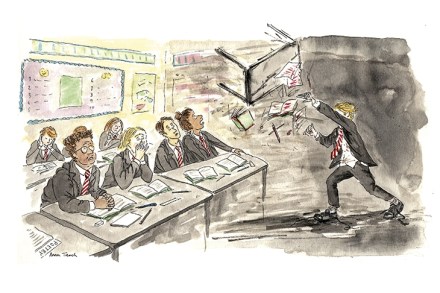
What should we do with difficult students? The ones who distract everyone else in the class, and don’t care how they are punished? Some schools exclude struggling pupils because they are worried that their exams performance might drag down the class’s grades. But children have a right to an education, says Sophia Waugh, so we need to find a solution. Former teacher Hannah Glickstein agrees, but argues that new Ofsted rules have been put in place by bureaucrats with no experience of teaching. It might not be the sexiest of subjects, but it’s certainly an important one. Talking of exams, Ross Clark takes a look at the rise in unconditional offers to university. As someone who was offered one himself, he thinks that they are a terrible idea.

Save your children – take them out of school

From our UK edition

A good decade or so ago I wrote a fairly vituperative article in response to a piece by the writer James Bartholomew in this magazine, who had announced that he intended to home-school his daughter Alex, aged nine. James had explained in great detail how he would inculcate his charge in the liberal arts: ‘I don’t want to give the impression that I will be a Gradgrind. We will have some fun, too. Alex loves to paint. We will go to the major Cézanne exhibition in Aix and see his paintings of Mont Sainte-Victoire. Then we will see the mountain itself from the same viewpoint that he used. I hope we will settle down to paint it ourselves — perhaps copying Cézanne’s technique.’ Ever the class warrior, I was annoyed by this paragraph in particular.

Just how bad are Donald Trump’s grades?

Donald Trump really likes to brag about his brains. To listen to him, he has kind of a supercomputer whirring away there beneath the plume of iridescent hair. He can do anything better than anyone else, whether it’s spending a few hours learning about nuclear strategy or winning trade wars. Besides, his uncle taught at MIT, which means that the Trump gene pool couldn’t be more robust: ‘My two greatest assets have been mental stability and being, like, really smart.’ For good measure, Trump noted that his ability to win the presidency on his first attempt ‘would qualify as not smart, but genius... and a very stable genius at that!’ Well, well, well. Now it turns out that Trump went to great lengths to suppress his high school transcripts.

donald trump grades

The problem with measuring progress

From our UK edition

The Department for Education (DfE) published its finalised data on the 2018 GCSE results last week, revealing that, for the second year running, white pupils are doing worse in English secondary schools than any other ethnic group. According to the new Progress 8 measure, which assigns a score to GCSE entrants based on how much progress they’ve made between the ages of 11 and 16 relative to children of similar abilities, Chinese pupils do the best, with a score of 1.08, Asians are second (0.45), then blacks (0.12), mixed race (-0.02) and, bringing up the rear, whites (-0.10). What that score means is that on average white children are behind by a tenth of a grade in each of their best eight GCSEs compared to all English schoolchildren with the same grades at the age of 11.

The man who would be king

From our UK edition

Last year on Who Do You Think You Are?, Danny Dyer — EastEnders actor and very possibly Britain’s most cockney man — discovered that he was a direct descendant of Edward III. Luckily, nobody had the heart to tell him that for somebody of English stock the chances of not being are estimated at 0.0000000000000000000000000001 per cent, and Dyer reacted with a memorable mix of excitement, delight and overwhelming pride. Now, in the two-part Danny Dyer’s Right Royal Family, both he and BBC1 are milking his regal lineage for all it’s worth in what might well be the oddest TV show of recent times.

The sideways thinking of Silicon Valley

It was the tweet posted by the New York Times that caught my eye: ‘Silicon Valley is backing a novel idea: instead of charging students tuition, students go to school for free and are required to pay back a percentage of their income after graduation, but only if they get a job with a good salary.’ It is all happening at the Lambda School, a new online learning start-up that this week won millions of dollars in backing from a glittering line up of venture capitalists – including Google Ventures, Ashton Kutcher, the actor turned Shark Tanker, and Geoff Lewis, an acolyte of Peter Thiel, the co-founder of PayPal.

lambda school silicon valley

Beyond Brexit | 13 December 2018

From our UK edition

None of us can predict the potential fallout from Brexit, good and bad. What began as a vote of confidence in our institutions has shown them to be dangerously fallible. A country where people usually rub along together is now marked by a cultural and emotional rift. If Brexit does continue to dominate our politics for years, will it mean a reform of our institutions, or a battening down of the hatches by a beleaguered elite? Will the House of Lords, having alienated its natural defenders, at last be seriously reformed? Shall we try to restrain the dangerously capricious powers of prime ministers? Shall we empower local government? Both Brexiteers and Remainers will be in a rather militant mood.