Ed miliband

What is David Cameron’s big idea?

[audioplayer src=”http://traffic.libsyn.com/spectator/TheViewFrom22_8_May_2014_v4.mp3″ title=”James Forsyth and Isabel Hardman look forward to the general election next year” startat=766] Listen [/audioplayer]In almost a decade as Conservative leader, David Cameron has tended to avoid talking about his political philosophy. He has presented himself as a pragmatist, suspicious of anything ending in ‘-ism’ — and the very opposite of a swivel-eyed ideologue. There is something to be said for this, but it raises the great question: what is a Conservative government for? There was no clear answer at the last election and so no clear result from that election. Voters had turned away from Labour, but were not quite sure how their lives would be

Ed Miliband needs to be smarter than this

Mr S would like to share this video with readers. It is the latest campaign ad from the Labour Party. As spoofs go, it’s leaden: puerile personal attacks mixed with divisive class war. It says nothing positive about Labour; it’s aimed squarely at people who would vote Labour in any circumstances. All in all, it’s not very clever, which is strange because Ed Miliband has spent much of the week professing that he has ‘more intellectual self-confidence’ than David Cameron. Labour staffers are certainly a little nonplussed. One party dogsbody lamented to Mr S: ‘How have we got from “I’m cleverer to that video in just 24 hours? It doesn’t

Pfizer’s already beaten Ed Miliband. Now it just needs to offer the right price

Pfizer will almost certainly have to offer more than its second bid of £50 a share for rival drug giant AstraZeneca, but the American predator seems to be winning the game of spin so far. For a start, Pfizer chief Ian Read turns out to be a Scottish-born graduate of Imperial College London who has spent his entire career with the company. AstraZeneca, by contrast, is run by a Frenchman, Pascal Soriot, under a Swedish chairman, Leif Johansson, both parachuted in two years ago — reminders that AstraZeneca is already a multinational with its research facilities divided between Cheshire and Sweden and less than 15 per cent of its workforce

The 2015 conundrum

One of the striking things about the next election is how what is going on at the macro level looks so different from what is happening at a micro level. On the macro front, things seem to be moving the Tories’ way. The economy is growing at a good clip and that is set to continue until polling day and David Cameron has a considerable advantage on the question of who would make the best Prime Minister. But to return to the micro, it is easier to see seats where Labour might gain from the Tories rather than the other way round. Ask even the most optimistic Tories what constituencies

Complacent Cameron slips on Miliband’s bananas

Easy triumphs soften victors. Cameron demonstrated this truism today as he took two unexpected blows from Ed Miliband at PMQs. The Labour leader led on his new policy of rent controls. Cameron, rather weakly, seemed amenable to the reform but offered no concrete proposals of his own. Miliband struck. ‘That was a pretty quick U-turn, even for him.’ Miliband then asked about the preparations to surrender AstraZeneca, trussed and bound, to Pfizer – with all the attendant risks to jobs and investment. Cameron flushed as red as a rhubarb crumble and accused Miliband of ‘playing politics’ while the government was ‘getting stuck in’ and defending the national interest. What irked

PMQs: Miliband and Cameron attack on each other’s weaknesses, not the issues

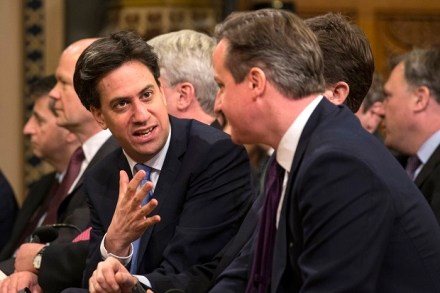
Both Ed Miliband and David Cameron turned up to PMQs today wanting to expose the flaws in their opponent’s character. First, Ed Miliband taunted the Prime Minister about Labour’s new private rented sector policy. Now that Labour is producing policies which seem to have purchase with voters, the Labour leader has what some might describe as the ‘intellectual self-confidence’ to kick off PMQs not just with a Labour policy rather than a government cock-up, but also predict that the government will eventually concede that Labour has a point. He said: ‘On our proposal for three-year tenancies in the private sector, can the Prime Minister tell us when he expects to

Ukip aren’t just David Cameron and the Tories’ problem anymore

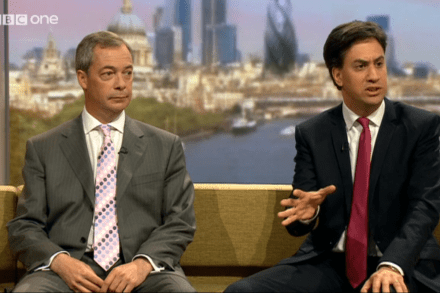
How the Tory party will react if, as excepted, Ukip pushes the party into third place in the European elections is one of the most discussed topics in UK politics. But overlooked in all this is how Labour will react if Farage’s party beats them on May 22nd. If Ukip come top in the European Elections, as the polls indicate they have a very good chance of doing, Labour will be thrown into a panic. No opposition has ever triumphed at a general election having not won the previous European Elections. A failure in the European Elections would be a big blow to the idea that Ed Miliband is going

Health diktats, rail renationalisation – Labour’s leftwards lurch continues

The evolution of Ed Miliband’s Labour Party continues today with a letter in the Observer from candidates demanding that the party renationalizes the railways to lower the fares. It would be popular in commuter towns, they say – no wonder, as this would pass the costs from commuters to the general taxpayer. When challenged about it on this morning’s Andrew Marr show, Miliband didn’t rule it out. ‘We’re looking at all the options,’ he said. His only concession was that he is ‘not going back to old-style British Rail,’ – he plans a new form of state intervention. Miliband then went on to accuse Cameron of being a ‘cheerleader’ for

Rents are falling, in real terms. So why does Ed Miliband want state intervention?

In recent weeks, I have found myself defending Ed Miliband as much as attacking him. I do believe that his election would be a calamity for Britain, but that doesn’t mean I think he is an idiot pursuing a stupid strategy. On the contrary, I think what he is doing is bold, coherent, radical and chimes with the emerging populist mood. I also think that it is working – as things stand, he is on course to become the next Prime Minister. I look at this in my Telegraph column today. The rent control policy announced yesterday embodies this bold populism. Britain has a problem with buying houses – one

Ed Miliband’s price control pattern

Ed Miliband has got the reaction he wanted to his speech on the private rented sector, which he used today to launch Labour’s local election campaign. Landlords and nasty right-wingers hate this latest stage in his ‘cost-of-living contract’. The Residential Landlords Association said rent controls ‘would critically undermine investment in new homes to rent and are not needed’ and the National Landlords Association said ‘the proposal for a three-year default tenancy is unnecessary, poorly thought-through and likely to be completely unworkable’. On Coffee House, Policy Exchange’s Chris Walker says ‘rent controls are at best misguided and at worst could be counterproductive, longer-term’. Grant Shapps suggested that these were ‘Venezuelan-style rent controls’. Which

Ed Miliband slapped in the face by bouncy Dave

As the economy bounces back it keeps smacking Ed Miliband in the face. At PMQs today he tried to pose as the people’s champion fighting fat-cat capitalism. He started with Royal Mail, which is now worth a billion more than when it was floated. In hindsight, any privatisation can look like a Westminster mega-blunder or a Square Mile stitch-up. Miliband took the latter view. Referring to the clique of 16 ‘golden ticket’ investors, he asked why these lucky speculators had been allowed to flip their shares for an instant profit while the hard-working posties had been ordered to retain theirs for three years. Cameron spotted the trick. Posties got free

David Cameron is linking Ed Miliband to Labour’s past mistakes

What a very long PMQs today, presided over by a very bumptious John Bercow. The Speaker let the exchanges run into what he called ‘injury time’, made a rather poisonous jibe at Labour MP Fiona Mactaggart over her private schooling, and told the Prime Minister that as far as he was concerned, he had finished an answer when the PM didn’t believe he had. listen to ‘Cameron defies Bercow’ on Audioboo

If Ed Miliband is the Union’s saviour then the Union is doomed

With apologies to John Rentoul, Can Ed Miliband save the Union? is a question to which the answer is God help us all. I admit to a blind spot vis a vis the Labour leader: Looks like Gussie Fink-Nottle, thinks like a Marxist Madeline Bassett. Clever enough in a droopy kind of way but, ultimately, a gawd-help-us kind of fellow. I wasn’t very impressed last time Mr Miliband came to Scotland and so I wasn’t inclined to be impressed by his most recent trip to Glasgow. Which is dandy because I wasn’t. I dare say Miliband’s belief that Scottish independence would be a bad idea – for Scotland and the rest of

Can Ed Miliband save the Union?

When Ed Miliband goes to Scotland and declares that ‘It is Labour that’s got to win this referendum’ it is a statement of political reality as much as it is braggadocio. The Tories have only one MP north of the border and the Liberal Democrats are the fourth party in the Scottish parliament. If this vote is to be won, Labour—as by far the largest Unionist party—will have to get the No camp over the line. Ed Miliband’s decision to take the entire shadow Cabinet to Glasgow last week was meant to show that UK Labour is now engaging fully in this battle. Miliband himself thinks that he has come

How Nick Clegg missed his chance with Nigel Farage

At the start of the year, some of the air seemed to have gone out of the Ukip balloon. The party’s warnings about the scale of Romanian and Bulgarian immigration to Britain hadn’t been borne out by events. But the debates with Nick Clegg enabled Nigel Farage to get his momentum back. In those debates, Clegg was too passive in the first one and then over-compensated in the second with the result that he ended up losing both of them. Clegg’s decision to not engage with Farage in the first debate meant that he missed his best chance to get under the Ukip leader’s skin. Strikingly, Farage admits to Decca

Labour’s unimpressive ‘zero hours’ announcement

Labour’s announcement on zero hours contracts today as the Shadow Cabinet visits Scotland is supposed to be a demonstration of how much better the UK can be by staying together. Ed Miliband’s reasoning is that a border between Scotland and rUK would mean a ‘race to the bottom’ between the two countries, who would come under pressure from ‘powerful interests’ to ‘worsen wages and conditions for everyone else’. It’s part of Labour’s ‘positive case’ for the union which the party wants to make today, and the reasoning does, if you’re a Labour type, make sense. The only spanner in the works is the policy that he’s announcing, which will hardly

Who tells Ed Miliband when he’s made a mistake?

Dan Hodges’ piece in this week’s Spectator on the team around Ed Miliband is a must-read (and we’ve posted an even longer version online here). As he runs through those working with the Labour leader, a clear pattern emerges. There doesn’t seem to be a Lynton Crosby equivalent working with Miliband. One of the many things that make Crosby so important to the Conservative party is his ability to swear at them and tell them they’re doing something wrong. Miliband doesn’t have a Crosby-esque character in that respect. Instead, all those around him seem keen to either demonstrate that they are the most loyal, in a Uriah Heep-esque display of

Podcast: Ed Miliband’s radical Old Labour agenda and Clinton vs Bush round two

Where has Ed Miliband found the policies to form the basis of his potential government? On this week’s View from 22 podcast, The Telegraph’s Dan Hodges and Marcus Roberts from the Fabian Society debate the current state of Milibandism and whether the Labour leader is successfully crafting an intellectually coherent set of policies for government. Will Miliband limp over the finish line into No.10 with a strategy to win 35 per cent of the vote, or go for a broader One Nation approach? And does he still have any chance of becoming Prime Minister? Harpers’ Magazine John Rick MacArthur also joins to discuss Clinton vs Bush, again, with Freddy Gray.

Old Labour, New Danger

[audioplayer src=”http://traffic.libsyn.com/spectator/TheViewFrom22_24_April_2014_v4.mp3″ title=”Dan Hodges and Marcus Roberts debate the state of Milibandism” startat=47] Listen [/audioplayer]A cruel new joke is doing the rounds about Ed Miliband: that the Labour leader is like a plastic bag stuck in a tree. No one is sure how he got up there, but no one can be bothered to take him down. It’s one of many unfair gags, made on the premise that he is a laughing stock and, ergo, doomed in next year’s general election. Many a Tory comforts himself with the idea that Miliband is just too implausible, too weak, too trivial a figure to make it to 10 Downing Street. Yet anyone

Can Labour really resist class war?

There’s something quite amusing about a party that majored on the number of Etonians in the Cabinet as the substantive part of its response to the Budget briefing the Independent that it won’t stoop to ‘class war’ in its 2015 election campaign. Labour, apparently, will occupy the moral high ground next year, which suggests the party will have to change its messaging quite significantly from this: ‘What do this lot now call themselves? They call themselves the workers’ party. Who is writing the manifesto for this workers’ party? We have a helpful answer from one Conservative MP: “There are six people writing the manifesto…five…went to Eton”. ‘By my count, more