Ed miliband

Why the Greek election could decide Britain’s next government

Before the eurozone crisis, Greek elections didn’t receive much attention in Westminster. At the moment, however, the polls from Athens are being studied by every politico from the Prime Minister down. How Greece votes on the 25 January could determine the result of our election. If anti-austerity Syriza triumphs, the eurozone crisis will move from a chronic phase into another acute one. For the second election in a row, the backdrop to a British poll and possible coalition negotiation would be talk of debt defaults and bank runs, as Athens struggles with the eurozone straitjacket. Syriza does not want Greece to leave the euro. But it does want the ‘fiscal

Did Richard Curtis script today’s showdown between Osborne and Balls?

Even though they ended up walking through the lobbies together (though not hand in hand, skipping, sadly), Ed Balls and George Osborne still managed to have the sort of Commons showdown that would fit right in to the script of Bridget Jones. On and on their furious fighting went, over whether the long-term economic plan was working, over whether Labour had a long-term economic plan, over whether Britain would get its AAA credit rating back, over whether Balls would borrow more and whether Osborne was cutting the deficit slower than he’d intended. On and on and on. Both looked as though they were enjoying tearing chunks out of one another

Ed Miliband’s dinner date with Amal Clooney

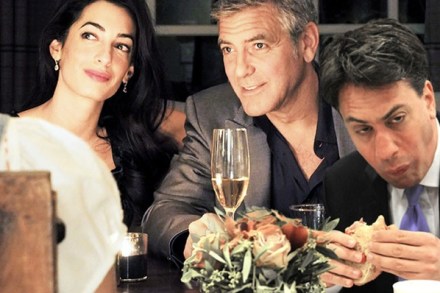
Ed Miliband’s popularity may be at an all time low, but the leader of the Labour party is at least now moving in A-list circles. The Telegraph reports that Miliband recently enjoyed a supper at the mansion of Geoffrey Robertson QC, the human rights barrister, which both George and Amal Clooney attended. Mrs Clooney is a barrister at Doughty Street, Robertson’s chambers. While the quality of Miliband’s general dinner party chat remains unknown, he is thought to have discussed with the Hollywood couple proposals for ‘fresh sanctions on Vladimir Putin’s regime’ following the case of Sergei Maginitsky,  the Russian whistleblower who died after months of beatings in prison. And while the menu

Islam had nothing to do with this (and other fibs you’re likely to hear)

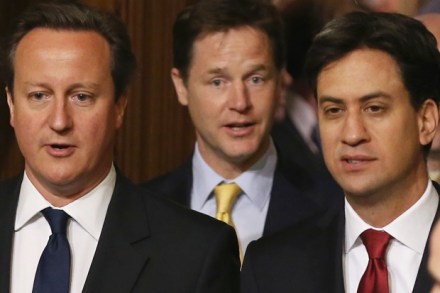
I don’t always agree with Peter Hitchens but this is by far the best piece I’ve seen on the political reaction to the Paris attacks. As far as Cameron, Miliband and Clegg are concerned, we must all sign up to these shibboleths: The attack was nothing to do with Islam. Almost all Muslims, here and abroad, found those attacks repugnant. The attacks were perpetrated and supported by a minuscule number of people who can simply be defined as ‘terrorists’. Immigration and multiculturalism were in no way contributory causes of either the Paris attack or the attacks which we might experience in the future or have suffered in the past. All

Revealed: the truth about Ed Miliband’s ‘1930s’ porkie

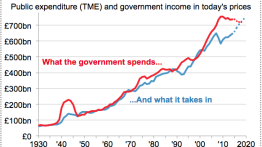
Today, on the Andrew Marr show, Ed Miliband repeated his porkie that David Cameron plans to reduce state spending to 1930s levels. When he first made this bizarre and obviously untrue claim, even your baristas here at Coffee House didn’t have 1930s spending data to hand. Now we do, so the extent of his deceit can be laid bare. The above graph (which you can explore by moving your cursor over the lines) shows total UK government spending, adjusted to today’s money. At £720 billion, the level of state spending in 2020 under George Osborne’s plans will be almost ten times higher the levels of the 1930s. Now that the Tories have agreed to drop their claim

Why Cameron doesn’t want any TV debates

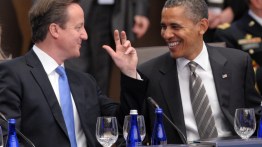
Before Christmas, David Cameron tightened up the rules about ministers going overseas. He wanted them in this country campaigning as much as possible. But, unsurprisingly, his visit to President Obama in Washington this week hasn’t fallen foul of his edict. This trip to Washington is the source of much satisfaction at the heart of government. There are some serious issues on the agenda—the world economy and cybersecurity—but as one of those involved in preparing for it admits, ‘‘There’ll be some crunchy stuff, but it’ll be a very nice photo op, too!’. Indeed, Cameron standing next to Obama at the White House will be a useful way of reminding voters of

The Tories need to ‘weaponise’ Ed Miliband’s incompetence

Ed Miliband was on Andrew Marr’s sofa this morning, drawing 2015 battle lines. It all looked very encouraging – if you are a conservative, that is. Miliband started discussing the Paris attacks, saying he wants to give the security services what is necessary — but as MI5’s director-general said on Thursday evening, that means more than money. It means the powers to put a wire on the bad guys, intercept emails and do so quickly. Does Miliband agree that these capabilities are also needed? On the deficit, he tried to play the fiscal hawk… “Most Labour leaders go into elections saying we’re going to raise spending. “I’ve got great news”,

Five reasons why winning in May won’t be that much better than losing

Defeat in May would be dire for either Cameron or Miliband. It would end their political career in ignominious failure. But winning would not be much better: they would be the weakest PM in living memory. Here’s why it won’t be easy for either of them: Miliband would be a prisoner of his own MPs: The best that both Labour and the Tories can hope for is the narrowest of outright victories. The 21 seat majority that John Major ground out in 1992 is, probably, beyond either of them. Miliband would then find himself having to steer swingeing cuts past a party that is simply not prepared for them. It

Podcast: the 2015 campaign begins, Charlie Hebdo and Britain’s A&E crisis

Will the next Parliament be impossible to handle? On this week’s View from 22 podcast, James Forsyth and Compass’ Neal Lawson discuss the latest Spectator cover feature on the challenges facing Ed Miliband or David Cameron if either manage to secure a majority on 7 May 2015. Will the Labour left or Tory right prove too troublesome for the respective leaders? Should Miliband or Cameron be the most worried? And are we on the brink of major electoral reform? Hugo Rifkind and Isabel Hardman also discuss the A&E crisis facing Britain and the problems of the NHS being used a political football. Who is to blame for the current crisis and will the government

Why no one will win on 7 May 2015

On 19 June 1815, after the battle of Waterloo, the Duke of Wellington declared that ‘nothing except a battle lost can be half so melancholy as a battle won’. Two hundred years later, David Cameron or Ed Miliband might feel the same way as they sit in Downing Street. Any elation over victory will be quickly overshadowed by the thought of troubles to come — in all likelihood insurmountable troubles for either man. Everyone has known for years when this election will take place, with the result that the campaign starting gun has been fired even earlier than usual. Cameron is busy prophesying economic chaos if Labour wins; Miliband is

Will Merkel throw her diplomatic weight behind Cameron’s renegotiation strategy?

Before today’s awful events in Paris, the meeting between David Cameron and Angela Merkel was going to be the big news of the day. The German Chancellor does not always observe the usual rules of neutrality when it comes to foreign elections. In 2012, she endorsed Nicolas Sarkozy in a joint TV interview, declaring that it was ‘natural’ to back a fellow Conservative. Now, there was no indication that Merkel was going to offer Cameron similar backing today. But senior Tories were keen to talk up what they were calling ‘das snub’, the fact that Merkel is not meeting with Miliband. (It is also worth remembering that in 2012, Miliband

PMQs sketch: In which today’s big loser is the NHS

Everyone predicted a sombre PMQs. It was anything but. A mood of opportunistic and lacerating silliness dominated today’s exchanges. The NHS – poor thing – was fought over like a bunny rabbit caught by two packs of ravening hounds. Miliband’s aim was to take the word ‘crisis’ and gum it to the health service with Superglue. He accused Cameron of destroying walk-in centres, wrecking social care and wasting billions on reorganisation. In reply Cameron airily waved five billion brand new pounds to be spent on social care which he says Labour opposes. Then he blundered by asking Miliband to suggest a solution to the problem. This not only validated Miliband’s

PMQs: Playing Punch and Judy with the NHS

Today’s PMQs was, predictably, about the NHS. But the Punch and Judy nature of the session seemed particularly small in the light of events in Paris. After expressions of solidarity with the French, normal business was resumed. Ed Miliband was enjoying himself, confident that he was on his party’s chosen turf. He piled into Cameron accusing him of blaming patients for the crisis and demanding that he apologise to those who have had to wait for more than four hours. Cameron fended him off, but didn’t look particularly comfortable. However, he had a good counter-attack ready, attacking Miliband for allegedly having told the BBC’s Nick Robinson that he wanted to

How will Ed Miliband use the A&E crisis at PMQs?

Towards the end of 2014, David Cameron was finding PMQs ‘boring’. He knew that it was turning into a session where each week both he and Ed Miliband basically said the same thing over and over again, usually with a long string of statistics that the other couldn’t quibble while in the Chamber. He would talk about the importance of a strong economy, while Miliband would talk about the NHS. And then everyone would filter back out of the Chamber having learned nothing. Well, today the Prime Minister will probably find PMQs takes the same ‘boring’ format, but if Miliband crafts something less stunningly dull than a string of statistics

Labour only hurts itself by whinging in public

Ed Miliband’s office has complained that no-one told them about Angela Merkel’s visit to London, which takes place tomorrow. They are apparently very irritated about no-one telling them, even though the Foreign Office isn’t required to flag up visits like this anyway. But worse than that, they were given warning: in the newspapers. Here are the first few paragraphs of a story published by the Times on 27 December, entitled ‘Merkel puts culture and G7 on agenda for visit’: ‘Angela Merkel will make Britain her first overseas visit of the year in a sign of the importance that she attaches to her relationship with David Cameron. ‘The German chancellor, named yesterday as

David Miliband: I might be back

David Miliband has refused to rule out a return to British politics in an interview with Vogue. Ed’s departed brother has not had much of an impact in New York, and is coy about his future: ‘I don’t know, is the answer.’ Intriguingly he also refuses to praise his brother’s performance as Labour leader: ‘I can’t say anything, because anything I say plays into the whole narrative. And I made an absolute commitment to myself not to play into the story … It’s not good for him and it’s not good for me for this to become a story.’ That would be true if David said something negative. Mr S

Will any party really offer an election message of ‘hope, not falsehood’?

Ed Miliband today promised that Labour will offer ‘hope, not falsehood’ in its General Election campaign. It’s a bold pledge given the party is making so much of the claim that the Tories want to reduce public spending to levels not seen since the 1930s – a claim that has foundations made of something oddly similar to sand. Similarly the Tories have today produced an interesting dossier that Miliband’s party has interestingly called ‘dodgy’ because it contains a number of ‘assumptions’. As James explains, that’s part of the plan, as Labour now has to say which cuts it wouldn’t reverse and which it would. But one of the central tricks

Do Cameron and Miliband secretly feel the same way about the EU?

At last, an actual dividing line. Ed has used his first proper speech of the 2015 campaign to declare that his party would never, ever leave the EU: ‘We must demand reform from Europe—a European Union that works better for Britain. But make no mistake: exit from the EU would be a dramatic mistake for our country and our economy. So, whatever the politics, I will not join those who cynically offer exit as a realistic plan for our future or the future of Britain’s working families.’ That should really help Labour shore up their northern heartlands against increasing working-class Euroscepticism and the rise of Ukip. Mr S suspects the Labour leader’s

Nick Clegg: I have a great fanbase

According to a recent YouGov poll, Nick Clegg has an overall rating of minus 54, making him more popular than the hapless Ed Miliband by just one point. While that wouldn’t appear to be much to celebrate, the Deputy Prime Minister seems to actually be in denial about his own standing amongst the British public. In the first ever joint interview he has given with his wife Miriam, Clegg is asked whether his wife’s ‘huge fanbase’ ever causes an issue given that his own reputation has ‘taken a kicking over the past four years’. ‘I also have a great fanbase,’ Clegg replies, looking rather hurt. In the interview, which appears in

Reasons for Ed Miliband to be cheerful (we had to stretch a bit)

Election omens Reasons for Ed Miliband to feel confident in 2015: — Only three parliaments since 1945 have run to their full five-year term. The subsequent general elections, in 1964, 1997 and 2010, all resulted in a change of government. But John Major did hold on in 1992, having gone to the country four years and ten months after the last election. — In four elections since 1945, the three main parties have been led by MPs who represent constituencies in each of the three countries which make Great Britain: 1970, 1979, 1983 and 1987. The Conservatives won them all. This year’s election, assuming no change of party leadership between now and