Economy

The trouble with Cable's posturing

What are we to make of the fact that No.10 gave the thumbs-up to Vince Cable’s bizarre anti-capitalist rhetoric today? “Capitalism takes no prisoners and it kills competition where it can,” he fumed – and you can argue that, technically, he is paraphrasing Adam Smith. But he has been in politics long enough to know what signal his speech sent out (and the reaction it would trigger). Mood music counts for a lot in politics, and in business. And the mood music from this government sounds like a bunch of politicians happy to tax the bejesus out of the high-paid – regarding them as ATM machines to be raided, rather

All so predictable from Cable

If Vince Cable has achieved anything, it’s to enliven a Lib Dem conference that had settled into cosy anonymity after Clegg’s speech on Monday. He has now delivered the address that David blogged about earlier – and all of the firebrand passages trailed in this morning’s papers were present and correct. “Capitalism,” Cable warned, “kills competition where it can.” And he followed that lead to kick the bankers where he could. In between passages extolling the virtues of “pro business, pro market” policy, he set about the “spiv and gamblers” who had triggered the financial crisis. To be honest, though, I find it hard to get too worked up about this. Sure,

Building more for less

There’s no way round this: housing in this country is in a pretty awful state. Waiting lists for the shrinking number of “affordable” or social homes are rising, while fewer people can afford to buy their own home. That would be the case even if the banks were able to lend – which they can’t because of the credit crunch.   Fewer than 100,000 new homes are currently being built per year, when 200,000 – 300,000 are needed.  The number of new mortgages being arranged is at its lowest level since 1975, while housing waiting lists have risen from 1 million in 2000 to 1.75 million today. The number of

Cable: interim immigration cap is "very damaging to the UK economy"

After stumbling in his crusade for a graduate contribution, Vince Cable seemed to go a bit quiet. But this morning he’s roared back into the newspapers with another attack on coalition policy. The target of his anger is, once again, the immigration cap – but he’s being far less equivocal about it this time around. The way in which the cap is being implemented this year, he tells the FT, is “very damaging to the UK economy.” To force the point home, he says he has a  “file full” of companies who are suffering because of it. And, for good measure, the word “damaging” gets deployed once or twice more.

Barber, Blanchflower and the fake debate on double dip

Watch or read much of the economics coverage in Britain and you sometimes get the sense that we’re entering the final round of a peculiar game. Let’s call it ‘Russian Roulette for Economists’. The rules are simple: teams of academics and economically-literate politicos line up on either side of an issue and hurl abuse at one another. The winner will be declared when something significant changes in the macro-economic position of the UK. The game was played when Britain entered the ERM (those who said it would be a disaster won). The current double dip debate is another example. This time, the principal players on one side are the former

Finessing the coalition’s EU referendum lock

The Coalition Government’s proposal for a ‘referendum lock’ on future transfers of powers to the EU has already been branded “worthless” by some Tory backbenchers . It’s easy to share their frustration at the Coalition’s lack of interest in EU reform so far. After all, the Government has chosen to opt in to the European Investigation Order; signed up for new EU financial supervisors; and chosen not to challenge the UK’s participation in the eurozone bailout (making British taxpayers potentially liable for up to £8 billion in loans to eurozone governments). However, the referendum lock is still significant. New crises, situations and politicians’ egos will always drive the need for

A worrying – but not disastrous – poll for the government

This morning’s Times/Populus poll (£) will have supporters of the coalition grimacing into their cornflakes. The headline finding is bad enough, if rather familiar, with Labour closing the gap between themselves and the Tories to only two points. But what follows is worse. According to the poll, around three-quarters of voters reject the government’s deficit reduction strategy – preferring, instead, what are loosely the approaches advocated by Labour and the unions. And, what’s more, economic pessmism is arrowing upwards. The number of respondents who think “the country as a whole will fare badly,” has risen by 13 percentage points since June. The number who think “me and my family will

A banking split

Blame Bob Diamond. Until the “unacceptable face of banking” (© the utterly acceptable face of politics, Peter Mandelson) was appointed chief executive of Barclays, the issue of banking reform was trundling along noiselessly in the background. But now it has spilled, violently, back out into the open. Critics of Diamond say that his very presence makes the case for splitting the retail and investmet divisions of banks – you can’t, they say, have someone who made their money via “casino banking” presiding over a high street banking chain. But the banks are warning that any such split would force them, and their tax dollars, abroad.   The government’s official position is

Gillard's fractious premiership

‘The definition of an Independent Member of Parliament, viz., one that could not be depended upon.’ – Former British prime minister, the Earl of Derby to Queen Victoria. In the August 21 federal election down under, the Labor government of Prime Minister Julia Gillard copped a stunning rebuke from the Australian people. Consider this: Tony Abbott’s centre-right Liberal-National Coalition won nearly half a million more votes than the Australian Labor Party. It secured more seats than the ALP (73 to 72 in the 150-seat House of Representatives). And the Labor administration became the first first-term government since 1931 to lose a parliamentary majority. So how does Labor claim a mandate

Stephen Green's double-dip warnings

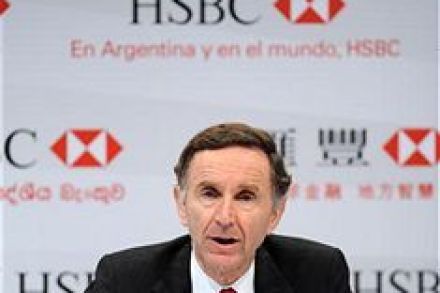
The Big Tent just got a little bit bigger with the appointment of Stephen Green as trade minister. As most of the papers point out, landing the HSBC boss is something of a coup for the coalition. David Cameron was struggling to fill the role, but he’s ended up with someone who is widely credited with steering his bank through the worst of the financial storm. Even HSBC’s purchase of a dodgy sub-prime company in 2003 has done little to tarnish Green’s reputation. Now that he’s in government, though, it’s worth pointing out that he is yet another minister who has warned of a double-dip recession. Here’s how the FT

What you need to know ahead of the Spending Review: the Canadian experience

This is the latest of our posts with Reform looking ahead to the Spending Review. The first six posts were on health, education, the coalition’s first hundred days, welfare, the Civil Service, and the New Zealand experience. Canada In a forward to Reform’s alternative 2010 Budget, Rt Hon Paul Martin, Canadian Finance Minister from 1993 to 2002 and Prime Minister from 2003 to 2006, noted that when a new Liberal government was elected in Canada at the end of November 1993 the deficit and debt-to-GDP ratios were, with the sole exception of Italy, by far the worst of the G7. In 1998, just 4 years later, Canada’s deficit was no

Balls' pitch for the shadow chancellorship

If there’s one observation to make about Ed Balls’s speech this morning it’s that it’s punchy stuff. His main point is that the coalition are “growth deniers” – not only do their “austerity and cuts” risk a slide back into recession, but they’re also unnecessary. He explains: Attlee didn’t make his “first priority … to reduce the debts built up during second world war,” and he left us with the welfare state – so why should we cut spending now? Et cetera, et cetera. These are, more or less, all arguments that we’ve heard from Balls before. But this is definitely the most concentrated form they have ever taken. It’s

The double dip predictions

Hark, there seems to be a lot of noise about a double dip recession at the moment – added to, yesterday, by Dr Martin Weale of the Bank of England. So I thought I’d collect some of the more recent, more prominent warnings and predictions for posterity’s sake. Do let me know (either in the comments or on phoskin @ spectator.co.uk) if there are any that are worth adding: Sir Alan Budd, 16 August Sir Alan was asked on BBC Radio 4’s Today programme whether he believed Britain would avoid slipping back into negative growth. “I’m not confident of it,” he said. “Our fan charts show that it is a

Osborne emerges from the shadows

George Osborne has been quiet these past few weeks, tussling with ministers desperate to preserve some of their budget from his spending review. Today though, Osborne will emerge from the Treasury’s recesses to launch a political attack on the ‘deficit denying’ opposition. Come on, Osborne will ask Darling et al, where are these £44bn of cuts you planned?   And answer comes there none, not even an incredible one. Labour’s refusal to countenance a spending review in government means it has very little to offer the spending debate in opposition. There is also a suggestion that ‘investment versus cuts’ dividing line that paralysed the Brown premiership has yet to be resolved: Ed

Clegg must resist temptation

As Pete notes, Nick Clegg is moderating the debate over the spending review in David Cameron’s absence. It’s an unenviable task. IDS and Liam Fox have been the most cussed opponents of George Osborne, but all ministers are fighting for their budgets behind the scenes. This morning, reports suggest that Chris Huhne could break from the ranks of the silent. The Times gives details of ‘intense discussions’ over the future of nuclear clean-up and renewable energy funding, worth more than £2bn of the Energy department’s £3.4bn budget. Obviously, any reductions in environmentally friendly initiatives carry a political cost for the Liberal Democrats. Chris Huhne has already overcome the habit of

What to do with the defeated?

One of the challenges facing the next Labour leader will be what to do with Ed Balls. Balls, as he demonstrated in the last few months, has the right mentality for opposition. Labour will need his appetite for the fight in the coming year. But if a new leader makes Balls’ shadow Chancellor, he’ll have a shadow Chancellor whose position on the deficit is simply not going to seem credible to the public; Balls has already said that he thinks the plan Labour went into the election with for the deficit was too ambitious. The Tories are convinced that if Balls is shadow Chancellor, they’ll have the dividing lines they

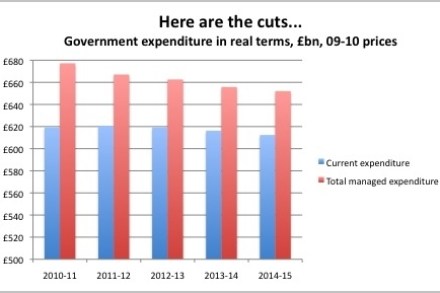
Where are the cuts?

John Redwood has entered the debate with a unique argument: spending isn’t being cut. He points to figures in the Budget which show “current” spending rising from around £600 billion now to around £700 billion in 2015. As Alex says, that suggests an increase of 15 percent over five years – hardly what anyone would describe as a cut. And there’s a similar picture for “total” spending, which will rise from around £670 billion to £737.5 billion.   Yet it’s worth pointing out that Redwood isn’t using inflation-adjusted figures (aka, “real terms” figures). If you do that, then there are cuts to be seen in both current and total spending:

This is no time for salami slicing

You can often achieve a lot more by doing things a bit at a time rather than attempting one bold and sweeping reform. In the 1970s, for example, the trade unions had extraordinary legal privileges; strike votes were done on a show of hands at works meetings (usually late at night when everyone except the Trotskyists had gone to bed); there weren’t even secret ballots for union elections. Edward Heath took the unions head on with his all-embracing Industrial Relations Act. It was a disaster: there were widespread demonstrations and strikes, and one of these confrontations forced him from office. Margaret Thatcher learnt from this and took things much more

To Labour’s successors…

Following this morning’s coalition press conference, the Tories’ have released this video: Labour’s Legacy. It’s effective, especially in view of Labour’s continued refusal to acknowledge that Gordon Brown did to Britain what Peter Ridsdale did to Leeds United, albeit on a grander scale.

The government's transparent approach to worklessness

Sometimes hope lies in the details. Take this morning’s press release from the DWP, for instance. On the surface, it is a response to today’s encouraging employment figures. But what it really is is a new way of approaching the problem of worklessness in this country. And all because of its headline: “Figures reveal five million on out of work benefits as Grayling pledges to make work pay.” This is, as far as I can remember, the first time that the total out-of-work claimant count has reached the summit of an official release. The last government always knew what the figure was, of course, but never drew much attention to