Economy

Clegg adheres to the script on deficit reduction

What a curious speech by Nick Clegg to the CBI last night. Curious, not because it was bad — but because, in straining to give a uniquely "liberal" justification for deficit reduction and the spending cuts, the Deputy Prime Minister actually crafted an address that most Tory ministers should, and would, deliver themselves. Take his "liberal analysis" of the last decade: "On a liberal analysis, the last decade represented the worst of all worlds. On the one hand: unchecked private debt; an unsustainable housing market; an overleveraged banking sector; overreliance on City-based financial services while other regions and sectors suffered neglect.

DSK resigns from IMF

The IMF has issued three press releases on Dominique Strauss-Kahn since his arrest last week, but none more resonant than the latest. It contains this statement from their now former-Managing Director: Ladies and Gentlemen of the Board, It is with infinite sadness that I feel compelled today to present to the Executive Board my resignation from my post of Managing Director of the IMF. I think at this time first of my wife—whom I love more than anything—of my children, of my family, of my friends. I think also of my colleagues at the Fund; together we have accomplished such great things over the last three years and more.

Keeping the States interested

David Cameron has a good relationship with Barack Obama, which will be on display when the US president visits Britain shortly. They speak regularly and frankly and their senior advisers are in near-constant contact. The idea that the Lib Dems would foist a more "Love Actually" policy onto the coalition has come to naught. Yet Britain's influence in Washington has waned. This is no fault of the Prime Minister. In fact, his personal diplomacy has probably slowed-down the process. Instead it has to do with structural changes in the US: the coming to power of a "pacific" President, the importance of US-China ties, the emergence of the Tea Party.

Inflation bites back

  Good job we didn't unravel the bunting after last month's inflation figures. Because today we discover that CPI inflation rose again in April, by 0.5 percentage points, to 4.5 per cent — its highest level since October 2008. That drop in March does look like a blip after all. Even with RPI inflation continuing to fall (by 0.1 percentage points), we seem to have returned to a grim, upwards trajectory. Most forecasters predict that inflation will keep on rising for the rest of this year, outstripping wage growth along the way. The squeeze on living standards continues: We have dwelt on the political problems this creates for Osborne before, so suffice to say that they will not be eased by one-month, one-off falls in the rate of inflation.

Could a Briton run the IMF?

With Dominique Strauss-Kahn, known as DSK, undertaking scientific and forensic tests to determine if he sexually assaulted a hotel maid, the International Monetary Fund will be run by its No. 2 official, John Lipsky. A former banker, Lipsky was appointed “first” deputy managing director in 2006, and was expected to step down later in the year. But the change at the top will bring the former Permanent Secretary of the Department for International Development, Minouche Shafik, into the limelight.

Mixed news from the Eurozone

France and Germany’s better than expected growth numbers are making news today. But the divergence within the Eurozone — Estonia grew at 2.1 percent in the first quarter, Portugal shrank by 0.7 per cent — highlights one of the single currency’s biggest problems: how can one interest rate fit all? Economists expect Germany, whose GDP is now larger than before the financial crisis, to continue to outperform the rest of the Eurozone. Given that Germany and France together make up half of the Eurozone economy, interest rates will have to be set with this in mind. But, on the other hand, the Iberian countries and Greece are struggling with austerity and need a continued monetary stimulus.

Who cares about immigration? (Or education?)

Who cares about immigration? In theory, everyone. It's always mentioned as the policy that exercises voters but is ignored by politicians. (Europe generally comes second in this category.) Let's see what YouGov reports. In one of their tracking polls this week they asked voters to pick the three most important issues. Chart? Fully 66% of Conservative supporters think immigration a vital issue, as do 54% of Londoners and 55% of C2DEs. Other points of interest: only 11% of Tories say Tax is one of the three most important issues, the same percentage as thinks education is in the top three. Europe is mentioned by just 9% of those polled (though by 14% of Tories). Broadly speaking, immigration is less vital and tax more important to voters under 39 than it is to those over 40.

The Royal Wedding around the world

So we’ve seen the ceremony at Westminster Abbey. How was the Royal Wedding celebrated – by expats and locals alike – around the world? In Afghanistan, British troops celebrated with bunting on the front line. In Australia, foods associated with the ‘Mother Country’ flew off supermarket shelves, with the biggest sellers being Maynards wine gums and Colman’s classic mint sauce. Even Aussie republicans appear to have been inspired to hold parties and wear tiaras. In China, a couple recently had a knock-off Royal Wedding, complete with horse-drawn carriage and archway of swords. And cashing in perhaps on the wedding fervour, McDonald’s in Hong Kong started offering wedding party packages.

Why David Blanchflower has it wrong

Gordon Brown may have gone, but advocates of his calamitous policies remain. David Blanchflower, the chief exponent of borrowing more, has a piece in The Guardian today which is worth examining. Written with his trademark chutzpah, it’s a very clear exposition of the Labour argument — along with its flaws. Here are some extracts, and my comments: "In his budget speech last month, Chancellor George Osborne suggested that he was hoping for 'an economy where the growth happens across the country and across all sectors. That is our ambition". Sadly, to judge by Wednesday's GDP figures, growth under this coalition remains just an ambition, a mere illusion." And why would that be? The GDP figures showed growth of 0.

Righting the wrong of sickness benefits

He may no longer be an MP, but the spirit of James Purnell lingers on. It was, after all, the former Work and Pensions Secretary who introduced the Employment Support Allowance as a replacement for Incapacity Benefit in 2008, with the idea of encouraging people – the right people – away from sickness benefits and into the labour market. And now we have one of the strongest indications yet of just how that process is working. According to figures released by the DWP today, 887,300 of the 1,175,700 claimants who applied for ESA between October 2008 and August 2010 failed to qualify for any assistance – with 458,500 of them declared fit for work straight away, and 428,800 not completing their medical assessment. That's 75 per cent overall.

What the GDP figures mean politically

The coalition can breathe a little easier today. The economy returned to growth in the first quarter of this year, avoiding a double-dip recession. It expanded by 0.5 percent which is in the middle of City economists’ forecasts but below the OBR’s prediction of 0.8 percent. Recoveries are generally choppy and particularly so when coming out of a debt-induced recession.  Labour, though, will see these numbers as a further chance to claim that cuts have sucked the confidence out of the economy and that Britain is just bumping along the bottom. This, obviously, isn’t the whole picture. The deficit reduction plan has, crucially, kept the cost of borrowing low and enabled a continuing monetary stimulus.

Economy grows by 0.5 per cent in the first quarter of 2011

So, we're not back in recession, and growth of 0.5 per cent in the first quarter of this year is in line with what many forecasters were predicting, but... It is hardly indomitable stuff. As Duncan Weldon explained in a useful post yesterday – in which he rightly picked me up on a loosely worded post of my own (since, cheekily, edited) – 0.5 per cent merely compensates for the shrinkage experienced thanks to the snow last year. Across the last two quarters, economic growth has effectively plateaued. It's as we were, Q3 2010. The politics of the situation is fissile, even if we are stuck in the murky area of not-recession-but-not-strong-growth. There will undoubtedly be more pressure on the Coalition, from all sides, to ramp up their efforts for growth.

Osborne is on track to rebalance the economy

It may look diminutive in between Easter and the Royal Wedding, but tomorrow is still a big day in the political calendar. It is, after all, the day when we hear the official growth estimate for the first quarter of this year. A negative number, and we shall have experienced two consecutive quarters of shrinkage — which is to say, the country will be back in recession. A positive number, and we shall have avoided that unhappy fate. So what are the forecasters saying? The consensus among bodies such as the NIESR and the CBI is around 0.5 percent, which – as Duncan Weldon explains in a very useful post – is barely enough to compensate for last quarter's snow-induced hit, but is still some sort of growth.

Brown reinforces his presence on the world stage

I'm sorry to do this to you, CoffeeHousers, at the start of a bank holiday weekend — but I thought you might have a morbid sort of interest in Gordon Brown's latest role. Turns out that, as expected, our former PM is to join the World Economic Forum in an advisory capacity. He won't be paid for his work, although the Forum will cover his staffing costs. One of his spokespeople has told ITV's Alex Forrest that his task is to "stop the next financial crisis." Which is to say, he'll be saving the world. Again. If nothing else, it's yet another demonstration of Brown's peculiar resilience. Our former PM may be electoral anathema in these parts, but he clearly still holds some allure for the technocrats of Davos, Geneva and Bretton Woods.

Reasons for optimism in the Middle East | 22 April 2011

As the Libya crisis drags out, and Bashar al-Assad orders a crackdown in Syria, many have begun to doubt whether the changes seen in Tunisia and Egypt will actually spread to the rest of the Middle East. One former British ambassador recently suggested that perhaps the peoples of the Middle East preferred a mixture of authoritarianism and democracy — and that Britain should accept this; not impose its values and views.   But there is plenty of reason for optimism. The first is to look at the countries that have transformed themselves over the course of the last fifty years. Powerhouses like India and Brazil, but also smaller countries such as Vietnam, were mired in poverty, maladministration and the consequences of war.

Standard & Poor’s bombshell

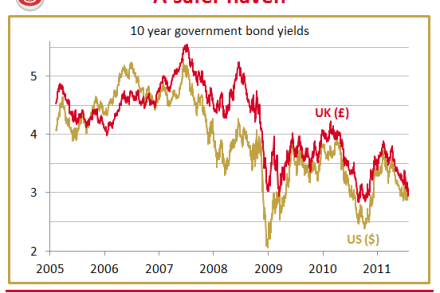
A mute, almost disbelieving response (except on the Markets) has met Standard & Poor’s announcement that the US government’s fiscal profile may become ‘measurably weaker’. The credit rating agency has put a ‘negative outlook’ on the US’s AAA rating; the accompanying report said:    “We believe there is a material risk that U.S. policy makers might not reach an agreement on how to address medium- and long-term budgetary challenges by 2013. If an agreement is not reached and meaningful implementation does not begin by then, this would in our view render the U.S. fiscal profile meaningfully weaker than that of peer ‘AAA’ sovereigns.

Andrew Sentance: interest rates must rise

Inflation - the cost of living - is the number one issue in Britain today. It is under-discussed in the House of Commons as MPs have no say in it: the task of controlling inflation lies with Mervyn King and his nine-strong Monetary Policy Committee, and its members are rarely interviewed. Little wonder, as a lot of them should be feeling fairly sheepish. But not Andrew Sentance. He's been arguing for a rate rise for months, and doesn't have long left to serve on the MPC, so he can speak quite freely. Inflation has been above target almost all the time he's been on the MPC, he says, so in what way can it be described as a blip?

Transatlantic Deficits

I don't know if the Obama administration is as enthused by the idea of deficit reduction as James suggests, not least since the American left has looked at George Osborne's approach and judged it a failure. Kevin Drum, for instance, says Osborne's plans are "not likely to work" and Britain "is probably going to be paying the price for this folly for many years to come". Matt Yglesias agrees, writing that "Austerity's failure in the United Kingdom should inform the American policy debate." This is all occasioned by a gloomy New York Times article with the headline British Deficit Defies Advocates of Austerity.

How the banks were framed

A week that started with the Vickers review on banking has closed without another national explosion of banker-bashing. Thank God. Beating up on the banks has lasted almost three years now, and it’s blinding us to the real causes of the financial crisis. The banks are the perfect alibi: blaming them gets everyone off the hook. How, asks Gordon Brown, was a mere Prime Minister to know that banks were doing such fiendishly complicated things? How, asks George Osborne, was an opposition expected to detect what the government could not? How, asks Mervyn King, was the Bank of England governor supposed to know that these bankers had been so wicked? For all of them, the bankers have been the perfect scapegoat.

Brown to the IMF? Not with CoffeeHousers’ blessings…

What to do when you've already saved the world? Save it all over again, judging by Gordon Brown's latest reported manoeuvrings. Today's Mail claims that our former PM is "clear favourite" to be succeed Dominique Strauss-Kahn as head of the International Monetary Fund. Although, as the paper says, it's likely that the Coalition would operate against any such appointment. To remind the suits what they might be imposing on themselves, I thought I'd return to this post that we put up on Monday. It asked CoffeeHousers what Brown's biggest mistake in government was. And we received more than enough responses to vote on a Top Ten, as below. We'll keep the vote open until 1700 tomorrow, at which point we'll announce the results. In the meantime, just get clicking and commenting.