Economy

A dozen questions for after the Brussels summit

Cameron will be depicted in tomorrow's press as either a Tory Boudicca or an Essex Bulldog (© Tristram Hunt), depending on your point of view. I suspect the truth is somewhere in between. Cameron did not go in swinging a handbag, although it will suit No10 to make out that he did. But Labour's caricature of him storming off and wasting the veto certainly doesn't ring true to me. An EU27 deal was never likely, and EU17 deal always was. Cameron, on their account, just seems to be being blamed for what was going to happen all along. In any case, we are still trying to assemble the pieces of last night's drama, work out the demands and counter-demands, and see what sort of picture they produce. I'm still not sure.

The Merkozy Plan fails to convince

A day or so ago, the markets were rising in anticipation of what might be achieved at this Brussels summit. But this morning they're mostly either unmoved, or — as in the case of borrowing costs in Italy and Spain — shifting in unpropitious directions. No-one, it seems, has been won over by yet another night of political bargaineering in Brussels. And understandably so. None of the measures mooted this morning are particularly concrete; all have a sogginess about them. More cash will be transferred to the European Financial Stability Facility, but it's still some distance short of the €1 trillion that was, ahem, ‘announced’ at the end of October.

Cameron’s plan

Much ado about a Cabinet split over Europe this morning. The Financial Times has interviewed Ken Clarke, whose europhile instincts are well known — something he shares with the senior Lib Dems. Clarke tells his eurosceptic colleagues not to expect powers to be repatriated from the EU at Friday’s summit. Meanwhile, David Cameron has written a piece in today’s Times (£), reiterating that he will veto any treaty that damages British interests. He also says that his ‘requests will be practical and focussed’. And therein, apparently, lays the split. The word ‘requests’ might open the possibility of repatriation.

The New York Times’ austerity myth

Yet again, the New York Times fact-checkers seem to have taken the day off. The newspaper yesterday printed an editorial about British economic policy which contained basic errors – identical to those made in a blog which Paul Krugman bashed out last week. It's worth fisking a little, because Krugman appears to be using the newspaper to create an austerity myth. 'A year and a half ago, Prime Minister David Cameron of Britain came to office promising to slash deficits and energize economic growth through radical fiscal austerity. It failed dismally.' This is right, insofar as there was no austerity. The below shows current spending, for every month since the government took power. They overspendt.

Worrying developments in the Middle East

It’s been an eventful , if worrying afternoon in the Middle East. First, the initial Egyptian election results confirm the expectation that Islamist parties would dominate the first round of elections: they've taken more than 50 per cent of the vote. Douglas Murray wrote a Spectator cover story two weeks ago on how the Arab Spring is turning to winter; it is required reading. Events in Iran are much more disturbing, though. Iran claims to have shot down an US drone in the east of the country and added further threats about further retaliation for the incursion.

The referendum question

As French and German officials make final preparations ahead of tomorrow’s meeting on fiscal union, it’s worth reconsidering the coalition’s triple referendum lock. James Kirkup has an incisive post on the issue, describing a potential government split. The division was evident on TV this morning: Iain Duncan Smith told Dermot Murnaghan that a referendum would be held ‘if there is a major treaty change’, while Nick Clegg told Andrew Marr that only ‘an additional surrender of sovereignty from us to Brussels’ can spark a vote. Kirkup argues that IDS reflects the broader sceptic position on the Tory backbenches: that the PM has promised a vote on all substantial treaty changes.

The importance of being earnest | 4 December 2011

The absence of growth and the importance of credibility are recurring themes in this morning’s papers. John Lord Hutton has told the BBC that revised growth figures make pension reform even more urgent, and he added that the deal that was put before trade unions was ‘perfectly credible’. Meanwhile, David Cameron has insisted that ministers increase their pension contributions by an average of 4.2 per cent (more than the 3.2 average across the public sector) to show that ‘we are all in this together’. Pensions also feature in an Independent on Sunday interview with Tim Farron, the Lib Dem President.

Austerity is not enough

The Euro crisis is terrifying, as Peter Oborne rightly says in today’s Telegraph. But what scares me even more is the paucity of the debate. Right now, the summitry is aimed at saving the euro as if this were an end in itself. Merkel’s logic (‘if the euro fails than Europe fails’) is dangerously simplistic: there are millions out of work, including half of young people in Spain, and they won’t be helped if their dole money is paid in euros. Recovery is needed. Jobs are needed. The euro has always been a project that puts politics first and economics second, with disastrous consequences. It cannot now be solved by political willpower or political cliches. The bailouts are mounting, and failing.

The Gospel according to Delors

An old enemy of England nestles in the pages of today’s Daily Telegraph. Charles Moore travelled to Paris to meet Jacques Delors, the architect of the euro and advocate of Europe’s ‘social dimension’. Moore found defiance where one might have expected humility, perhaps even repentance. Delors insists that the fault was in the execution not the design of the euro.

Balls’ blindness

This week has marked something of a watershed in the British economic debate. The story of the strike on Wednesday was not one of paralysis, but of resilience. There was an 85 per cent turnout in NHS staff; Cumbria council kept every office open as so few staff went on strike; Aussies landing at Heathrow cleared passport control in record time, due to the large number of volunteers who were qualified with two days' notice. As I say in my Daily Telegraph column today, the union leaders went rather quiet afterwards: they misjudged the mood of the country. As has Ed Balls.

A tale of two cities | 2 December 2011

Nicolas Sarkozy is grudgingly admired by French socialists as a political fighter, capable of thriving even in the most desperate situation. David Cameron is coming to understand what they mean. It is the best of times and the worst of times between Paris and London. Two months ago, David Cameron and Nicolas Sarkozy assumed the victor’s garlands in Benghazi; today, they met at odds, if not yet in animosity, over the contested logic of ever closer union in Europe. Sarkozy appears to have got his wish: the 17 countries of the Eurozone will deepen their economic and political relations in an attempt to save the single currency — and with it, he hopes, France’s economic and political strength on the international stage.

Woolf tucks into perfidious Albion

Yesterday night's news that a senior FCO official lobbied Oxford University on behalf of Saif al-Islam Gaddafi adds more ordure to the already fetid story of Britain’s role in Colonel Gaddafi’s rehabilitation. The Woolf Inquiry into Saif’s dealings with British universities and businesses found that, 'It was made clear [to Oxford] … that the FCO would appreciate help in this case since Libya was opening up to the West again.'  Oxford resisted; but this episode has hardly covered Britain’s elites in glory: the civil service, BAE and august universities are all criticised in Woolf's report.

What did the public make of the Autumn Statement?

The lack of growth in the economy has taken its toll on the government – and George Osborne – according to YouGov's post-Autumn Staement poll. After the Budget in March, 34 per cent said the Chancellor was doing a good job – now it's just 24 per cent. And the percentage saying he's doing a bad job has risen from from 40 to 49. Here's how the public's view of the economic performance of the coalition as a whole has declined since Osborne's first Budget: Despite this, Labour have failed to seize the initiative. Osborne still leads Ed Balls on the question of who'd make the better Chancellor, 30-24. Indeed, that just 61 per cent of Labour supporters pick Balls should be of deep concern to the Labour leadship.

Another voice: Why the strike is right

If I were a teacher, I’d be on strike today. Public sector workers are being asked — in what is now a well-rehearsed soundbite — to work longer, receive less, and pay more. In these austere times, with deficit reduction a necessity,  two of those three aims might be reasonable. But doing all three at once, and conflating the package with the spurious notion that public sector pensions are ‘unsustainable’, justifies the direct action being taken today.   The rise in contribution rates — in effect a three per cent tax rise — will be especially hard to bear for those on modest salaries who are already facing a prolonged pay freeze. A nurse, for example, can expect to pay an extra £1,000 per year.

Rowdy and raucous — but that’s how we like it

It was vicious. It was frenetic. It was full of rage and class-hatred. It was great political sport. If you like a serious punch-up, the Commons at mid-day was the place to be. The viewing figures at home were boosted by the many millions of strikers who couldn’t quite make their local anti-cuts demo and were sitting out the revolution with a nice cup of tea and PMQs on the Parliament channel.  Ed Miliband started by claiming that the PM had been seen in private rubbing his hands, like Moriarty, and boasting that ‘the unions have walked into my trap’. Cameron, although not denying this, slammed the Labour leader for supporting a strike which had been called in the middle of the negotiations.

Meanwhile, in Europe…

There probably hasn't been a meeting of European finance ministers as important as the one tonight. The euro is still at risk; with new governments in Spain, Italy, and Greece incapable of calming the markets, and Angela Merkel unwilling to let the ECB act. In a speech in Berlin, Polish foreign minister Radek Sikorski put it clearly: ‘I fear German power less than I am beginning to fear German inactivity.’ It is a fear shared in London and Paris as well. The 17 finance ministers will discuss the range of options on the table: from setting up an EU Treasury to the possibility of eurobonds or establishing a supra-national process to monitor national budgets.

Fuelling the recovery

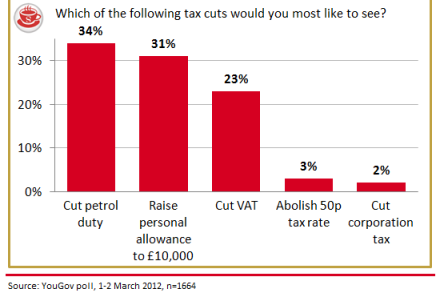
Today, the government has listened. In his Autumn Statement, George Osborne scrapped the fuel tax bombshell that was scheduled for January 2012.    As regular Coffee House readers will know, more than 100 MPs supported my cross-party campaign for cheaper petrol. At its height, it saw an e-petition attract more than 124,000 names — triggering a full MPs’ debate in Parliament. It has been a very long campaign, working with many organisations, from FairFuelUK and the RAC, to the independent forecourt industry, The Spectator and the Sun, to thousands of members of the public who wrote to me in support.

Osborne has made the right choice — but it’s not without its costs

Today, George Osborne had a choice. Growth prospects have evaporated, and tax revenues along with it. Should he reopen the 2010 Spending Review and cut the spending totals? Or stick with those totals, and finance this with extra debt? He chose the latter. And I think, on balance, he was right to do so. Credibility is the most valuable currency in this eurozone crisis, and Osborne said it was a fixed five-year plan. He chose more debt over less certainty, and it looks today like the markets believe he chose correctly.  But all this comes at a cost. The government will now run deficits higher than those which Labour proposed. Certainly, had Labour been confronted by evaporating growth it may have had to choose even lower spending or even higher borrowing.

Growth has upset Osborne’s plans — and it’s likely to get worse

The real story, as everyone expected, wasn't in the Pre-Budget Report ‘Green Book’ — but in the supplementary document produced by the Office for Budgetary Responsibility. Growth forecasts have taken a dive. And while that is both unsurprising and not all that revealing, it carries grim implications for so much else. I mean, just look at the graphs we produced in our last post: forecasts for debt, unemployment and borrowing are all up. It is not a pretty picture. But despite the dreariness of it all, I suspect that the numbers are far too optimistic.