Easter Island

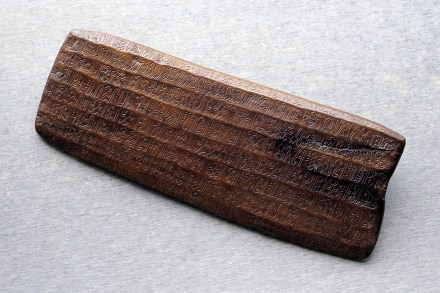
The mystery of Easter Island’s still undeciphered script

When British and Ottoman forces defeated the remnants of Napoleon’s army in Egypt, General Menou, the Frenchman in charge of Alexandria, was ordered to surrender his personal collection of looted antiquities. ‘Never has the world been so pillaged!’ he moaned unironically. The item which provoked such self-pity was the Rosetta Stone, whose extraordinary value Menou had identified – and publicised in an academic article – two years earlier. When two British officers were sent to collect the stone, Menou challenged one of them to a duel, though he seems to have been talked out of this. The stone was strapped to an artillery cart and began its journey to London, where it resides today as one of the star attractions of the British Museum.
John Power, Nick Carter, Elisabeth Dampier, Maggie Fergusson & Mark Mason

26 min listen

On this week’s Spectator Out Loud: John Power argues the Oxford Union has a ‘lynch-mob mindset’; Elisabeth Dampier explains why she would never date a German; Nick Carter makes the case for licensing MDMA to treat veterans with PTSD; Maggie Fergusson reviews Island at the Edge of the World: The Forgotten History of Easter Island by Mike Pitts; and, Mark Mason provides his notes on guided walks. Mark will also be hosting a guided walk for the Spectator, for tickets go to spectator.com/events Produced and presented by Patrick Gibbons.

Are all great civilisations doomed?

To quote Private Frazer in Dad’s Army, ‘We’re doomed, doomed!’ That seems to be the message of Paul Cooper’s eminently readable series of essays about how and why 14 civilisations rose to greatness and then collapsed. He begins with the Sumerians in the fourth millennium BC, at the northern tip of the Persian Gulf, and he finishes with Easter Island in the 18th century. He then concludes with dark prophecies about how a few centuries from now an overheated planet will look in a simpler post-industrial age. The style is informal, based on a series of popular podcasts, and one can almost hear the spoken word as one reads.