David cameron

No 10 moves to place trusted Cameron supporter at the top of the No campaign

From our UK edition

Imagine that we find out on May 6th next year that the Liberal Democrats have taken a pasting in the Scottish Parliament elections, done badly in the Welsh Assembly ones, lost seats in English local government and AV has been defeated. In these circumstances, Nick Clegg would face loud and sustained calls from within his own party to quit the government. Charlie Kennedy’s warning would have come true.  It would be situation critical for the Coalition. For this reason, I suspect that David Cameron wouldn’t shed any tears if the AV referendum passed. As I write in the Mail on Sunday, Number 10 has moved to install Rodney Leach, of Business for Sterling and No campaign fame, at the top of the save first past the post campaign.

Hague caught in the middle

From our UK edition

When General Petraeus called for a "united effort" on Afghanistan earlier, he might as well have been addressing our government.  Between David Cameron's and Liam Fox's recent statements, there's a clear sense that the coalition is pulling in two separate directions.  And it's left William Hague explaining our Afghan strategy thus, to the Times today: "'The position on combat troops is as the Prime Minister set out last weekend. By the time of the next election, he hopes we won’t still be fighting on the ground. We are working towards the Afghan national security forces being able to stand on their own two feet by 2014,' but there is 'no strict or artificial timetable'. 'Five years is a long way ahead. There is a lot more work to be done.

The Ashcroft report

From our UK edition

One thing that the AV referendum might do is revive the debate in Conservative circles about why the party did not win a majority in the general election. As the most striking example so far of the price of Coalition, it is likely to start off some grumbling about why the party is in position where it has to govern with the Lib Dems. Interestingly, on this front, Francis Elliott reports in The Times today that Lord Ashcroft has nearly finished his review of the campaign and that an ‘early draft is said to be unsparing in its criticism of Mr Cameron and his inner circle.’ But Ashcroft has yet to decide whether or not to publish his review. If Ashcroft were to publish a critical report of the campaign, then I suspect the gloves would come off.

Report: David Cameron will campaign against AV

From our UK edition

ITV's Lucy Manning reports that David Cameron will campaign against AV ahead of next year's referendum  In one respect, it's not surprising news: this is what the Tories have always said they'd do.  But given recent rumblings and speculation to the contrary, it's still worth noting down. If the Tories don't change their minds before 5 May 2011, the question is how loud and proud that 'No' campaign will be.  If Cameron keeps it low-key, then it might win him some goodwill with the Lib Dems.  But, equally, it could leave him stranded between a strong Yes campaign on one side, and more vocal No campaigns on the other – and under fire from both.

A new foreign policy?

From our UK edition

An inventive article from Ben Brogan this morning, arguing that a new vigorously Tory foreign policy is emerging. I can be a little slow sometimes, but I haven’t noticed anything new or Tory about Britain’s foreign policy. Brogan records that the Prime Minister has let it be known that British troops will withdraw from Afghanistan by 2015. Cameron said nothing of the sort; he said he wanted British troops out of Afghanistan by 2015, something quite different. Contrary to expectations, relations with Europe are flourishing under the coalition, as pragmatic government has superseded bellicose opposition. William Hague hopes to influence the EU closely.

Harman in need of a peace-pod

From our UK edition

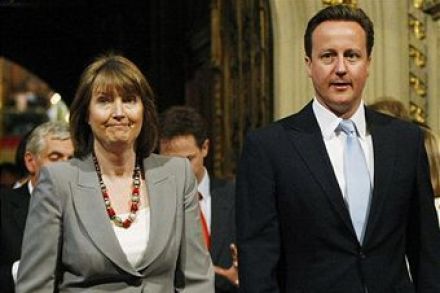
Hattie came to PMQs in one of her ‘visible-from-space’ frocks. Today’s fashion statement from the acting Labour leader introduced honourable members to a shade of electric turquoise which may well be new to Newtonian physics. It was best enjoyed through sunglasses to prevent retinal scarring. Ms Harman had just one political weapon today – the leaked report that the budget would cost 1.3m public sector jobs – and she deployed it with little guile and maximum predictability. Cameron dodged the question altogether and shifted attention to an OBR prediction that 2.5m more private sector jobs will be created. Hattie tried slicing the cake different ways. Did the leak originate from  the Treasury? How much would be lost in tax receipts?

A mandarin for the moment

From our UK edition

Most people probably greeted Liam Fox sacking of Sir Bill Jeffrey, alongside that of the Chief of Defence Staff in that Sunday Times interview with one word - who? The department’s Permanent Under-Secretary –- or PUS -- is a pretty unassuming figure especially sat next to the be-medalled soldiers he works with. Few people outside of Whitehall knew who he was before his defenestration; few will remember his name even today. But there is more at work here than one man's professional demeanor. Britons, despite being reared on the power of officials by TV shows like "Yes Minister", do not know and do not care about anonymous power-brokers such as Sir Bill. Only when a scandal grows out of all proportion do they become known.

The rookie gambler turns pro

From our UK edition

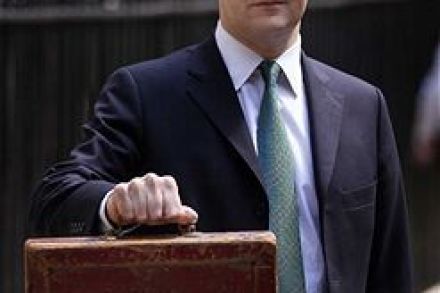
George Osborne is an enigma. For many, his politics and personality are defined by a photograph of him sneering in the Bullingdon’s clashing colours. The determined face that presented the Budget contradicted that stereotype; it suggested that Osborne was coming of age.    Paul Goodman was part of Osborne’s Shadow Treasury team and one of the 'Gang of Four' who prepared IDS and Michael Howard for PMQs, along with Boris, Cameron and Osborne. He has written an extensive appraisal of Osborne the man and politician. Read the piece: it’s enthralling, a detailed account of Osborne’s political adolescence through the years of defeat and a candid analysis of his tactical expertise. Two of Goodman’s observations stand out.

Harman the hawk

From our UK edition

Harriet Harman’s response to David Cameron’s statement on the G8 and G20 was noticeable for her attacking the Prime Minister for talking about bringing British troops home from Afghanistan within five years. Her criticism was that talking about withdrawal undermined the troops in the field, she sounded more like John McCain than I ever expected Harriet Harman to. She chose to reinforce her point by using quotes from Liam Fox about the effect that timelines have on military morale. Her use of the Fox quotes suggests that Labour see the Cameron Fox relationship as a weak point in the government.

Cameron meant what he said on Afghanistan

From our UK edition

Although David Cameron said later that he didn’t mean it, there was no mistaking the sincerity when he told Adam Boulton that “We cannot be there for another five years having effectively been there for nine years already”. In my News of the World column  today, I say that it’s pretty clear his Afghan strategy is to secure the earliest dignified exit. But I also say that this does not necessarily bode ill for defence more widely. I gather that George Osborne, fresh from the success of his Budget last week, is working on a plan that will freeze defence budget in cash terms (an 11% real terms cut over five years) thereby saving the military from the 25% average cut for non-ring fenced departments.

The G8 doesn’t mark a change in strategy towards Afghanistan

From our UK edition

Has the G8 agreed a five-year deadline for getting out of Afghanistan? This is the Politics Home headline, and that of other publications. Either there are some Chinese whispers going on - or some British spin. None of the foreign media appear to have discerned a new strategy - but for Brits it chimes with what Cameron was saying yesterday that he wanted to be out after five years. In fact, the full text of the G8 agreement reads as follows... The Kabul Conference in July will be an important opportunity for the Government of Afghanistan to present its detailed plans and show tangible progress in implementing the commitments made in the January 2010 London Conference Communiqué, including measures to...

Cameron and Clegg’s love-in deepens

From our UK edition

What began as a coalition of expediency is maturing into a pact of principle – or at least that’s what Cameron and Clegg would have you believe.  Of course, relations may sour and enormous efforts are being made to preserve Cameron and Clegg’s public cordiality. Journalists are being briefed that plans are in progress to enable Cameron and Clegg to speak at each others’ party conferences.   It will be little more than a public relations exercise if it goes ahead, and an extremely hollow one in all probability. What are they going say? It’ll be a cartoonist’s dream, as Clegg is politely applauded by the contemptuous Colonels, and Cameron, shandy in hand, schmoozes the socks and sandals brigade.

Britain’s foreign aid should empower women

From our UK edition

Here is a question. Which politician said the following: “We’ve seen too that when women are empowered economically they are more likely to have a voice in the community and to be advocates for other women.” Or “Britain will be placing women at the heart of the whole of our agenda for international development”. Clare Short? No. Hillary Clinton? Nope. Harriet Harman? Wrong. It is former Army officer and International Development Secretary Andrew Mitchell speaking yesterday to the think-tank Carnegie Endowment in Washington DC.   To some, his comments will illustrate how the Conservative Party has moved to far away from its roots.

Unwinnable war?

From our UK edition

Today is Armed Forces Day, and I don’t recall seeing such collective negativity from newspapers and broadcasters on the Afghan war.  It borders on despair. Most news outlets have dissected David Cameron’s comments yesterday, where he could only offer the hope that troops would be withdrawn by the end of this parliament. Cameron’s non-committal answers, the regular drip of casualties and the sense that the surge has become a slog have led journalists and analysts to conclude, en masse, that the war is unwinnable.   Three interviews are particularly striking. Nick Harvey, the armed forces minister, re-iterated Cameron’s comments in the exact same terms. As I argued yesterday, the vague statements pose questions not answers.

Cameron wants troops out of Afghanistan by 2015

From our UK edition

Everything about the Cameron government comes in fives. Five year terms, a five-year coalition and now we learn that it is Cameron’s considered opinion that British troops cannot remain Afghanistan for another five years. All Cameron has offered is the hope that troops will be home before the proposed May 2015 election. Five more years in Helmand on the current trajectory would be extremely costly and unpopular, especially given the political pressure surrounding defence cuts. Cameron realises this but will the nature of Britain’s engagement change? The assumption was that Britain would mirror President Obama’s timetable and begin a gradual withdrawal next year. That political and military strategy depended on the success of COINS entirely.

Obama wants ‘global concert’ to delay cuts

From our UK edition

G20 summits are usually turgid affairs, but this one has some (limited) potential. Relations between the White House and Britain and the White House and Europe have been frosty of late. Afghanistan, BP, the Falklands, Merkel and Sarkozy’s irritation at Obama’s personal and political aloofness, all of these have been contentious. Diplomatic tension has now developed an economic arm. The broadly centre right governments of Britain, France and Germany are committed to cutting public spending now. Each has introduced an austerity programme, and Cameron has made retrenchment is his international cause. Obama still stands for stimulus.

Cameron takes to the global stage, orating for a domestic audience

From our UK edition

From the point of view of historical curiosity, it is a pity that the great Victorian statesman predeceased the era of global summits. What would Palmerston or Melbourne have made of the pageantry? What might they have said to permeate it? Would they have wanted to? Modern British Prime Ministers have moulded themselves on the world stage: Blair as a liberal interventionist, Brown as a Keynesian. Judging by an article David Cameron has written in the Globe and Mail, he hopes to lead the world to fiscal re-trenchment and inaugurate lasting and real prosperity through free trade. Once again, Cameron’s premiership appears to be descended from Gladstone.

The true meaning of Osborne’s Budget

From our UK edition

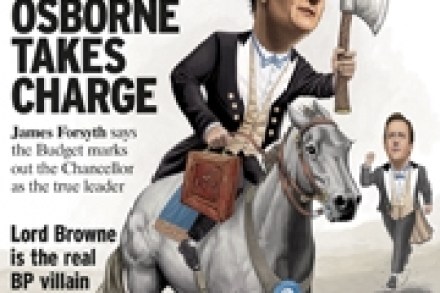
To understand the budget properly, read James Forsyth's cover story in The Spectator today. Sure, it was about reducing the deficit - but within it lie several political strategies which explain how George Osborne hopes to win a majority Conservative government. James says that those around Cameron will not entertain this notion - they "have been persuading themselves that coalition government is the best possible result". But Osborne, he says, finds it deeply unsatisfactory and has a twin mission: fix the economy, and win outright next time. "He has been observing recently that Gordon Brown spent 13 years successfully creating Labour voters — mainly through state dependency — and that the Tories need to reverse this process if they are to win.

RIP Lord Walker

From our UK edition

Peter Walker, Baron Walker of Worcester, has died aged 78. He served as a Cabinet Minister in both the Heath and Thatcher governments. He was what might be termed derisively as a ‘Wet’, and was a leading figure on the liberal side of the Conservative Party for thirty years. He was a founder member of the Tory Reform Group, which propounds One Nation Toryism and economic efficiency, ideals that have, it might be argued, profoundly influenced David Cameron’s leadership. Walker served with distinction throughout the Thatcher government, carrying the brief for Wales, Energy and Food and Fisheries. As Energy Secretary, he was a key figure during the Miner’s Strike.

Loving Hattie

From our UK edition

The unthinkable has happened. I’ve started to admire Batty Hattie’s performances at PMQs. Her career may be over, her party may be trashed, her movement may drift leaderless, and her colleagues’ reputation may have been shot to pieces but Hattie always turns up and gives it everything. Nature has not overburdened her with talent. She can’t count. She can hardly speak. She reacts to events about as quickly as a self-timing oven but she has epic quantities of pluck. Every week she pounds out into the surf, like a battleship equipped for the last war but two, and heads for the centre of the fray where she refuses to sink under the heaviest fire.