David cameron

No politician visits the frontline

From our UK edition

A few years ago, when I was serving with the Grenadier Guards in Iraq, I was part of a team tasked with looking after the visiting Secretary of State. There were five Defence Secretaries during my short spell in the army – a sign, perhaps, of the lack of attention the last government paid to the armed forces. Some were impressive, some less so. One was famous for falling asleep during briefings, but the one I was accompanying in Basra was wide awake. He wished to carry out of the most important missions facing Cabinet members in a warzone: conduct an interview with the Today programme on BBC Radio Four. He asked if we could turn off our own radios, so as to reduce the background noise – and seemed amazed and a not a little put out when we refused.

Cameron repulses Harman’s misdirected assault

From our UK edition

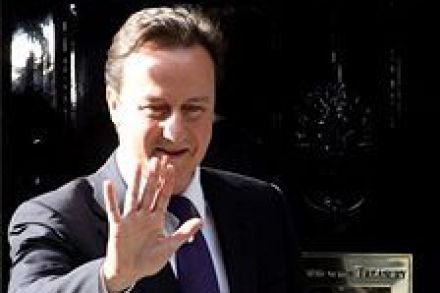
The PMQs attack No 10 was expecting from Labour on the Coalition’s planned spending cuts did not materialise and today’s was another relatively quiet affair. It started with a minute’s silence in memory of those who died in the shootings in Cumbria. Harman asked one question on gun laws before moving on to the electoral roll and whether it is fair to redraw the boundaries on a roll that does not include three and a half million people. Harman would be on quite strong ground here except for the fact that the boundaries were redrawn under the last government using this electoral register, a point Cameron made.

Will the coalition rue ring-fencing health?

From our UK edition

George Osborne has unveiled his plans for a comprehensive spending review. In addition to the pledge to broaden the base of consultation, the most significant announcement was that health spending “will increase in real terms in every year of this parliament”. The oft repeated objection to this pledge is that of the IFS. Spending in other departments will have to be cut by a savage 25 percent to pay for it. In view of Britain’s current commitments, could the defence budget sustain such a cut? David Cameron defines his politics with three letters: NHS. But think of the political damage caused by mass resignations over, say, the relationship between swingeing cuts and problems with defence procurement.

The previous government’s economic failure laid bare

From our UK edition

As Ben Brogan notes, there was a clean symmetry to David Cameron’s speech this morning: the crisis was Labour’s fault; therefore, Labour is to blame for the painful measures needed to restore stability. As Cameron put it: ‘I think people understand by now that the debt crisis is the legacy of the last government. But exactly the same applies to the action we will take to deal with it.’ Cameron made constant reference to the actions of the ‘previous government’. As a foretaste of what the Independent Office for Budget Responsibility will expose, Cameron alleged that Alistair Darling withheld estimates that Britain will be repaying £70bn per annum in debt interest by 2015.

Cameron lays the ground for cuts

From our UK edition

David Cameron’s speech today was about preparing people for the cuts to come, persuading them that Labour’s mismanagement of the public finances had made this ‘unavoidable’ and reassuring them that he had no ideological desire to make cuts and so would do them in the most sensitive way possible. Cameron managed to pull this off fairly effectively. He is managing the rhetorical transition from leader of the opposition to Prime Minister fairly well. In a way, what Cameron is doing now is the easy bit: the intellectual case for dealing with the deficit is unarguable. It is when the Coalition has to outline not broad principles but the specifics that things will get tough.

D-Day (plus one)

From our UK edition

Cuts are here. The most important news of the weekend was the G20’s official backing for spending cuts. It was a significant volte face, and doubtless the sight of violent uprisings in Greece concentrated minds. Finally, George Osborne has been vindicated; but having convinced finance ministers, he must now carry the coalition and the country with him. The first thing to do is ignore Nick Clegg and his claim that cuts will not be savage. Cuts will re-configure government in Britain, the current invasive Leviathan will be dismantled; but the process will be painful in the short-term, it must be.

The war on poverty opens a second front

From our UK edition

I detest the use of the word ‘Czar’. Everything has a Czar – potato regulation, multi-story car parks and Twitter being my favourite three. But the war on poverty needs to be fought by free-thinking absolutists. The appointment of Frank Field to conduct an independent review into poverty and life chances confirms David Cameron’s, and the coalition’s, non-partisan commitment to social mobility and betterment.   Field presents his analysis in a succinct piece in the Telegraph.  He writes: ‘Over recent decades, the Left and centre-Left’s answer to poverty and inequality has been to spend more money, to redistribute from richer to poorer.

Noises off, officers

From our UK edition

David Cameron is caught between a rock and a hard place. His government is rightly committed to its AfPak policy and the need to keep ties with the United States strong and close. But the Prime Minister and his aides probably also know that the assessments offered by a number of senior military officers of the campaign are rose-tinted, and suspect that the US administration may pivot and head for the exit far quicker than is comfortable for its allies. This is a tough choice; a wrong move could damage transatlantic ties and set back the fight against Jihadism. Staying the course will mean greater opposition from both Right and Left.   Unhelpfully, the government is also beginning to see signs of the kind of sniping from the Army that beset the Labour government.

Flotilla follies

From our UK edition

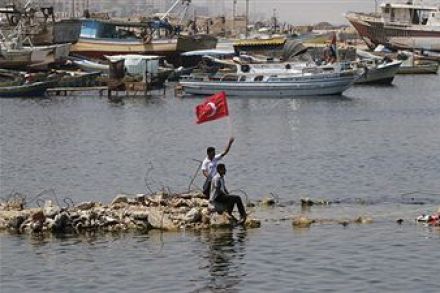
Two groups in the Conservative party that have worried most about Con-Lib government are the social conservatives and the neo-conservatives. The latter have been particularly worried about UK relations with Israel. There is a real concern in parts of the Conservatives Party that three factors would come together to sour Anglo-Israeli relations: what the neo-conservatives see as the Foreign Office’s knee-jerk Arabism, the presence of many supposed Arabists in Cameron-Hague’s teams, and the anti-Israel bias exhibited by many leading Liberal Democrats. Whatever the truth of these allegations, they are held with considerable fervour.

Cameron impresses on first outing

From our UK edition

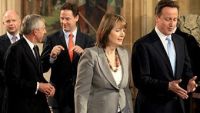
The shootings in Cumbria this morning meant that today’s PMQS was always going to be a subdued affair. David Cameron was impressive, though.  You wouldn’t have guessed it was his first time answering questions and he controlled the pace of the session expertly. There were fewer people on the front bench than last week meaning that Nick Clegg was more visible than he had been during the opening of the Queen’s Speech debate. Clegg sat to Cameron’s right while Hague was on his left. Harriet Harman asked some cleverly constructed questions, her ones protesting at plans for those accused of rape to be given anonymity are never going to be easy to dismiss.

Cameron must not radically change his style at PMQs

From our UK edition

Watching David Cameron’s mannequin-like performance during the TV election debates, it became apparent just how good he is at the dispatch box. Quick witted, funny and incisive, Cameron invariably demolished Gordon Brown at PMQs. Daniel Finkelstein’s column is a must read today, bludgeoning the absurd guff about  the ‘new politics’. But Finkelstein argues: ‘David Cameron is very good at being combative in the chamber. He has won many battles. And it will seem unecessarily risky to change his style. But the prize is great. For he can be a national leader, not a party one. And he can make a reality out of the nonsense of the new politics.

What to look out for at PMQs

From our UK edition

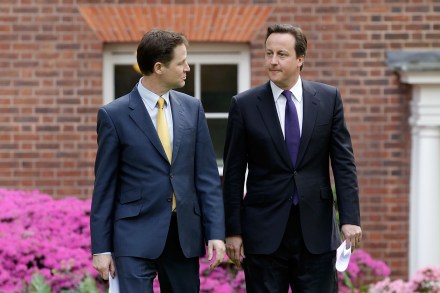
Today is the first PMQs of the new term. Given the Coalition, the whole thing will be a bit different from what we’re used to. The leader of the opposition will, as before, have six questions. But no other MP will have more than one question.   There’ll be a couple of little things I’ll be keeping a particularly close eye on. During the opening of the Queen Speech debate last week, the front bench was so crowded that Nick Clegg was not really visible on the TV. Instead, Cameron appeared to be flanked by two Tories. It’ll be interesting to see if this leads to a slightly different seating arrangement today. I’ll also be watching to see if Clegg whispers advice to Cameron during it.

Hughes in the ascendant

From our UK edition

The indications are that Simon Hughes will become Lib Dem deputy leader. Politics Home reports that Hughes is backed by 29 of the party’s 57 MPs, which make him the outright winner in the race with Tim Farron. Hughes also received the backing of 60 percent of party activists on the Lib Dem Voice website. The Tories will be both wary and pleased at this development. Hughes is left-wing, determinedly so, and among those who favoured a deal with Labour. Rumours abound that Cable’s resignation was contrived to promote Hughes, who is also said to be livid at being excluded from government - an Ashen-faced Hughes was spied shaking his head during the Queen’s speech debate. Animus and ego make for toxic coalition politics.

Avoiding Groupthink

From our UK edition

I hope CoffeeHouse readers will forgive the attention I am heaping on the Afghanistan War these days, but the campaign is moving into a decisive phase with a July donor’s conference in Kabul that Hillary Clinton is reportedly attending, a “peace jirga” scheduled to consider plans to negotiate with the Taliban and only a year to go before the first US combat troops begin heading home. No 10 is now letting it be known that the Prime Minister, his key Cabinet ministers, generals and aides will gather shortly to discuss the mission. A sort of condensed Obama review of the UK contribution.

The transparency revolution

From our UK edition

David Cameron has made his first podcast since becoming Prime Minister. There are a couple of noteworthy points: he didn’t name-check any Lib Dems (a slight if perhaps telling oversight); and he reiterated his call for a ‘transparency revolution’, allying accountable public services with a new style of open politics. The coalition will 'rip-off the cloak of secrecy... and rebuild public trust in politics.'  Oh the difference a day makes. Recorded on the train down from Yorkshire yesterday, pithy catchphrases such as ‘by the time we've finished, they (politicians) will have far, far fewer places to nowhere to hide’ sound a little insensitive today. But I’m nit-picking. It’s an excellent spiel: clear, direct and contrite.

Organising for national security

From our UK edition

Four weeks into the new government and the National Security Council machinery is still being put in place and ministers are still getting read into their briefs. The visit by William Hague, Andrew Mitchell and Liam Fox to Afghanistan was important, despite the brouhaha over the Defence Secretary’s comments. Such a visit was simply not imaginable under the Brown government. On the other hand, insiders say there is no real difference yet from the NSID committee that Gordon Brown created and the National Security Council that David Cameron has convened - except that the latter meets weekly, producing a torrent of tasks for officials. Permanent Secretaries are meeting regularly to support the NSC, but the subordinate structures are still not in place.

Can he stay or must he go?

From our UK edition

Paul Waugh and Matthew D’Ancona are debating whether David Laws will stay or go. D’Ancona is plain that Laws must go; Waugh wonders if this is an ‘Ecclestone moment’ and that Cameron and Clegg will dig in. John Rentoul agrees with Waugh. Laws’s situation looks bleak, and Andrew Grice concludes that Laws is no longer master of his fate. But it is not hopeless and Laws can survive. Laws is indispensible to the coalition - especially with left-wing Lib Dems Menzies Campbell and Simon Hughes increasingly intent on dissent. Second, who would replace him? There’s more talent on Virgin TV than there is on the blue and yellow benches, and the government cannot afford instability at the Treasury with the emergency budget looming.

Sir Menzies Campbell: Cameron and Clegg look like brothers

From our UK edition

Surprise, surprise – Menzies Campbell doesn't sound 100% taken with the coalition in interview with Andrew Neil on Straight Talk this weekend.  This is, don't forget, the man who encouraged the Lib Dems to seek a deal with Labour at the last minute.  And here he claims that he "would have found it very difficult to make the kind of arrangement with David Cameron that Nick Clegg has obviously found so easy."  He adds that: "...there is this determination to make [the coaltion] work and nowhere is that more obvious than in David Cameron and Nick Clegg.

Cameron creates cover for cuts

From our UK edition

David Cameron's speech today was, in many respects, the one he needed to make: the clean-break speech, which trashed Labour's record on the economy while also outlining how the coalition would deliver us to the sunny uplands. As it happens, it was also quite effective: a blend of policy specifics and punchy rhetoric.  And while we'd heard many of those specifics before – corporation tax cuts, reduced regulation, carbon capture, etc. – they cohered here as they rarely have done before. The most earcatching apsect of the speech, though, was the emphasis Cameron placed on government intervention.  Yes, there was a solid core of small state fundamentals.