David cameron

David Cameron: It’s our fault voters don’t understand why austerity is necessary

From our UK edition

David Cameron paid a rare visit to those hacks that lurk in the Commons press gallery for lunch today. In between cracking jokes about how 'as you know, I have very little control over what Boris does', and tantalising us with references to his EU speech, which is coming 'soon', the Prime Minister made an interesting admission about the way his government is communicating with voters about the difficulties in the economy: 'They are not expecting miracles. I think what people hear is a rather hard, technocratic message. They are not hearing - in fact, this is our fault - they are not hearing enough about why this matters and who this is for.' He did say that the Autumn Statement did demonstrate that the government was on voters' side, with its measures on fuel and personal tax allowances.

The War on Drugs is as pointless as it is immoral; obviously it must continue. – Spectator Blogs

From our UK edition

Like Tom Chivers I'd not planned to write anything about the latest suggestion our drug laws are sufficiently confused, antiquated and beyond parody that at some point it might be worth reconsidering them. It's not that I've tired of reform, rather that I've pretty much tired of making the case for reform. I have precisely zero expectation that this Prime Minister, who once seemed unusually sane on drug issues, will fulfill the naive and youthful promise he showed on the opposition benches. But then, like the redoubtable Mr Chivers, I saw Thomas Pascoe's views on the matter and found myself sufficiently provoked by his argument that I was stirred to action once more.

A storm of nonsense: gay marriage opponents lose their wits – Spectator Blogs

From our UK edition

My word, the latest kerfuffle over gay marriage runs the gamut from dumb to dumber. Here, for instance, is Cristina Odone: He may get away with bullying a great many – perhaps the majority – into accepting his proposals. But in doing so Cameron will create a less liberal and tolerant society. Those who have held fast to their principles, will have to accept what the majority wants. But will the majority respect what the minority believes in? Not in Cameron's Britain, they won't. The moment the vicar or priest refuses to celebrate a gay marriage in their church, the aggrieved couple will see them in court — in Strasbourg.

Jeremy Heywood, just call him very influential

From our UK edition

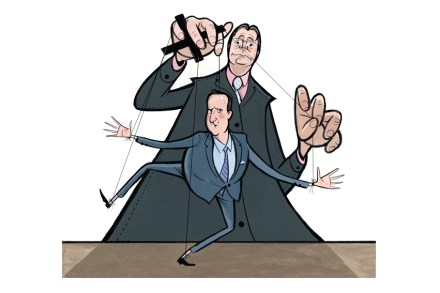
The main topic of conversation in Whitehall today has been The Guardian’s profile of the Cabinet Secretary Sir Jeremy Heywood. One particular passage has raised some eyebrows in several ministerial offices: He believes, they say, that reports of his power are overstated and the very suggestion that he might be making decisions on behalf of politicians makes him "cringe". He prefers to describe himself, they say, as simply very influential. Heywood, and this irritates some in Number 10, briefs journalists personally. He is known to be particularly concerned about his image. I’m told that after The Spectator cover depicting him as the PM’s puppet-master, there was much discussion over what should be done to finesse things.

David Cameron backs gay marriages in church

From our UK edition

This week marks seven years since David Cameron was elected leader of the Conservative party, and he has celebrated the occasion by making an announcement that will certainly keep things lively among his MPs and grassroots. Joe Murphy reports in the Standard today that he will allow religious groups to host same-sex weddings in their places of worship. The Prime Minister made clear this lunchtime that he would allow a free vote, appearing on the lunchtime news to say: 'I'm a massive supporter of marriage and I don't want gay people to be excluded from a great institution. But let me be absolutely 100% clear, if there is any church or any synagogue or any mosque that doesn't want to have a gay marriage it will not, absolutely must not, be forced to hold it.

Who speaks for the British press?

From our UK edition

At the end of the editors’ meeting in 10 Downing St today, there was an awkward moment when someone asked if the past hour had been on or off the record. There was something odd about the idea of a bunch of journalists keeping something secret, and anyway there was anyway not much to reveal: it was just the start of a discussion. But a very important one that could yet decide whether Britain retains its ancient tradition of press freedom. David Cameron restated his position: that he’s instinctively against statutory regulation, but wants to see self-regulation along the lines of the Leveson Report. And could the newspaper industry deliver that?

Ed Miliband’s Leveson response shows his weakness: he’s a follower, not a leader. – Spectator Blogs

From our UK edition

The biggest risk in punditry is the determination to see what you want to see. Confirmation bias is an ever-present clear and present danger to solid thinking. Nevertheless, though keeping this in mind, I wonder if Ed Miliband's reaction to the Leveson Report has been wise, far less a response that will help him win the next election. By "wise" I mean wise in a purely political sense, not "wise" as in appropriate, sensible or well-judged. The Labour leader's demand that Leveson's recommendations be implemented is, in its way, remarkable. This, after all, is a 2,000 page report published in four volumes. And yet within this mountain of ponderous, muddle-headed thumb-sucking Mr Miliband has not been able to - or has chose not to - identify a single passage with which he might quibble.

The end is neigh: even Jilly Cooper has dumped Dave

From our UK edition

It has been a rough few days for David Cameron. First he was drubbed at the polls in last week’s by-elections. Then little Alan Titchmarsh said that the Tory party had lost its roots in the countryside (and we know what happens to trees which lose their roots). And now I must be the bearer of even more bad news for young Dave, bad news from a once ardent Tory supporter: Jilly Cooper. As the cognac flowed at the 56th Hennessy Gold Cup on Saturday afternoon, Cooper told me that she is very disappointed with this government and declared that the Conservative Party is 'full of terrible people now.' The same event saw Elaine Page pass the classical singing torch on to rising star Natalie Coyle, who Page invited to join her as a special guest at a New York concert.

Pressure on the editors as Labour threatens own Leveson bill

From our UK edition

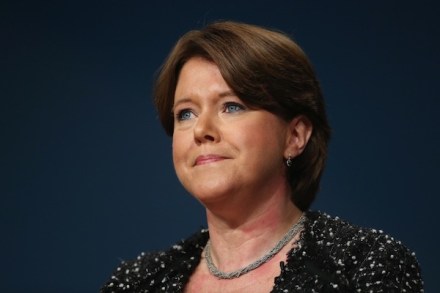
One of the foundations on which David Cameron based his decision to reject statutory underpinning of press regulation was that editors would set up a new system based on Lord Justice Leveson's recommendations which would prove far tougher than the Press Complaints Commission. The failure of the industry to reach consensus on a new body - and this is a real risk given the refusal of some publications to join the PCC - would pull the rug from under the Prime Minister's feet as he fights critics pushing for statute. Cameron is also facing claims that he is bowing to bullies in the press, and it is for these two reasons that the Prime Minister will be applying great pressure on editors as they meet Culture Secretary Maria Miller this week.

Tory MP attacks Cameron for allowing party to become ’emaciated’

From our UK edition

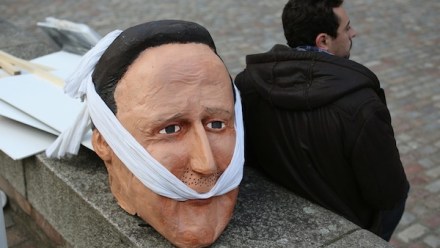
Brian Binley is fond of giving journalists new ideas for illustrations featuring David Cameron's head superimposed onto a new and unusual get-up: his 'chambermaid' allusion caused quite a stir back in August. Today he's written another one of his angry blog posts, which takes his criticism of the Prime Minister on a little further. Today the Prime Minister is a caretaker, apparently, and one who isn't taking great care of his party. Binley describes the Conservative party as being 'in a very sorry state', and launches an attack on Cameron for setting his face against his own party.

Government to draft legislation on Leveson recommendations

From our UK edition

The first of many cross-party discussions on the response to the Leveson Inquiry lasted 30 minutes last night. The 'frank' meeting resulted in David Cameron agreeing to draft bill to see if the proposals in Lord Justice Leveson's report were workable. The idea is that the legislation will prove that the statutory underpinning of the new independent press regulator is unworkable, while Number 10 sources are briefing that the Prime Minister has 'not shifted one inch' on his position on the report. But agreeing to draft legislation, if only to prove those deep misgivings that Cameron retains, is a canny way of approaching the divide in Parliament over the response to the report.

Press freedom has just acquired its most important defender: David Cameron

From our UK edition

For precisely 99 minutes yesterday, it looked like press freedom in Britain was doomed. At 1.30pm Lord Leveson announced his plans for statutory regulation of the press – with his bizarre instruction that we were not to call it statutory regulation. Worse, respectable commentators seemed to buy it. A very clever compromise, it was being argued. Self regulation really was being given another chance, albeit with a device which puts a legislative gun to the head of the press. If they obeyed his demands, he would not apply the force of the state. But at 3.09pm, the Prime Minister rejected all this outright. The existence of such a device, he said, would mean politicians setting the parameters under which the press operates which it hasn’t done since 1695.

‘The first thing we do, let’s kill all the lawyers’

From our UK edition

Given that David Cameron, rightly, seems to believe Lord Leveson’s recommendations are a crock of shit, what was the point of the inquiry in the first place? To show that something was being done? To give people like the hilarious Coogan a day in the sun, and that smug prolix lawyer who thought he was James Mason in The Verdict? We have to stop handing things over to lawyers and judges. Journalists are bad enough, but these people are even more thieving, grasping, self-righteous and utterly out of touch with public opinion. Too much time is given over to what they have to pronounce, too much weight given to their usually fatuous perorations. For all their flaws, I prefer the MPs – at least you can get rid of them.

Leveson report: Cameron’s defining moment

From our UK edition

I do believe that David Cameron has just pledged to  protect press freedom – and, in effect, reject the most illiberal proposals of today’s Leveson Report. He has asked the media to reform itself, and radically. He accepts the principles of the report and asks the media to 'implement them, and implement them radically'. But he asks. He doesn’t want to tell. And he draws a very important distinction between the two: parliament hasn’t told the press what to do since 1695 and Cameron doesn't want to start now.

Breaking: David Cameron says ‘I am not convinced statute is necessary’ for press regulation

From our UK edition

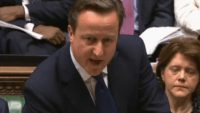
David Cameron has just told MPs that while he accepts Lord Leveson's recommendations for a new independent press regulator, he rejects statutory underpinning of the new regulatory system. The Prime Minister said: 'I accept these principles... The onus should now be on the press.' He said he was in favour of giving the press a period of time to implement the recommendations. But to roars of disapproval from MPs on the other side of the Chamber, he said: 'I am not convinced... that statute is necessary.' He also told MPs that he accepted Leveson's recommendations on the relationship between the police and the press. The Prime Minister also took care to praise Health Secretary Jeremy Hunt, who was cleared of wrongdoing by the Inquiry.

The big flashpoints over Leveson

From our UK edition

Nick Clegg and David Cameron will return, with their officials, to their speed reading exercise of the hefty Leveson report this morning. The Deputy Prime Minister wasn't giving much away unsurprisingly, when he spoke to journalists a short while ago as he left his home. He said: 'In this whole process, everybody wants two things: firstly a strong, independent, raucous press who can hold people in positions of power to account. And secondly to protect ordinary people, the vulnerable, the innocent when the press overstep the mark. That's the balance we're trying to strike, and I'm sure we will.' There is still the possibility that Clegg may give a second statement in the House of Commons later today if he and the Prime Minister fail to agree on the government's response to Leveson.

Arts cuts? What arts cuts?

From our UK edition

Luvvies have never really liked Tory governments. Poor Tracey Emin was nearly lynched by the arts crowds when she had the audacity to let David Cameron hang  one of her neon pieces in Downing Street. Things are getting heated with the new no-nonsense Culture Secretary, Maria Miller, who seems to have upset the triumvirate of darlings: Danny Boyle, Stephen Fry and Stephen Daldry. They have all laid into the government this week for apparently choking off arts funding, with the less-than-subtle undertone being that Tories are philistines. Needless to say, their star quality has given the story some glittering legs.

PMQs sketch: PM paints Work Programme a marvellous success

From our UK edition

While Leveson packs his sun-cream and flip-flops and prepares for a holiday in Australia, the nation holds its breath in anticipation of his report. One lucky citizen, the prime minister, is permitted a sneak glance at the findings of the great inquisitor into press malpractice. At 11.45 this morning, the monumental hardback landed with a thump on Number 10’s doormat. David Cameron barely had time to turn to the index and see how many name-checks he’d been given before he was whisked off to the Commons to answer questions from Ed Miliband. It was not a great occasion. The opposition leader challenged Cameron on the failure of the Work Programme, (b. June 2011), to terminate long-term unemployment. Reports yesterday revealed that just 3.

The Coalition split over Leveson

From our UK edition

I'm informed by someone involved in the coalition negotiations on the issue that the reason the Liberal Democrats want to be able to make their own statement on the Leveson Report is that they intend to back the rapid creation of a statutory back-stop for newspaper regulation. By contrast, I hear that David Cameron doesn’t want to back any press law, at least for now. The key moment tomorrow will come with a meeting of the Cabinet’s coalition committee at noon. It is scheduled for an hour and is meant to thrash out whether a common position can be agreed. Michael Gove, the government’s most passionate opponent of statutory regulation, is a member of it as are all five Liberal Democrat Cabinet Ministers and David Laws.