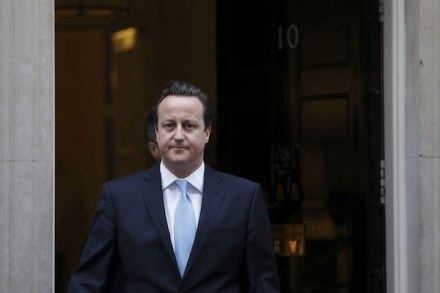
David cameron

Exclusive: David Cameron meets eurosceptic backbenchers ahead of speech

From our UK edition

The Prime Minister met a group of Tory backbenchers in Downing Street this afternoon to discuss Friday's Europe speech. I have spoken to the group's ringleader, John Baron, who has stressed the confidential manner of the discussion, but has given Coffee House readers some exclusive details of what went on. John Baron, Peter Bone, Edward Leigh, Mark Reckless, Philip Davies and Steve Baker attended the meeting. They were representing the 100 Conservative backbenchers who had signed the original letter in June calling for legislation in this Parliament for a referendum in the next. The meeting, which had a good atmosphere, lasted 20-25 minutes, and Baron and colleagues reiterated to the Prime Minister the letter's two demands.
PMQs sketch: Cameron and Miliband’s merry slanders

From our UK edition

It was written in the faces at PMQs today. Ed Miliband seemed relaxed and happy as he exploited Tory splits ahead of Cameron’s Euro-address on Friday. The PM looked irritable and resigned, like a long-distance hiker whose brand new Timberlands have started chafing just a few yards from his starting point. His conundrum is simple. Until he recommends carpet-bombing Brussels he’ll never placate the Euro-bashers. And his hope for renegotiation, even at its most conciliatory, will only inflame their escapological instincts. Miliband asked if Britain would still be an EU member in five years’ time. Cameron kept his crystal ball hidden. ‘The UK is better off in Europe,’ he said.

PMQs: Miliband mocks ‘divided’ Tories

From our UK edition

After PMQs today, David Cameron must be wishing he could just get on and deliver his much-trailed Europe speech. Ed Miliband took advantage of all the speculation to mockingly question Cameron on the subject, asking him to comment on every bit of process. Cameron wouldn’t rule out this morning’s James Chapman scoop that Tory ministers will be allowed to campaign on different sides of the referendum question. This made it all too easy for Miliband to get away the line: ‘ it's the same old Tories, a divided party and a weak Prime Minister’. For Miliband, that was mission accomplished. Those close to Cameron are arguing that Miliband has now shut the door to Labour offering a referendum, putting Labour on the wrong side of public opinion.

Tory MPs warn Cameron of ‘mañana moment’ for EU speech

From our UK edition

Number 10 has got quite the job to do over the next few days if it is to get backbenchers ready for David Cameron's EU speech on Friday. Tory MPs are now obviously in a high state of excitement, but their expectations will inevitably be disappointed to some degree. Some are already expressing fears about this, including the MP leading calls in parliament for a referendum. John Baron, who chairs the All-Party Parliamentary Group for an EU referendum, tells me that he is worried the 'mood music' in Europe isn't quite as positive about renegotiation as the Prime Minister might hope. He says: 'The chance of repatriating powers, I think they are slim: but I wish him well.

No 10 has intensive work ahead to prevent Tory criticism drowning out Cameron’s EU speech

From our UK edition

The date of David Cameron’s Europe speech has been moved yet again. But this time it has been pulled forward, to this Friday. Downing Street realised that they weren’t going to be able to talk about anything else until the speech was done. The mood in the party ahead of the speech is not good. There’s considerable irritation among Tory Cabinet Ministers that they haven’t been consulted about the speech. Another source of irritation for Eurosceptic ministers is that Ken Clarke has been allowed to — or, at least, not prevented from — joining up with Peter Mandelson and this new Centre for British Influence Through Europe.

David Cameron’s Europe “Strategy” is Going to Fail – Spectator Blogs

From our UK edition

This is unfortunate, not least because the Prime Minister is a greater realist than many of his erstwhile supporters. They, too often, seem to be another bunch of Bourbons. They helped destroy the last Conservative Prime Minister and they seem determined to help vanquish this one too. The country is not nearly so obsessed with Europe as the Conservative party thinks it is and, whatever the people's frustrations with Brussels and the European Union, I still think it unlikely the electorate is liable to be impressed with or by a party that spends quite so much time and energy on the European question. Not that the Prime Minister is helping. His forthcoming euro-speech has been so widely and lengthily trailed that it now has almost no chance of succeeding.

David Cameron continues with his ‘tantric’ European strategy

From our UK edition

David Cameron told journalists before Christmas that he had a 'tantric' approach to his European policy speech: that it would be all the better when it eventually came. So today he decided to continue tantalising his party and the media by popping up on the Today programme a whole week before he's due to give the speech, and refusing to give details of what that speech will contain. It's an interesting strategy, as speaking so far before the speech won't help the Conservative party remain calm. The next week was always going to be a little frenzied in the run-up to the speech. But here's what we did learn from the Today interview: 1. The Prime Minister is in favour of Britain in Europe. He argued that 'Britain does have a European future', but that this future involves reform.

How David Cameron can save money and boost interest in politics

From our UK edition

David Cameron started his times as Prime Minister by saying that 'the days of big government are over'. But he is still missing a major trick with the internet. The Times has highlighted(£) some of the ludicrous policy consultations undertaken by the coalition, many of which have received no responses at all: 'Another consultation into Cornish wine received no responses at all. The owners of the Camel Valley Vineyard at Nanstallon, near Bodmin asked for protected status for their award-winning ‘Darnibole wine’. After consultation on the issue failed to stir the public or even rival growers, the wine is now being considered for submission to the EU Commission for protected status.

How the mid-term review didn’t quite hit the spot

From our UK edition

Bearing in mind that the mid-term review was originally conceived as means of boosting Coalition morale after the collapse of Lords reform, it hasn't done enormously well. With two more very awkward stories stemming from the review hitting the papers today, the exercise has left Downing Street in reactive mode, rather than functioning as the proactive promoter of proalition politics. These are the main problems with the review: 1. In trying to manage headlines about the review, Downing Street inadvertently created a slew of negative coverage by withholding the 'audit' of coalition achievements. The audit turned out to be a very boring and badly applied gloss (Ronseal quality control would have rejected it).

Merkel ally’s referendum warning underlines Cameron’s precarious position

From our UK edition

The major gamble that David Cameron is taking with his strategy on Europe is, as James explains in this week's magazine, that he's relying on signals from Angela Merkel that she is keen to help him with a renegotiation. She has certainly given a few of those in recent months. But today one of her colleagues in the Christian Democrat party undermined some of the confidence that has been building about Merkel's position. Gunther Krichbaum is the chair of the Bundestag's European Affairs Committee, and is leading a two-day cross-party delegation to Britain. He believes a renegotiation would open a 'Pandora's Box', and that Britain should tread carefully: 'There is certainly a risk that [a referendum] could paralyse efforts for a better Europe and deeper integration.

The Fox pulls in a crowd

From our UK edition

An impressive turnout in the Churchill Room of the Carlton Club last night for Liam Fox’s New Year drinks. My eyes in the room reports that a smiling Liam claimed he had ‘invited 180 people’ and 162 had turned up. Interestingly, the big beasts came out for the former Defence Secretary, who is said to be eyeing a political comeback. Chancellor George Osborne stopped by, as did Party Chairman Grant Shapps, and Chris Grayling joined the party together with ‘a smattering of Whips’. Though he was left high and dry by colleagues during the scandal that ended his frontbench career in October 2011, his friends were back for the free bar and mini fish and chips.

The View from 22 — Britain’s accidental EU exit?

From our UK edition

We're delighted to be back with a bang for the first Spectator podcast of 2013. This week, our political editor James Forsyth discusses David Cameron's long-delayed speech on Europe with Mats Peerson, director of the Open Europe think tank. Will the Prime Minister manage to keep his party together over a renegotiation? Will Angela Merkel come to Cameron's rescue and what will the City make of his stance? The Spectator's editor Fraser Nelson looks at why the coalition mid-term review is a waste of time, while our panel agree that David Milliband's influence in the Labour Party is completely overrated. And what will happen to Rupert Murdoch's reforming plans for The Times? Under the new era of Leveson, will the media mogul be able to protect the newspaper's influence over governments?

What David Cameron plans to say in his Europe speech

From our UK edition

David Cameron’s big Europe speech is now less than a fortnight away. It will be, I suspect, the most consequential speech of his premiership. When you look at the challenges involved, one can see why the speech has been delayed so many times. Cameron needs to say enough to reassure his party, which has never been more Eurosceptic than it is now. But he also needs to appeal to European leaders, whose consent he will need for any new deal. At the same time, he’s got to try and not create too much nervousness among business about where all this will end up. I understand that he intends to argue that Britain needs to remain inside the single market. But he will commit to a renegotiation of Britain’s terms of membership, starting after the next election.

PMQs: Leaders trade dull insults as Andrew Mitchell holds court

From our UK edition

No one could call today’s PMQs illuminating. Ed Miliband led on the whole embarrassment of a Downing Street aide being snapped with a memo about whether to release a full audit of the coalition’s performance. There followed some not particularly sharp PMQs knock-about. Miliband claimed the ‘nasty party is back’ while Cameron bashed Labour for having no policy and took his usual shot at Ed Balls. There was a brief flurry of excitement when David Cameron declared, unprompted, that he had never broken the broken the law. Lots of the press are now pointing out various incidents when we know that he has. But in the Chamber it was clear that Cameron was talking about the hunting ban, the subject of the question, rather than more generally.

Copper-bottoming the Coalition

From our UK edition

Number 10 officials have been working on the mid-term review since the autumn, with what the Prime Minister's spokesman described today as a 'long-term intention' to publish the awkward annex. But even though the review itself was delayed from the real mid-term point of the Coalition to this Monday, it doesn't seem to have given those working on it sufficient time to get the annex ready for publication at the same time. The PM's spokesman said: 'It has been a long standing intention to publish the annex. What we needed to do was to copper-bottom it.' The implication was that there was a great deal of copper to put on the bottom of this point-by-point analysis of the government's progress against the pledges in the Coalition agreement.

2013: Can the SNP move beyond preaching to the already converted? – Spectator Blogs

From our UK edition

Alex Salmond is back in Bute House, refreshed and chippered by a much-needed holiday. If 2012 was a year in which the Referendum Guns were first deployed it was still, in the end, something of a phoney war. At the risk of exhausting an easily-exhausted electorate, 2013 should see more action. This week's column at Think Scotland argues that the SNP need to broaden their vision and approach the campaign with a greater sense of generosity than is sometimes seen. At present they depend too heavily - in my view - on the idea that independence is a way to Tory-proof Scotland. That's a negative, not a positive, case. Moreover it's one that muddles a short-term inconvenience (A Tory-led government with little support in Scotland) with a long-term reality: independence is for life, not Christmas.

David Cameron reads blog comments

From our UK edition

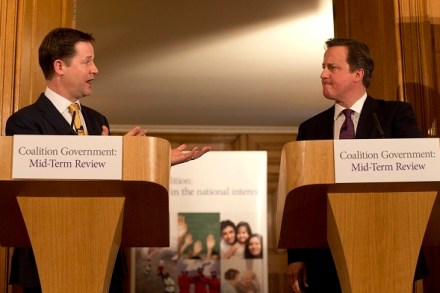
The Cameron/Clegg press conference did not teach us very much — save that the chemistry between the two is as good as ever, that they can still finish each other's sentences and exchange bad jokes. The Prime Minister's bad joke related to one of the comments under his interview with Matthew d'Ancona yesterday where he (in effect) said he wanted to stay in No10 until 2020. When asked about this today, the PM replied that a commentator on the Telegraph Online complained: ‘It's already 20:51 and you're still here.’ The assembled journalists treated his joke with the same respectful silence that they did to Clegg's ‘unvarnished truth’ joke. ‘You're all very slow today,’ Cameron chided.

Mid-term review: A return to the rose garden?

From our UK edition

‘David Cameron and Nick Clegg get coalition better than anyone else in the government’ one Downing Street aide remarked to me recently, and watching the two men at today’s press conference you could see what they meant. Us hacks who came looking for disagreement or awkward body language went away disappointed. As they both talked about how the coalition had come together to deal with long-term challenges and, to quote Cameron, the ‘positive benefit’ of two parties working together on these issues, I wondered if they thought that a second term of coalition might be needed to deal with Britain’s long-term problem. Intriguingly, when asked Cameron refused to say that if he had a majority of one, he would definitely govern on his own.