David cameron

David Cameron and Nick Clegg’s joint foreword to the Mid-Term Review

From our UK edition

Two and a half years ago, our parties came together in the national interest and formed a coalition at a time of real economic danger. The deficit was spiralling out of control, confidence was plummeting, and the world was looking to Britain with growing anxiety about our ability to service our debts. This Government’s most urgent job was to restore stability in our public finances and confidence in the British economy. In just two years we have cut the deficit by a quarter and have set out a credible path towards our goal to balance the current budget over the economic cycle. Dealing with the deficit may have been our first task, but our most important task is to build a stronger, more balanced economy capable of delivering lasting growth and widely shared prosperity.
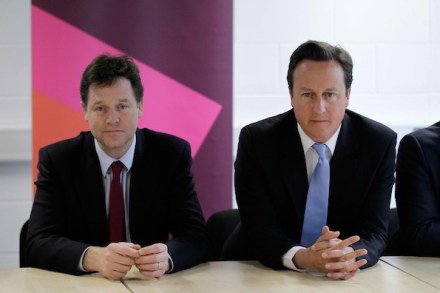
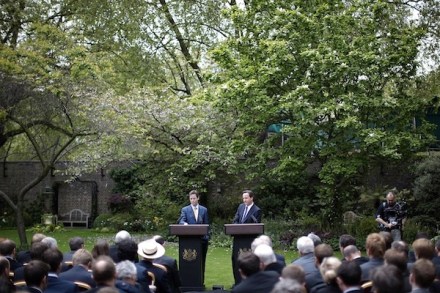
While the Coalition celebrates proalition, the two parties are still making their differences public

From our UK edition

The Coalition reaches its proalition peak today with the publication of the mid-term review, but Downing Street strategists are keen to spin out the good feeling for as long as possible. David Cameron and Nick Clegg will launch the review in their first joint appearance in Downing Street since December 2010, but the details of many of the measures on childcare, transport, housing and pensions won't come today. Instead, we'll see a trickle of announcements over the next couple of months. The leaders have already published a foreword to the review document, which starts by restating the Coalition's central mission: deficit reduction.

Cameron readies childcare package

From our UK edition

David Cameron and Nick Clegg will launch the coalition’s mid-term review tomorrow. There will be some announcements in it. But I understand that some of the most interesting, new coalition policies are being held out from it. The government wants to keep some of its powder back for later. There are also some final details to be worked out in certain areas. I’m informed that there’ll be a Quad on childcare this week. The coalition is close to agreement on a package which, as I say in the Mail on Sunday, would see working mothers receive thousands of pounds of help with childcare costs for the under fives. This will follow on from moves to liberalise the sector which will be announced in the next week or so.

In a preview of David Cameron’s 2013, Europe dominates his New Year interview

From our UK edition

David Cameron’s New Year interview on Marr was dominated not by the economy but by Europe. In a sign of what the promise of a speech setting out his European strategy has started, Cameron was repeatedly asked about what powers he would like back. He didn’t give much away, repeatedly telling Andrew Marr he would have to wait for the speech later this month. But two interesting things did emerge. First, Cameron indicated that he wanted to toughen up the way that the free movement of people is applied. I presume this means that only those with work or a clear means of support could come here; Nick Boles and others have long argued that this is possible under the existing treaties. Second, Cameron indicated that the new terms-or-out referendum would take place within five years.

David Cameron denies bickering with Nick Clegg

From our UK edition

Nick Clegg made clear before Christmas that he wants gory, open and honest government; today the Prime Minister was equally clear that he doesn't. Asked this morning on Radio 5Live about whether he was happy with the Lib Dem desire for greater differentiation between the parties, the Prime Minister replied: 'I think that both parties will succeed if the Coalition succeeds, Nick Clegg and I work well together, and actually there are huge challenges facing this country. We have got to pay down the deficit, re-balance the economy and we have got to improve standards in our schools.

The Tory message in 2015: Vote Cameron for PM

From our UK edition

One thing is already apparent about the Tories’ 2015 campaign, it will be even more dependent on David Cameron than the 2010 one was. Why, because as Anthony Wells points out again today, Cameron polls ahead of his party. There’ll be those who criticise this decision. They’ll point out that the big billboard posters of him in 2010 backfired badly. Others will wonder what more juice can be squeezed out of Cameron, given that by the next election he’ll have been leading the party for nigh-on ten years. But to the Tory leadership, the Cameron lead on the best Prime Minister question is one of their trump cards. It is key to their attempt to take seats off the Lib Dems.

Realism and optimism: David Cameron’s New Year message

From our UK edition

David Cameron's New Year message is a rather sober one, but it's not downbeat. The theme is 'realism and optimism' and the Tory leader's aim is to demonstrate to voters that his policies are putting the country on the right track, and to that end he makes some strong points on deficit reduction, unemployment, education, welfare, tax and pensions. Encouraging optimism about Britain's trajectory is important because 2013 is going to be a difficult year, not just for the Conservative party internally on issues such as Europe and gay marriage, but for the Coalition, as new cuts come in and critics call on the government to change tack. Ed Miliband's Dickensian pre-Christmas PMQs offered a little taster of that.

Hunting with the Heythrop

From our UK edition

In this week's issue of The Spectator, Melissa Kite joins David Cameron's local hunt, the Heythrop, to find out what its members think of its recent drubbing in the courts from the RSPCA, and the Conservative Party's troubled relationship with fox hunting. She meets former huntsman Julian Barnfield, who was fined £1,000 in the case, and chats to him about the recent admission from the Tories that a free vote on the hunting ban isn't on the cards for the new year after all: To understand fully the sense of grievance, you need to cast your mind back to the way the Conservatives campaigned at the last election. Then, the party was happy to cosy up to people like Mr Barnfield. This is because he was pounding the streets putting leaflets through doors in marginal seats.

David Cameron needn’t fear renegotiating Britain’s relationship with the EU

From our UK edition

Nick Clegg has made a not-so-startling intervention in the debate about Britain's relationship with Europe today, warning that Britain must avoid selling itself short in a renegotiation. His interview with the Guardian is a necessary piece of positioning ahead of David Cameron's Big Europe Speech in mid-January, and this kind of differentiation is something the Tories are more than happy for the Lib Dem leader to continue doing. So in some ways, Clegg warning Cameron not to overdo it on Europe isn't at all significant. But the Deputy Prime Minister makes an important observation in his interview about Britain's bargaining power.

David Cameron should explain why Europe isn’t working

From our UK edition

Philip Collins knows a thing or two about speech writing; but I can’t help thinking that his assessment of what David Cameron should say about Britain and the EU is misguided. Perhaps it’s his Labour blood, but he is fascinated with ‘those in Mr Cameron’s party who are obsessed with Europe in general or frightened of UKIP in particular’. Collins’ analysis seems to suggest (or hopes?) that Cameron’s speech will be primarily for Bill Cash et al. But the speech is the first step to a referendum renegotiating Britain’s position in the EU. The primary audience must be the public – Mrs Bone rather than Peter Bone. Therefore, its content should be about people rather than politics. What might David Cameron say?

David Cameron promises Tory MPs strong 2015 offer on Europe

From our UK edition

David Cameron's appearance before the 1922 committee was designed to reassure his party, and he tried to do this by promising them that the Conservative party would be strong on Europe in 2015. It has been a hard term, and today's PMQs was savage, so the Prime Minister decided to start his speech by telling them to think about the Conservative party's record in government. He touched on welfare, on schools, on the NHS - in particular mixed sex wards and waiting times - and income tax. He is clearly looking forward to the next election, too, as he mentioned the appointment of Lynton Crosby, to cheers from those listening, as well as attacking the Labour party. He also told the MPs about the importance of a strong and united Conservative party.

PMQs sketch: Labour stage a relentless attack on Cameron

From our UK edition

A fascinating PMQs. Labour staged one of the most carefully orchestrated attacks on David Cameron they’ve ever mounted. It was relentless. Ed Miliband kicked off by asking the PM about the six fold rise in food-bank dependency. Cheekily, Cameron praised Miliband for applauding the volunteer spirit. ‘It’s what I call the Big Society.’ Miliband gave him the ‘withering disbelief’ look which he practises in the mirror. He then revealed that two out of every three teachers ‘know a colleague’ who has given food or cash to famished children. Cameron shrugged this aside and replied that he wanted to do the most for the poorest.

PMQs: Labour attacks Cameron as the leader of a ‘Dickensian Britain’

From our UK edition

PMQs started off in a very consensual manner as Ed Miliband asked some worthy questions on Afghanistan. But this quickly changed when Miliband moved onto food banks. The Labour leader attempted to paint food banks as a consequence of the coalition’s policies. When Cameron mentioned the ‘Big Society’, Miliband shot back that ‘I never thought the Big Society was about feeding children here in Britain.’ A string of Labour MPs then made similar attacks on Cameron. One even waved a suicide note left by a constituent affected by changes to disability benefits. The question is whether the picture of, to quote one Labour MP, a Dickensian Britain with ‘grandeur for the few, the workhouse for the many’ rings true. I don’t think it does.

Cameron prepares his European argument

From our UK edition

If logistics had allowed, David Cameron would have given his long-awaited speech on Europe tomorrow. Instead, it’s been postponed until January and we had to make do with a statement on the European Council in the Commons today It’s quite clear that Cameron is thoroughly bored of these meetings: he complained that it was the seventh he’s attended this year and that he ‘wouldn’t describe it as a landmark council’. When Ed Miliband mocked the Eurozone countries for coming up with a timetable for having a timetable, Cameron chuckled and nodded. But Cameron does think that something big came out of this summit. As he put it, ‘the principle has been established that changes in the Eurozone, requires safeguards for those outside.

Gay marriage: no culture wars, please, we’re British

From our UK edition

Ever since the issue of gay marriage returned to British politics, we have seen the debate become crazier and crazier.  When Tony Blair handled this with his Civil Partnerships Act 2004, he did so with care and discretion, mindful of deeply-held opinions on either side of the debate. David Cameron seems to pursue gay marriage as some kind of defining mission statement, and seems to have driven his party quite mad. Nick Clegg released a speech drawing a distinction between the supporters of gay marriage and 'bigots'. He revoked the b-word, but his tactic was clear. We are witnessing an attempt to bring American-style culture war to a country that has never known it - and is utterly unsuited to it. I look at this in my Telegraph column today.

Insults fly at PMQs

From our UK edition

Today’s PMQs was visceral stuff. Ed Miliband accused the Prime Minister and the Chancellor of being Bullingdons Boy who were taking decisions about ‘people they’ll never meet, people, people whose lives they’ll never understand.’ Cameron gave as good as he got, attacking Labour as the ‘party of unlimited benefits’ and said that Miliband ‘only stands up for those who claim.’ These exchanges over the decision to limit the increase in working age benefits to 1% in the autumn statement cheered up both side of the House, the Lib Dem benches looked a bit glum though. Labour and the Tories are both comfortable with these battles lines—convinced that the public is with them.

Private sector growth pushes employment to new record high

From our UK edition

The number of people in work in the UK hit 29.6 million in August-October – the most ever — according to today's figures from the Office for National Statistics. So despite GDP still languishing 3 per cent below pre-recession levels, employment has fully recovered, with half a million jobs created in the last year: The rise in employment has been thanks to the private sector more than making up for the job cuts in the public sector.

Tory minister says yes to EU and no to immigration to win at 2015

From our UK edition

David Cameron's Conservative modernisation agenda is struggling. Several of today's front pages highlight how traditional Tory issues — immigration and family values — have returned to the centre stage. And many of Cameron's attempts to modernise his party on big issues (climate change, green energy, gay marriage, HS2) have met with a negative responses. How can he retool his modus operandi to win a Tory a majority at the next general election? Policing and ex-immigration minister Damian Green has a few suggestions. In a speech he will give to Bright Blue this evening, Green suggests Cameron's modernising agenda is not yet an ex-agenda, and can still be refashioned to work in 2015.

David Cameron defends secret courts

From our UK edition

It was striking that at today’s liaison committee session the Treasury Select Committee chairman chose not to ask the Prime Minister about the economy but the secret courts bill. In what were the tensest exchanges of the 90 minutes, Tyrie questioned whether secret courts were necessary while Cameron asked Tyrie to think what he would do in his position. Cameron kept stressing that the government was not making any existing proceedings secret but trying to find a way to have cases heard that can’t be at the moment. Tyrie’s vocal opposition, though, is further evidence that this bill isn’t out of the woods yet. Given that the terms of it were essentially thrashed out between Cameron and Clegg, I’d be surprised if Lib Dem MPs turned against it.

David Cameron’s X-Factor confusion

From our UK edition

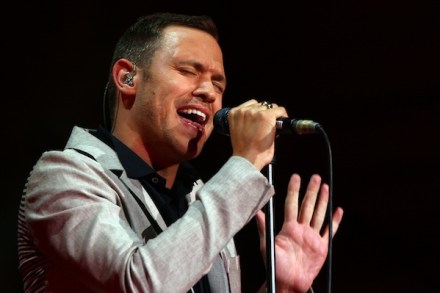
As David Cameron was leaving his lunchtime date with Westminster’s lobby journalists, my spy overheard him asking an aide: ‘I don't think I gave them anything too interesting, did I?’ Quite so, except that the Prime Minister showed once again that he has an odd relationship with the truth. Commenting on Nadine Dorries' trip to the jungle, young Dave claimed that he had not watched the show and certainly did not vote. Apparently he had only ever engaged in such plebeian entertainment once: voting for Will Young on X-Factor because ‘his daughter had made him’. Two problems here. One: Will Young was not on X-Factor, rather Pop Idol in 2002, as any fan would know. Secondly his daughter Nancy was born in 2004.