David cameron

Adam Afriyie ‘coup’: a false start for the stalking horse

From our UK edition

The camp supporting backbench Tory MP Adam Afriyie in a possible leadership bid have been busy, managing to get whispers of their planned coup into three Sunday newspapers (the Sun on Sunday, The Sunday Times, and the Mail on Sunday). Whether or not Afriyie is a popular backbencher who managed to soothe colleagues over toasted teacakes in the Pugin room, and whether or not he's the ideal person to lead the Tory party after Cameron, the timing for the Windsor MP of the plot appearing in print couldn't be worse. This time last week, it wasn't difficult to find a clutch of MPs who would gloomily mourn the direction their party was going in.
The view from Davos: Boris Johnson’s economic adviser on infrastructure

From our UK edition

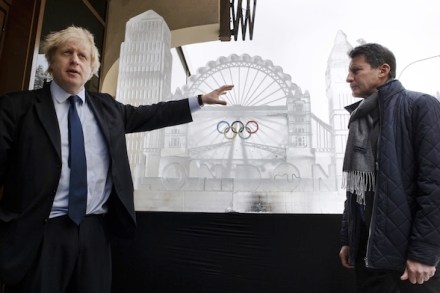
As the speaker for yesterday's Davos British business leaders’ lunch, Boris Johnson had the audience in his hand in his usual colourful way. I grabbed his very new Chief Economic Adviser, Dr Gerard Lyons, former Chief Economist at Standard Chartered, on the way out. How did he think we are doing economically? He told me the last big economic gathering was the IMF last October in Tokyo.  There, he said, the mood about the global economy was pessimistic, but now, three months later, the mood had improved, if only slightly.  There was more confidence about China and the US but still a lot of caution about Europe.

The EU must change | 26 January 2013

From our UK edition

I have been out of the country for a couple of weeks and away from the sweet furore of the internet. I'll be posting in the coming days on some of the bigger things which have gone on while I have been away. In the meantime, readers who are interested can read here a piece of mine published last week in Die Welt. Written before David Cameron's recent pronouncements, it is an attempt to explain the legitimate reasons for British EU-scepticism to a German audience.

The view from Davos: Cameron’s mad to talk about leaving the EU

From our UK edition

‘Cameron’s speech on Europe is badly timed; we must stop this endless European bickering when facing such huge worldwide political challenges’.  That’s the view of Neil Selby, the London-based Director of Executive Education for the Cheung Kong Graduate School of Business but who at the moment is, like me, here in Davos. ‘Let’s think instead of the links we can make with East Asia’, he tells me. It’s very disconcerting: while in Britain most columnists and commentators seem to be congratulating Cameron on his big Europe speech, here at Davos there’s no enthusiasm. Most of the people around me think the emphasis was all wrong. At a lunch on East vs.

Worst recovery in history: British GDP shrinks by 0.3 per cent

From our UK edition

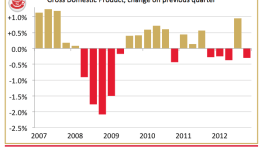
Now we know why David Cameron delivered his Europe speech on Wednesday. It’s time for bad headlines again: the GDP figures just announced show that the British economy is contracting yet again — by 0.3 per cent in the final three months of last year (see above graph). Now, you’ll hear a lot of people tell you today that quarterly data does not matter. The ONS say this is a fallback from the Olympics, which sucked economic growth forward. And they’re right: the ONS usually revises quarterly data, often dramatically. What matters more is the long-term trend, and this is pretty appalling. It now seems inarguable that Britain is going through the worst recovery in history. Slower and longer even than the 1930s.

David Cameron marries a Rothschild

From our UK edition

In the Jewish joke a matchmaker calls on a poor tailor living in a Tsarist shtetl in the middle of nowhere. He tells the old guy that he wants to arrange the marriage of his middle daughter to the heir to the Rothschild fortune, no less. The tailor isn't impressed. He cannot marry off his middle daughter until he has married off her older sister, he says. He does not want his beloved girl to move far from him, and everyone knows the Rothschilds live in Paris and London. In any case, he is not sure about this Rothschild fellow: he has heard he is irreligious and a drunk. The matchmaker answers all the objections with great patience until, eventually, the tailor relents. 'Excellent,' says the matchmaker, 'now all I have to do is talk to the Rothschilds.

Will Cameron’s EU speech help his drive for gay marriage?

From our UK edition

The government's gay marriage bill is published later today, after receiving its first reading in the Commons yesterday. How it's received by the Tory party will be an interesting indication of just how powerful David Cameron's EU speech was this week. When Maria Miller unveiled the 'quadruple lock' to protect the Church of England from being forced to conduct same sex ceremonies, she did so into a febrile Commons. In the tearooms, MPs quarrelled or shook their head at the exodus of stalwart Conservatives from their constituency parties. But the Prime Minister's speech gave the party such a shot in the arm on Wednesday that the atmosphere is currently very different.

Cameron & co relieved by Merkel reaction to speech

From our UK edition

Angela Merkel’s statement yesterday was a big fillip to David Cameron’s European strategy as it suggested renegotiation was possible. One senior government source called it ‘as good as we could have hoped for'. I understand that Merkel and her officials have indicated to the Cameron circle that they want Britain to stay in the EU and are prepared to consider Britain’s concerns. But Merkel does not wish to look like she is interfering in British domestic politics; she doesn’t want to appear to be endorsing the Cameron approach. Secondly, she does not yet know how much room for manoeuvre she has.

After party political porky pies, Number 10 admits debt is rising

From our UK edition

Finally: Number 10 admits that far from 'dealing with debt', the government is seeing it rise. This morning the Prime Minister's spokesman was grilled on the party political broadcast that horrified Fraser last night in which the Prime Minister said 'we are making progress. We're paying down Britain's debts.' Fraser has explained the reality - that Cameron is in fact increasing Britain's debt by 60 per cent - in this post with two unnerving graphs, and the Prime Minister's spokesman conceded that 'the debt as a percentage of GDP has risen'. Asked whether the Prime Minister understood the difference between the debt and the deficit, he said: 'Yes, he does.

Why I’m not keen on referenda

From our UK edition

It did not, in the end, take very much to outfox Ed Miliband. You wonder what he had been expecting the Prime Minister to say about a referendum on withdrawing, or otherwise, from the EU. As it was, Ed floundered, and felt obliged to say that Labour would not be promising a referendum – that will lose him even more votes to UKIP. Later ex shadow cabinet and existing shadow cabinet members had to defend this position, which they did by stating that this was Labour’s intention ‘at the moment’. Great. There’s increasing evidence that UKIP is taking more and more votes from the Labour Party, whereas once they thrived on disgruntled ex Tory votes.

The View from 22: Get out of jail free and Cameron’s EU speech

From our UK edition

How broken is the British criminal justice system? In this week's View from 22 podcast, Fraser Nelson and Rory Geoghegan, research fellow at Policy Exchange, explain the rehabilitation game and the cover up masterminded by our political class to hide the truth about how we dole out justice. Why is the government so keen on using electronic tagging? And does it work? Why are they deliberately fudging statistics to hide the real picture of reoffending? We also examine what an actual bobby on the beat thinks about the current policy of more cuts and more tagging? We're also delighted to be joined by the New Statesman's political editor Rafael Behr, who went head to head with our own James Forsyth on yesterday's EU speech.

David Cameron tells porkies about Britain’s national debt

From our UK edition

And then David Cameron has to go and spoil it all by telling porkies about what his government is doing to our national debt. The party election broadcast the Conservatives have just released is so astonishingly dishonest that it really would have disgraced Gordon Brown. In it, the Prime Minister tells an outright – how to put it? – untruth. He says:- “So though this government has had to make some difficult decisions, we are making progress. We’re paying down Britain’s debts.” listen to ‘David Cameron: "We're paying down Britain's debts" 23 Jan 13’ on Audioboo David Cameron’s policy is to increase Britain’s debt by 60 per cent, more than any European country. To increase it more over five years than Labour did over 13 years.

David Cameron’s Europe speech: The Spectator’s verdict

From our UK edition

Just for Coffee House readers, here is a sneak preview of the leading article from this week's Spectator. Download our iPad and iPhone app to read the rest of the magazine first thing tomorrow.  It was almost worth the wait. The substance of David Cameron’s speech on Europe was disclosed in this magazine a fortnight ago, but his delivery was excellent. He offered a clear-headed and almost touchingly optimistic vision of the type of union that the British public would find acceptable: one based on free trade, not bureaucratic diktat. One where power can flow back to countries, not be leached from them. And one founded on genuine popular consent, rather than broken promises and dodged referenda.

Tory MP: The public will struggle to believe Cameron’s EU pledge

From our UK edition

Six months ago, the word ‘referendum’ had not even passed David Cameron’s lips. The issue was not on the table. I would, therefore, like to thank the 100 Conservative Parliamentary colleagues who co-signed my letter in June, urging the Prime Minister to commit to a referendum. In a small way, I like to think our efforts helped to change his mind. We can now have a vigorous debate. However, whilst not doubting the Prime Minister’s sincerity, I am concerned his pledge will not be believed by the public. Far too many promises have been broken in the past, such as Blair’s promise on the EU Constitution and the Liberal Democrats’ commitment at the last General Election.

The Spectator: One step ahead of David Cameron’s EU manoeuvres

From our UK edition

While David Cameron's EU speech today made all the front pages, it is far from fresh news. Two weeks ago, James Forsyth revealed to Spectator readers what the Prime Minister would say in his speech. But as far back as last May, we revealed that a referendum on EU membership was almost certain: A referendum on Europe is the obvious answer. It is one the leadership seems set to embrace. The popularity of Cameron’s EU veto made his circle realise how much of a political asset Euroscepticism could be, if used in the right way. There is also concern in No. 10 that if the Tories don’t offer the public a vote, Labour will. One source intimately involved in Tory electoral strategy told me recently that a referendum in the next manifesto was ‘basically a certainty’.

PMQs: It’s Cameron’s turn to have some fun

From our UK edition

Last week at PMQs, Ed Miliband had great fun, mocking the wait for David Cameron’s Europe speech. He lampooned the Prime Minister as the weak leader of a divided party. It was a performance that disturbed even some normally calm Number 10 aides. But this week, it was Cameron who was relishing PMQs. By the end of the session, he was even telling Dennis Skinner — who normally brings out the Prime Minister’s irritable side — that he might agree with the speech Cameron is  giving in Davos tomorrow. Now that Cameron has set out his position, Miliband is under pressure to follow suit. Miliband appeared to rule out a referendum, responding to Cameron’s taunts with the line ‘No, I don’t want an In/Out referendum.

Cameron’s EU referendum pledge makes winning the Battle for Britain more difficult

From our UK edition

At the risk of seeming parochial, I'd suggest that David Cameron's long-awaited Europe speech and his endorsement of an In or Out referendum has implications and consequences for another referendum campaign closer to home. I suspect he has bought himself some time on the Europe question but this comes at a price. He has made winning the Battle for Britain - to be decided in 2014 - more difficult. The SNP should be very pleased today. Cameron has demolished a couple of core Unionist arguments. He can no longer credibly point to the unknown uncertainties of Scottish independence. Not when he has embraced, even made a point of celebrating, uncertainty regarding Britain's membership of the EU.

Cameron doesn’t want Britain to stay in the EU come what may

From our UK edition

One of the more intriguing lines in David Cameron’s speech this morning was his declaration that ‘when the referendum comes let me say now that if we can negotiate such an arrangement, I will campaign for it with all my heart and soul.’ This begs the question of what Cameron will do if we can’t negotiate such an arrangement. Now, Cameron made clear earlier in the speech that his strong preference and inclination is for Britain to stay in the EU. This seems to apply even if he can’t get everything he asks for in the renegotiation. As he put it: ‘You will not always get what you want. But that does not mean we should leave – not if the benefits of staying and working together are greater.

Sketch: Cameron’s EU climax

From our UK edition

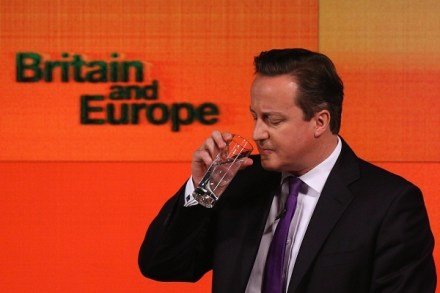
This was no tantric anti-climax. This was a seismic moment in British politics. David Cameron breezed into a London press conference this morning and proceeded to reshape Europe. The wooden lectern he stood at was pale and municipal. He wore a dark suit and a nice purple tie, and his affable pink chops glowed with moderation and good sense. He looked like a council negotiator arriving to settle a hedge dispute between warring neighbours. The Euro-crisis will lead to the restructuring of Europe, he said. He called for a new design that would incorporate more openness, flexibility and competitiveness. And the single market, not the single currency, should lie at its heart.