Cuisine

Dining with the Chinese food pioneers of New York

From our US edition

For first-time restaurateur Bolun Yao, New York is a city to experiment in: “I feel like New York is the city that is always exploring new things. If you have a new idea, you put it here.” The Chinese-born entrepreneur — who has also spent significant time in New Zealand — came to NYU to complete a master’s degree in food studies. He quickly fell in love with the fine-dining Korean scene, including the two-Michelin-starred Atomix and COTE, America’s only Michelin-starred Korean steakhouse. Both merge contemporary and traditional techniques and ingredients. “Wow, that’s really, really smart and really creative,” the twenty-eight-year-old recalls thinking. “Why is there not a Chinese restaurant that does the same thing?

Chinese

Against the ‘concept restaurant’

From our US edition

My wife and I live in Northern Virginia, in Fairfax County. Whenever we go out to eat, we almost always go somewhere in the suburbs. Fairfax, along with neighboring Montgomery County in Maryland, is home to a wealth of restaurants serving cuisines from all over the world. Just last January, Bon Appétit wrote that “to travel DC’s Beltway is to sample the flavors of the world,” and the New York Times declared that “America’s next great restaurants are in the suburbs.” You could argue that the suburban food scene in the DC metro area surpasses that of the city itself. Nonetheless, DC is widely seen as a “foodie city,” and its restaurants generally get more coverage and hype than their suburban counterparts.

Why food in Britain is so much better than France

Fifty years ago, the food in Britain was comically terrible. The Wimpy Bar was the place for a date, fish and chips was the limit of takeaway and if you were lucky you might get a packet of crisps at the pub. Everything French was better. French bread. French cheese. French wine. French restaurants, bistros, cafés. Today the positions are reversed. Britain is the land of foodie innovation, with every cuisine in the world represented, deconstructed, reinvented. Reopening after the lockdowns, even after a number of casualties, Britain will return to a cornucopia of diversity and plenty of quality.

In praise of the bacon butty

I was tipped off to meet a white Hyundai at a French motorway toll rest area at 2.30 p.m. (I would be driving a red Seat, I’d said.) My prearranged deal was for €230 worth of gear. I swung into the car park 20 minutes early and waited nervously. Ten minutes later the Hyundai appeared and parked in a nearby bay. A young blonde woman in Sweaty Betty leggings got out and opened the boot. I got out of my car, sidled over and gave my surname. She found my name on her list and ticked it off. Then she rummaged about among a heap of labelled packages until she found the right one and we did the deal: my €230 in exchange for a hefty carrier bag of sausages and smoked back bacon, all hand-made and cured by her and her partner in Antibes.

A guide to Greek eats – from souvlaki to spanakopita

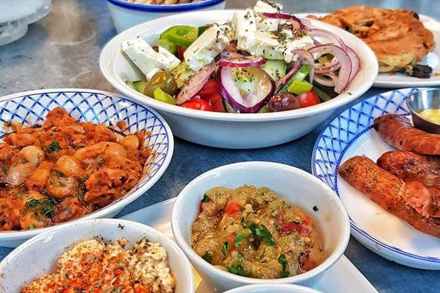
The legacy of Greek antiquity extends to the country’s cuisine. One eats there as the Ancients would have done—Greek yoghurt and honey for breakfast, simply-cooked fish and cold wine for lunch and supper—as one reclines languidly on the klinai couch, grapes dangling from the mouth, like Dionysius and Adephagia. Greek food can sometimes be disparaged as crude and one-dimensional: the runt of the Mediterranean litter, overshadowed by the glorious culinary traditions of France and Italy. But, for me, its beauty lies in its simplicity. And while it is often familiar it is simultaneously unexpected: fat olives in spectacular Greek salads, but also acerbic caper leaves. Feta crumbled atop everything, but baked too with aubergines and peppers.

Even hungry migrants won’t eat the food in Italy

A few months ago, Nigerian migrants housed at a government hostel in Milan suddenly refused to eat any more of the free food on offer. Italian food is monotonous and indigestable, they explained. Then they went berserk. This was not a one-off case. Far from it. There have been hunger strikes, demos, sit-ins and the odd riot in protest at the stuff. Recently, a group of mainly Pakistani migrants based in a Reggio Emilia hostel were given their own taxpayer-funded chef ‘specializzato in piatti pachistani e africani’. They had complained that Italian food was making them ill. Many migrants en route from Libya to who-knows-where are marooned in Italy for now, and they are getting fed up. They know that other EU countries have better food.