Conservative party

Darling talks sense on public sector pay

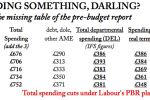
How things change.  A few months ago, Alistair Darling would only go so far as to not rule out a public sector pay freeze.  By the time of the Pre-Budget Report, that became a 1 percent cap on pay rises.  And now, in an interview with the Sunday Times, he’s talking explicitly about public sector pay cuts.  He cites the example of the private sector, where workers have accepted cuts to hang onto their jobs. It certainly makes sense.  Wages make up such a hefty proportion of public spending, that any serious plan to cut the deficit will have to take them into account.  Besides, there’s the fairness point as

Labour have Osborne in their sights (and on their fridges)

It’s only a small thing, but does anyone else find this detail from today’s Times interview with Alastair Campbell a little, erm, peculiar: “On the [Campbell] fridge is a Christmas card from David Miliband, a clipped photo of George Osborne in the Bullingdon Club shooting pheasant, a GCSE revision schedule. It is the type of handsome but unostentatious London professionals’ house that the Blairs once owned in Islington.” I mean, it’s no secret that the Labour hierarchy loathes the shadow Chancellor – but putting what I assume is this photo on your fridge?  Armchair psychologists, the comments section is yours…

Good advice for Dave

Ok, ok – so PMQs may be of more interest inside Westminster than out.  But, love it or loathe it, it’s still one of those things which affects the mood music of politics and how it is reported.  Far better for a party leader to do it well, than to be bludgeoned by his opponent at the dispatch box. Which is why Team Dave should internalise Matthew Parris’s article in the Times today.  Not only is it typically readable, but it’s packed full of sound advice for how the Tory leader should present himself in the weekly knockabout sessions.  Here’s a snippet: “Millions are now eyeing Mr Cameron up as

Don’t be surprised if Jowell is kept on by a Tory government

As Ben Brogan outlined in his Telegraph column last November, there are plenty of Tories placing a good deal of emphasis on the London Olympics.  By the time it comes around, they may well have spent two years cutting spending, raising taxes, and generally struggling against the fiscal problems that Brown has hardwired into our nation’s fibre.  A successful Games, the thinking goes, could be just the tonic for their midterm government – as well as for the country as a whole. Which is why today’s story about the Tories somehow keeping on Tessa Jowell, the current Olympics Minister, is unsurprising.  The thinking is clear: a bit of continuity could

Why Osborne is getting it right on banking

Oh dear. After Massachussetts, it seems like the usual sneering about “populist” politicians, and about voters who aren’t happy with the bankers, is back.  So here are a few facts of life for those knocking people who think the banking sector could still do with a lot of fixing: 1) The financial performance of the financial services industry over the past decade, in aggregate, has been shocking. Someone who had invested in the US or UK stock market would have seen their investment in real terms (net of inflation) fall by over a third. Shareholders have been brutalized for the best part of a generation now. 2) The last ten

Dirty tricks are off and running

The Tories are bracing themselves for an election campaign of smears and dirty tricks. Today the sniping begins. Attack dog Liam Byrne has criticised Cameron’s ‘Broken Britain’ speech in the following terms: “I think when people read what Mr Cameron is saying today they will see that it is quite an unpleasant speech…Mr Cameron is seizing upon one appalling crime and almost tarring the people of Doncaster and the people of Britain.” Cameron is not tarring anyone; he is clear that Doncaster was one of a number of extreme incidents (Baby P being another) that exist alongside a groundswell of anti-social behaviour. The terms ‘Broken Britain’ and ‘moral recession’ are

Obama is playing politics<br />

FDR was plainly confident when he indicted the “practices of unscrupulous money lenders” during his 1933 inauguration address; Obama’s speech yesterday was scented with desperation. He exchanged eloquence for provocation. “If these folks want a fight a fight, it’s a fight I’m ready to have.” Bankers do not want a fight with a President seeking cheap political capital; they want to turn profits and do business. Obama’s proposals frustrate that aim – by carving up corporations and neutering investment banking on the grounds of excess risk. As Iain Martin notes, Obama has departed from the G20’s emerging narrative, and though the details are imprecise there is no doubt of the

Will the civil service help Cameron rein-in his frontbenchers’ spending ambitions?

In his Telegraph column today, Ben Brogan asks one of the most important political questions of all: do the Tories have a plan for dealing with the mess they face in government?  They talk tough on debt and spending, for sure, but the details are still kinda lacking.  Is there anything behind the rhetoric?  And, if there is, will they pull it off?   Of course, the only proper answer is: let’s wait and see.  The proof of this particular pudding will come in the event of a Conservative election victory and, then, in the Emergency Budget that George Osborne has pencilled in for June or July.  On that front,

Confusion surrounds the Tory position on the Muslim Council of Britain

The government broke off relations with the Muslim Council of Britain over Daoud Abdullah, its deputy secretary-general, signing the Istanbul declaration, which the government believed encouraged attacks on British forces if they attempted to enforce a weapons blockade on Gaza. Last week, the government retreated; inviting the MCB back in despite Daoud Abdullah’s signature remaining on the document. The question now is whether the Tories are going to go along with this surrender. The first test of this is a fundraiser that the MCB is holding on the 22nd of February. The invitation boasts that Jack Straw and Nick Clegg will be attending and says that Chris Grayling has been

Forget inheritance tax – Tory marriage policy is Labour’s new favourite target

For some time, Labour has been trying to push the line that behind the Cameron facade there’s an old-school, “nasty” party waiting, drooling, for an opportunity to engineer the country as they see fit.  Over the past couple of days, it’s become clear that they’ve struck on a new variant of that attack. Yesterday, we had Ed Balls on Today saying that the Tories’ marriage tax break was a “back to basics” policy.  And, today, as Paul Waugh reveals, Harriet Harman described the same agenda as “modern day back to basics. It is back to basics in an open-necked shirt.”  The reference, of course, is to John Major’s ill-fated, relaunch

The Brown brand

How do politicians achieve that “unspun” look?  Why, by emulating the spin of a soft drinks company, of course.  This from Jonathan Freedland in the Guardian: ‘[The Labour campaign team have] taken a look at the branding of Innocent smoothies, hoping the authentic, unspun look might fit their own ‘unairbrushable’ product, G Brown. They were heartened by the reaction to the retouched Cameron poster, which suggests people are sick of the slick trickery associated with the age of Blair.’ In which case, here’s the Innocent website so you can get an insight into the Brown brand (although I doubt he’ll provide two of your five-a-day).  If Labour persist down this

Drink isn’t the curse of the working classes, but its easy availability is

It must be stated from the outset – most drinkers are responsible and drink only on special occasions, with other people or by themselves. However, binge drinkers, or that caste of drinker whose evening is neatly rounded-off with a stomach pump, are a minority, albeit a growing one. Relaxed licensing laws and the government’s refusal to strong-arm the drinks industry have led to roving bands of Sally Bercows traversing town centres, and who end the night by falling out of their dresses and into a taxi, or onto a pavement. Readily available alcohol has over-stretched the NHS’ dwindling A&E resources and the police’s time – Alice Thompson discloses that alcohol

Darling struggles to find consistency

Alistair Darling’s got an interview in today’s FT, and you know the story by now.  Yep, the government thinks that borrowing needs to come down drastically; extra growth would go towards cutting the structural deficit; there’ll be the “toughest settlement” on public spending for twenty years, only it shouldn’t be introduced too quickly; those bankers aren’t quite as evil as previously suggested; and so on and so on.  As we’ve said before, it’s certainly an improvement on that fatuous investment-vs-cuts line.  But you’ve got to wonder whether the public will find it credible, in view of what Brown & Co. have said, and done, in the past. Reading the complete

Labour’s IT bungles cost taxpayers £26bn

This morning’s Independent contains an almost incredible splash that £26bn has been wasted on IT projects over the last decade. It’s a litany of binary bungles – the incompetence: staggering; the forecasting: inept; and the planning (or lack of it): simply shocking. Contending with such absurdity whilst staring down the barrel of a £175bn deficit, you don’t know whether to laugh or cry. Let me take you on a whistle stop tour of dud investments made on our behalf. The major culprits are the NHS’ national IT programme (over budget and late at £12.7bn and used by only 160 health organisations out of £9,000), the MoD’s defence information infrastructure (over budget

Burning bridges

A noteworthy point from Tim Montgomerie in ConservativeHome’s latest general election briefing*: “The Daily Mail continues to blast Labour for neglecting marriage, as in an editorial today. It accuses Labour of being ‘deluded’ and ‘opportunist’. The Conservative policy is praised as ‘creditworthy’. The family is one of the top concerns of the paper’s Editor, Paul Dacre. Brown is undermining the last hope he had with Dacre by allowing Ed Balls to trash the Tory plan to save the two parent family.” Of course, no-one really expects the Mail to turn out for Labour come the election, but – after the attack they launched on Cameron before Christmas – the Tories

The Tories’ simple moral purpose

Education is the area where the Cameron agenda inspires most. The supply-side revolution the Tories are planning to enable, will transform education for the better in this country. This morning, the Tories launched the education section of their draft manifesto at the Walworth Academy in south London, one of the ARK schools.  The event was memorable for a compelling performance by Michael Gove. Gove, speaking with the passion of a preacher, set out the ‘simple moral purpose’ of expanding opportunity that lay behind his education reform proposals. He detailed how the gap between rich and poor grows as children spend longer in school and how more boys at Eton get

Three steps to cleaning up our toxic banks

Fraser outlined the problem with the British banks in his earlier post, but I’d like to suggest a three-step solution.   1. To deal with the problem, you have to admit to the problem. This is the First Step for Alcoholics Anonymous 12 step plan but holds true for politics. Say it out loud: the banking system is still broken. It needs fixed, and the process won’t be pretty. There will always be a political temptation to turn a blind eye, as there was in Japan during its ‘lost decade’. 2. Use an objective and credible third party to analyse the ability of banks to withstand losses, and to go

At last, a “brazenly elitist” approach to teacher recruitment

The next target for the Tories’ policy blitz is teacher recruitment. Cameron will pledge a “brazenly elitist” system with considerable incentives to lure top graduates from law firms and banks and into state school classrooms. What will this entail? Well, holders of degrees of less than a 2:2 will not receive funding for teacher training. Maths and science graduates with firsts or 2:1s from the 25 top universities will have their student loans paid off if they go into teaching; repayment will be staggered to encourage teachers to remain in the profession. The Tories will scrap graduate teaching programmes and replace them with on the job training, modelled on the

Labour’s policy is a hostage to their internal struggles

So Gordon is selling himself as a champion of the middle classes.  There is, as various commentators have pointed out, more than a little bit of hyposcrisy about that.  But the thing that strikes me most about our PM’s change of tack is how similar it is to Darling’s honesty over cuts last weekend.   Like Darling’s admission, it represents some sort of progress for Labour: on paper, the politics of aspiration should play better – and have wider appeal – than the crude class war that they’ve engaged in recently.  But, also like Darling’s admission, it highlights just how inconsistent the government have been over the last few months.