Conservative party

Confirmed: Tories to “block” Labour’s planned national insurance hike 

We’ll have more details tomorrow but, for now, Tim Montgomerie has the lowdown.  As I said a few days ago, this is a smart move from the Tories, and gives them a good message to deploy on the doorsteps.  Indeed, Tim has already drafted it for them: “Seven out of ten working people will be better off if Cameron becomes Prime Minister.” UPDATE: The Telegraph has more information here.  Looks as though the Tories might keep the rise for those above a certain income (the Telegraph speculates £37,400).  Either way, we’ll know for sure tomorrow morning.

The most corrupt parliament ever?

It makes you proud to be British. Where resourcefulness and self-worth are concerned, our political class is unmatched. Former Sports minister and ambassador for the 2018 World Cup bid, Richard Caborn, has been stung by the Sunday Times soliciting influence for £2,500 a day ‘plus expenses, obviously’. Obviously Richard, we would expect nothing less from a man of your eminence. So to for former Defence Minister, Adam Ingram, who takes lobbying so seriously he charges VAT. I wonder how Colonel Gadaffi reacted to the 17.5 percent extra charge when Ingram facilitated the construction of a new Libyan defence academy? Hypocrisy is more ubiquitous at Westminster than Pugin. Apologists for the expenses scandal argue that

Explaining the NotW endorsement

The News of the World’s endorsement of the Conservatives today is worth reading. It has taken some time and much soul-searching for the paper to make this decision. Papers, even under the same proprietor, have different readerships with different outlooks on life. The Sun came out for the Tories on the last day of the Labour conference last September, but its stablemate has taken far longer. It has been firm in its denunciation of Brown’s failings but – like many voters – it has looked long and hard at just how a Tory government would correct them. The reason for its endorsement now is laid out in the leading article.

Three Sunday polls have growing Tory leads

We’re operating in or around the margin of error here, so we can’t be certain whether this is truly the result of the Budget – but it’s still striking that three polls in tomorrow’s papers have growing Tory leads.  The ICM poll for the News of the World has the Tories up one to 39 percent, Labour down one to 31, and the Lib Dems on 19.   YouGov’s daily tracker has the the Tories unchanged on 37 percent, Labour down one to 32, and the Lib Dems on 19.  And Anthony Wells is reporting a BPIX poll for the Mail on Sunday, which has the Tories on 37 percent, and

How Brown would get Darling out of the Treasury

After reading Brown’s claims in the Guardian today, this Kill A Minister mechanism in his speech today rather jumped out at me: “I will set out a clear and public annual contract for each new Cabinet Minister, detailing what I expect them and their department to deliver to the British people, and that their continued appointment is dependent on their delivery just as it would be in a business or any other organisation.” I mean, you can just imagine what Alistair Darling’s first “contract” would look like: You, the Chancellor, will undertake to deliver the following to the British people: i) Economic growth of 5 percent in 2010-11 ii) A

The Tories are paying the price for Osborne’s mercurial political instincts

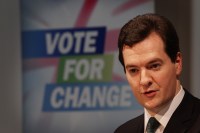
I’m at a loss. How can a government that will raise the national debt to £1.4 trillion be trusted to run the economy? The Daily Politics/Com Res poll shows that Labour is more trusted on the economy than the Tories; it indicts George Osborne’s political performance. As Fraser noted, Osborne blew an unprecedented opportunity on yesterday’s Today programme. The danger inherent in a £1.4 trillion national debt is not a difficult argument to make. Tax hikes, inflation and soaring interest rates will be the progeny of Brown’s continued borrowing binge. Yet Osborne confined his attack to valid but esoteric points about credit ratings and a list of acronyms. Ken Clarke

How to foil a Dispatches sting

The producer and director behind the Dispatches lobbying sting, Philip Clothier, has a snappy article over at Prospect, in which he basically asks the question: how could MPs have been so stupid?  But it’s his suggestion that some former ministers may have got off lightly which really caught my eye: “Meanwhile, one former Labour cabinet minister was interviewed, but the sound was so poor that we could only hear appetising phrases. He had the good fortune to be sitting in front of a brightly lit window, over-exposing the shot. And we just couldn’t understand much of what another former minister said because of his thick accent.” Cue all MPs adopting

A glass of clear, blue water?

One of the most eye-catching stories this morning comes courtesy of ConservativeHome: “As part of the pre-election package, ConservativeHome expects Mr Osborne to announce that a Tory government will cancel Labour’s National Insurance tax rise. The Tories will announce an alternative way of plugging the hole. Earlier this week Policy Exchange argued that the NI rise was a very damaging way of raising extra revenue.” Sure, Cameron has hinted at this before, and there will be questions about how the Tories would fill the fiscal gap.  But that doesn’t make this anything less of a smart move.  Not only does it makes sense economically, but it would give the Tories

Osborne’s weak response

I was all set up to Fisk the post-Budget analysis which Darling normally gives to the Today programme after the Budget – but he wasn’t there. The Treasury refused to have him debate with Osborne which is what Today (unusually) seems to have assumed. Well, we’d best get used to hearing Osborne post-Budget day. At first, I thought it was a coup for the Tories – but as Evan Davis sharpened his claws, it soon appeared to have been a net negative. Osborne just didn’t sound confident. A series of exchanges left him looking unprepared. His line – that he will eliminate ‘the bulk’ of the annual overspend over the

Darling and Brown get away with it

Strange days, indeed.  While most of the frontpages today are unflattering for Labour – particularly, and unsurprisingly, those of the Telegraph and the Sun – I imagine that Brown & Co. will be quite pleased with the general tone of the Budget coverage.  Much of it mirrors the Independent’s view that Darling “played a weak hand well”.  Or, elsewhere, there’s a kind of detached indifference about what is described as a “boring” Budget. Yes, if you like, you can take that as proof that the Darling-and-Mandelson approach to the public finances is less politically toxic, and a good degree more sensible, than the Balls-and-Brown approach.  But, to my mind, it

Darling’s nothing budget puts the ball in the Tories’ court

This year’s Budget was never going to win the election for Labour but it could have lost it. If the markets had reacted really badly to it, warnings about how Britain is in danger of going Greek would have suddenly gained traction. But Darling avoided that fate with a Budget that did little. Listening to it, it was clear that those inside Labour who argued that the strategic imperatives for this Budget had to be appearing credible and not risking an adverse market reaction had prevailed. The mood music was very different from the PBR, with its emphasis on investment versus cuts. Politically, the challenge for the Tories is this:

Fiscal drag

It is good to see the Tories calling fiscal drag what it is, a tax rise by another name. Fiscal drag is a result of holding income tax thresholds steady while both prices and earnings are increasing. This means that more people have to pay more of their income in tax. Gordon Brown indulging in this ploy so often as Chancellor was one of the main reasons that the number of people paying the 40p rate pretty much doubled between 1997 and 2008. One other good thing about the Tory line on fiscal drag today, is that it will put pressure on them to raise personal allowances and income tax

Germany to the EU: no more integration

A Conservative Party article of faith has been the belief that other Europeans are innately more pro-EU than the British. In the past, this has undoubtedly been the case. Poll after poll has shown that Britons see the EU differently than most other Europeans. But as I have argued before, times are changing on the continent. In an article in the Frankfurter Allgemeine Zeitung (not a Europhile newspaper by any stretch), Germany’s new politics is explained. Nikolas Busse argues that the Greek crisis and failure of EU leaders to cobble together a plausible bail-out is the first major manifestation of Germany’s new role in Europe – that of a country

Closing the gap between state and independent education

I do hope that Oxford will finally be free from government claims of snobbery soon. We learn today that the proportion of state school pupils it admits has fallen from 55.4 percent to 53.9 percent – but, as the university says, this is in line with the (appallingly low) proportion of state school pupils achieving three As. The problem lies with the schools, not the universities, and it helps no one to pretend otherwise. Here’s one figure that you won’t read in the ongoing “Oxford snobbery” story: in 1969, only 38 per cent of Oxford’s places went to privately-educated children. Why? Because the private schools in those days were not

Cameron denounces Labour’s “lies”

David Cameron’s press conference this morning was ticking along rather uneventfully until James Landale asked Cameron a question that set the Tory leader off on one about, what he called, “Labour’s complete and utter lies.” Cameron had started off by talking about how pleased he was that we going to be a father again, letting slip that he and Samantha had been trying for another baby for a while, and with some remarks on the lobbying scandal and the Budget. There had been questions on Ashcroft and cuts but nothing had really got going. Then, James asked Cameron about a Lib Dem plan to scrap the winter fuel allowance for

John Butterfill won’t get a peerage…

…confirms David Cameron, at his monthly press conference.  If you didn’t catch last night’s Dispatches, Butterfill is the Tory MP who said, among other things, that it is “quite likely that I will go to the Lords,” and that this is “another string to my bow as far as you’re concerned”.  More on him from Paul Waugh here.

The Budget is a bigger opportunity for the Tories than for Labour

Last night’s Dispatches programme was a concentrated double blow for Labour.  Not only did the limelight burn more unflatteringly on their party, but it has also undermined their careful Budget operation.  For the next few days, at least, it’s possible that broken politics may trump the broken economy in the public mind.  And Alistair Darling is going to have a difficult, if not impossible, task in bridging that chasm of “distrust and disbelief” with his prescriptions tomorrow. It doesn’t help the Chancellor’s cause that, by most accounts, we’re going to get an unconvincing and unspectacular Budget – some spin about lower borrowing forecasts; none of the tax rises that Peter

Both Labour and the Tories need to get stuck into Vince

The public remains infatuated with Vince Cable. A Politics Home poll reveals that 31 percent want Cable to be chancellor. It’s a crushing endorsement: Don’t Know is his nearest rival on 24 percent, followed by Ken Clarke on 16 percent. Cable’s reputation rests on his sagacious airs and an apparent contempt for party politics. His eminence is baffling. Fleet-footed fox-trotter he may be; economic guru he is not. Andrew Neil’s interview shattered Cable’s invincibility. The Sage of Twickenham admitted to changing his mind over the HBOS Lloyds merger and his constantly shifting position on cuts was exposed. Add to that the ill-thought out Mansions Tax and Cable begins to look