Conservative party

Tories would look to withdraw from Afghanistan in the next parliament

Today’s Express is reporting that David Cameron has said it would be wrong to set an ‘artificial deadline’ for withdrawal of British troops from Afghanistan, but that he hoped troops would come home during the course of the next Parliament.   In many ways this is smart politics. Given that President Obama has said that US troops would be looking to come home from 2011 onwards, it is hardly surprising that the Tory leader hopes British troops would return within the next five years. Other countries in Helmand, like Denmark, have begun signaling the same. The statement may – I say may – help those who care passionately about the

The Tories’ final push

Fresh from David Cameron’s victory in the final TV debate, the Tory campaign has taken another assured step this morning.  As Tim Montgomerie reports over at ConservativeHome, they’re going to flood the doorsteps with the leaflet, ‘A contract between the Conservative Party and you’ (pdf here).  Inside, a list of clear policy commitments from “publishing every item of government spending over £25,000,” to “reducing immigration” to the levels of the 1990s – meaning tens of thousands a year, instead of the hundreds of thousands a year under Labour.”  And, on the back page, a refutation of some of Labour’s most misleading claims about the Tories.  Clear, simple and direct. You

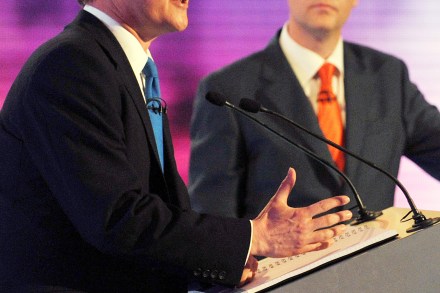
Tonight David Cameron turned in the performance he needed to. In the post-debate polls, Cameron has won three comfortably, one narrowly and tied the other

For the first forty-five minutes it was rather like the first debate. Brown attacked Cameron, Cameron hit back and all the while Clegg soared above it. But then immigration, Clegg’s Achilles heel, was thrown into the mix. Cameron went hard for Clegg over his amnesty policy, and Clegg had no clear answer—initially backing away from the policy, before coming back to it. Throughout this exchange, Cameron had covering fire from Brown. Clegg appeared knocked back as he came under the most sustained attack of the campaign and didn’t get back into his groove until his closing statement. In the meantime, Cameron capitalised; delivering some of his strongest answers of the

Cameron shines, Clegg wobbles and Brown sinks

Well, Cameron saved the best till last. His aides are even joking that they could do with a fourth debate because their man is really getting in the swing of it. He looked more confident, assured – and spoke convincingly about immigration at last, a subject he fluffed last time. I’d place Clegg second. Brown was worse than awful: third in this debate, and will probably be third next week’s election too. Clegg was his usual telegenic self – in thespian terms, an accomplished performance. But he ran away from his own asylum policy, and was comically inept with the facts. He screamed at Cameron: “Will you admit that 80

The final TV debate – live blog

2227, JGF: Rumour going around the press room that a certain A Campbell has been overheard saying ‘I think we’ve had it’ 2201, PH: And that’s it. I’ll be putting up my verdict in a separate post shortly. Thanks for tuning in. 2200, PH: Woah. Brown starts positive – thanking everyone involved in the debates.  But he’s soon into hardcore negativity: attaking the Tories for their inheritance tax plans and pointing out what areas of spending they will cut.  It’s all scaremongering about child tax credits, cancer guarantees and the like.  This, lest you need reminding, is his pitch for the country. 2128, PH: Clegg hones in on the “old

Dear Dave,

Tonight is about the economy – the most important issue troubling voters. Amazing, though, your economic mesage has not been particularly clear. Incredible given what the Labour government has done, I know, but true. George Osborne cannot seem to win over the City; the Lords of Finance never miss an opportunity to tell the FT that they don’t like/trust him. Your deficit-reduction message is on the other hand clear – but voters don’t seem to like it, believe it is actually necessary and seem worried about the “Sword of Cable”, which, like that of Damocles, is said to hang over the country by a hair and can come plunging down

The morning after the duffing up

It will be hard to isolate the influence of ‘bigot-gate’ on the polls as any taken after today will also include the effect of the final debate. But a few things are worth noting. First, this will be a ‘slow-burn’: Brown’s dismissal of such a large section of the electorate will take a while to sink in. It’s the kind of thing that is going to get discussed for days. I was doing a phone-in on Radio Five last night and those working on the programme told me that it was one of their highest ever volumes of calls.  Second, its ultimate result might be reduced Labour turnout—note how Mrs

A deeply emotive issue

Jonathan Bartley, the man who ambushed Cameron yesterday, has written a piece for the Guardian. In it, the education establishment’s counter-productive monopoly is exposed. Bartley writes: ‘Either we are for inclusion or we aren’t. To include children with special needs in mainstream schools takes commitment and a lot of work. Indeed, it requires “bias” – which has actually been lacking in the education system, despite all the talk of inclusion from Labour. There are few parents of children with special educational needs who would not want their children to attend their local school with brothers and sisters and friends, provided that the school is properly resourced, equipped and able to

The high tide of Liberalism?

Cleggmania may be in remission. A Populus poll for the Times puts the Tories up 4 at 36 percent, the Lib Dems down 3 at 28 percent and Labour down one at 27 percent. Com Res has Labour and the Lib Dems tied on 29 percent with the Tories up 1 to 33 percent, whilst You Gov has the Tories on 33 percent, Labour on 29 percent and Clegg’s party on 28 percent. A hung parliament remains the probable outcome next Thursday. Anything other than a decisive Tory victory will sustain the Liberal surge, as Clegg would hold the balance of power or a Lib-Lab coalition would seek to inaugurate

The battle for the middle ground

The New Statesman has interviewed Douglas Alexander, who appeals, as Andrew Adonis has, to Liberal Democrat voters to back Labour to inaugurate what he terms a ‘New Dawn for Labour and progressive politics.’ Progressive is a vague term, but the best definition for it is reform to encourage social mobility. In this morning’s Times, former Fabian Stephen Pollard argued that only the Tories can guarantee this. For the time, Pollard says, he will vote Conservative and all because of Michael Gove’s schools reform.   ‘Mr Gove has promised that within four years of a Tory government, all parents will have the option of sending their child to an independent school

Where is the axe going to fall?

If you want a sense of where our politicians are when it comes to sorting out the nation’s finances then I’d recommend you read this briefing paper which the IFS released earlier today.  What it shows, in stark graphs and charts, is what Adam Boulton, Andrew Neil et al were getting at in Labour’s press conference earlier: yes, we know that there are significant cuts to come, but none of the parties are really letting on just where they will come from.   To my eyes, this chart tells the story particularly well.  It depicts how much each party will cut “unprotected” departmental spending by – and how much of

The Tories in a PR pickle

Clegg won’t join without proportional representation; Cameron says he won’t countenance such a ‘con’. Indeed, it runs deeper than that. Iain Martin has canvassed Tories from across the party and found that Cameron will get short shrift if he tries to reform the voting system at all. There is another consideration. This election has the potential to blow traditional party structure out of the water. Labour’s right will be marginalised by the unions’ grip over the party and Liberal Democrats like David Laws and Clegg (up to a point) have more in common with the One Nation Tories than they do with out and out left wingers like Kennedy and

The Tories’ latest campaign image

Arresting, to the point and right. But tactically it leaves the Tories open to claims about ‘scare tactics’, of which the Tories accuse Labour. UPDATE: This one is more effective because it avoids the other one’s tactical shortcomings.

Attacking Clegg’s self-interest

Cameron is now in Lib Dem held Romsey. After a walk-about, where he received a largely positive reception, he delivered a stump speech. His message was that Nick Clegg, with his comment that PR is a pre-condition to getting Lib Dem support, is trying to hold the whole country to ransom. “It is now becoming clear he wants to hold the whole country to ransom just to get what would benefit the Liberal Democrats.” The aim is simple: portray Clegg as just another politician, interested in power and his own self-interest.  As I say in the magazine this week, how quickly the Clegg bubble bursts will be determined by how

Latest projections confirm deepening Labour decline, will it be terminal?

Well no surprise there – the Politics Home poll projection suggests that the Tory recovery, started by Cameron on Thursday night, comes at the expense of Labour but remains indecisive: ‘In the new projection, which incorporates all polls published up to and including Sunday 25th April, The Conservatives would be thirty six short of a majority, with 289 seats – 11 more than they were projected to win last week. Labour are projected to win 234 seats and the Lib Dems 94. Labour’s projected total has fallen by nine, while the Lib Dem total has fallen by four. The Tories are projected to gain a 35.1 per cent share of

Meeting real people, the staple of campaigning

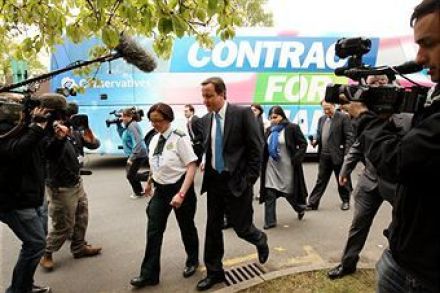
David Cameron is visiting Hampshire today, hitting both Labour and Lib Dem held seats. In a visit to Southampton University, he was confronted by a feisty Lib Dem supporting student who accused him of planning changes that would make it more difficult for working class kids like her to go to university. Cameron dealt with the question well. He said that the Tories would keep bursaries and that there simply isn’t the money to abolish tuition fees. He also pointed out that currently only 40 odd children on free school meals go to Oxford and that Tory plans to bust open the state monopoly in the provision of education would

Coalition government may be minimal government

Post-election deals are tough for those on the wings of political parties – the activists, the die-hards, the idealists. Those in the middle, by definition the pragmatists, find it easier to prioritise aims or to compromise in the short-term in order to win over the long-term. Any Con-Lib deal will be tough for the left-wing of the Lib Dems and the right-wing of the Conservative party. But both will have to accept that power is better than opposition and that being able to implement part of your party programme is better than carping on the sidelines, your manifesto languishing on never-visited websites. To make the most of a political shotgun

Why Cameron was right about the regions

Given that Labour has put out a hilarious plea to discuss “issues” rather than personality (or lack thereof), I would like to rise to this challenge to discuss an excellent point raised by David Cameron on Friday: that the state spending/GDP ratio is far too high in many parts of the UK and needs to be lowered. Stating this utterly uncontroversial fact landed him in a bit of trouble, I suspect because of lack of understanding of the issues. So, in the spirit of Labour’s plea, here are some facts. Cameron told Paxo that: “In Northern Ireland, it is quite clear – and almost every party accepts this – that