Conservative party

Waiting on AV

Every conversation I have about the durability of the Coalition comes back to the AV referendum. The conventional wisdom is that if AV is defeated then it will be very hard for Clegg to keep his party in. For this reason, people pay extremely close attention to the Tory leadership’s attitude to AV. We are waiting to see if there is even a hint that Cameron is prepared to soften his position on the issue to strengthen the Coalition.   So Danny Finkelstein’s blog this morning suggesting that ‘AV might provide the answer to the otherwise impossible question – if the parties stay together, how can they fight the election

The rookie gambler turns pro

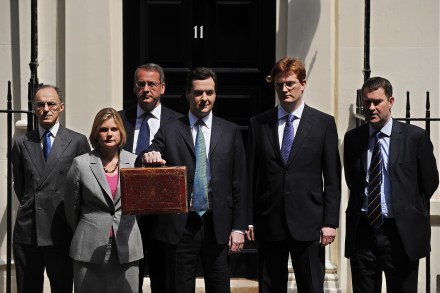
George Osborne is an enigma. For many, his politics and personality are defined by a photograph of him sneering in the Bullingdon’s clashing colours. The determined face that presented the Budget contradicted that stereotype; it suggested that Osborne was coming of age.    Paul Goodman was part of Osborne’s Shadow Treasury team and one of the ‘Gang of Four’ who prepared IDS and Michael Howard for PMQs, along with Boris, Cameron and Osborne. He has written an extensive appraisal of Osborne the man and politician. Read the piece: it’s enthralling, a detailed account of Osborne’s political adolescence through the years of defeat and a candid analysis of his tactical expertise.

Hugh Orde’s rhetoric is encouraging for Osborne

Whatever happened to Sir Hugh Orde?  A few months ago, he was threatening to resign over the Tories’ plans for elected police commissioners.  But later, in a speech to the Association of Chief Police Officers, he seems to have come over considerably more cooperative.  On spending cuts, he stresses that police numbers will likely be reduced, but adds that “we fully understand that all will have to share the pain.”  And on elected police commissioners, the worst he can bring himself to say is that “the test is reconciling it with operational independence for policing … we have an absolute right to clarity on how this system will work.”  There

Harman the hawk

Harriet Harman’s response to David Cameron’s statement on the G8 and G20 was noticeable for her attacking the Prime Minister for talking about bringing British troops home from Afghanistan within five years. Her criticism was that talking about withdrawal undermined the troops in the field, she sounded more like John McCain than I ever expected Harriet Harman to. She chose to reinforce her point by using quotes from Liam Fox about the effect that timelines have on military morale. Her use of the Fox quotes suggests that Labour see the Cameron Fox relationship as a weak point in the government. Certainly, Ben Brogan’s blog and Conservative Home’s description of the

Miliband the conman

Who’d have thought it? There’s David Miliband getting all self-righteous about the “cons” in George Osborne’s Budget, when – oh dear – he slips in a small con of his own.  Here’s the relevant passage: “[The Budget] was avoidable. Labour set out plans to cut the deficit by half over the next Parliament. The Tories have chosen to cut the whole of the deficit and more to the tune of £32billion in public services and £11billion in welfare.” And here, going off Labour’s own plans, is what he should have written: “[The Budget] was avoidable. Labour set out plans to cut the structural deficit by ‘more than two-thirds’ over the

War of words | 28 June 2010

Yvette Cooper has condemned IDS’ ‘nasty’ rhetoric this morning and claimed that the government’s proposals are about ideological cuts, not welfare reform. It’s simple, but effective. IDS’ reforms are both radical and necessary. The plan is to incentivise movement out of areas of welfare dependency with regional tax breaks and housing guarantees. There is a clear link between this policy and the non-EU migrant cap, which will protect at least some low skilled or unskilled jobs. A policy that encourages fairness, aspiration and a first chance in life for those condemned to worklessness by accident of birth. But the coalition is losing the rhetorical argument. When used in conjunction with

Osborne turns his attention to welfare

George Osborne suggested as much in his Today interview last week, but now we know for sure: the government will look to cut the welfare bill even further in October’s spending review, and incapacity benefit will come in for special attention from the axemen. It was, you sense, ever going to be thus. With unprotected departments facing cuts of over 25 percent unless more action is taken elsewhere, the £12bn IB budget was always going to be a tempting target for extra cuts. Particularly as so much of it goes to claimants who could be in work. The questions now are how? and how fast?  The first answer seems clear

Post-Budget polls show drop in Lib Dem support

ICM’s post Budget poll for the Sunday Telegraph confirms YouGov’s finding that the Lib Dems have dropped after the Budget. It has them down five to 16. By contrast, the Tories are up two to 41. Labour have also risen four to 35. YouGov has the Lib Dems on 16, the Tories 43 and Labour 36. These polls matter because they will add to the jitteriness that some left-leaning Lib Dem feel about such a fiscally conservative Budget. There is a feeling in Lib Dem circles that they could do with some things to please and reassure their base in the coming weeks. The Coalition is planning a policy push

Cameron and Clegg’s love-in deepens

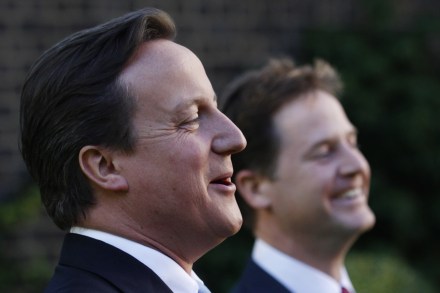
What began as a coalition of expediency is maturing into a pact of principle – or at least that’s what Cameron and Clegg would have you believe.  Of course, relations may sour and enormous efforts are being made to preserve Cameron and Clegg’s public cordiality. Journalists are being briefed that plans are in progress to enable Cameron and Clegg to speak at each others’ party conferences.   It will be little more than a public relations exercise if it goes ahead, and an extremely hollow one in all probability. What are they going say? It’ll be a cartoonist’s dream, as Clegg is politely applauded by the contemptuous Colonels, and Cameron,

The Budget PR battle enters a second phase

The government is on the defensive. The IFS’ pronouncement that the Budget was ‘regressive’ and the VAT hike ‘avoidable’ has given sustenance to the opposition and their supporters in the media. At the time, Harriet Harman’s response to the Budget seemed execrable. Now, I’m not so sure. Harman is like a Swordfish bi-plane attacking a battleship: she is so slow and obsolete that her superior opponents cannot bring their modern guns to bear. So she closes the range and scores a hit. Tuesday was one of her more successful strikes. As John Rentoul notes, Harman had a point beneath the bluster. The OBR is George Osborne’s weak spot; it downgraded

The true meaning of Osborne’s Budget

To understand the budget properly, read James Forsyth’s cover story in The Spectator today. Sure, it was about reducing the deficit – but within it lie several political strategies which explain how George Osborne hopes to win a majority Conservative government. James says that those around Cameron will not entertain this notion – they “have been persuading themselves that coalition government is the best possible result”. But Osborne, he says, finds it deeply unsatisfactory and has a twin mission: fix the economy, and win outright next time. “He has been observing recently that Gordon Brown spent 13 years successfully creating Labour voters — mainly through state dependency — and that

RIP Lord Walker

Peter Walker, Baron Walker of Worcester, has died aged 78. He served as a Cabinet Minister in both the Heath and Thatcher governments. He was what might be termed derisively as a ‘Wet’, and was a leading figure on the liberal side of the Conservative Party for thirty years. He was a founder member of the Tory Reform Group, which propounds One Nation Toryism and economic efficiency, ideals that have, it might be argued, profoundly influenced David Cameron’s leadership. Walker served with distinction throughout the Thatcher government, carrying the brief for Wales, Energy and Food and Fisheries. As Energy Secretary, he was a key figure during the Miner’s Strike. Walker

Osborne winning the Budget PR battle – but VAT remains a thorny issue

Well, that’s gone as well as can be expected for the coalition.  Most of today’s newspaper coverage highlights the severity of George Osborne’s Budget – but, crucially, it adds that the Chancellor had few other options.  The Telegraph calls it a “brave Budget”.  The Times says that it delivers “the best of fiscal conservatism combined with no small measure of social justice”.  And even the FT – no friend of the Tories in recent years – suggests that Osborne might be “remembered for doing Britain a great service.” The sourest notes chime around the government’s welfare cuts and the hike in VAT.  Already, it’s clear that the latter will be

What Harriet Harman won’t tell you

By her usual standards, Harriet Harman was quite effective in her response to George Osborne’s Budget earlier.  She was clear, direct and had a few gags at Vince Cable’s expense.  And she also benefitted from what, on the surface, was a strong central attack: the Office for Budget Responsibility, she said, has downgraded its jobs forecasts on the back of the Budget.  And so, she followed, this is a Budget which destroys jobs. But there were a few things that Harman wasn’t letting on.  First, as Jim Pickard points out at the FT, the OBR forecasts haven’t shifted by all that much from their previous incarnation.  And, second, they are

Unspectacular, but quite effective

Well, that was excitingly unexciting.  There was little in George Osborne’s Budget that we didn’t expect, either in terms of rhetoric or policy.  But it still felt new and different nonetheless.  Here we had a Chancellor setting out exactly how much spending he will cut, and putting plenty of emphasis on both our deficit and debt burdens.  It drew a stark contrast with the Brown years, and was a solidly understated performance in itself. There will be plenty of attention paid to the hike in VAT, and rightly so.  But there were some macroeconomic forecasts which were just as eyecatching.  In his address, Osborne suggested that the deficit on “current

Budget 2010 – live blog

1343, PH: Harman has sat down now, so we’ll draw the live blog to a close.  I’ll write a summary post shortly. 1342, FN: I wish I could trash Harman’s response, but it’s actually quite good.  Many a Tory would be secretly cheering her trashing of the LibDems. “The LibDems denounced early cuts, now they’re backing them – how could they support everything they fought against, how could they let down everyone who voted for them?” Again, a fair point. “The LibDems used to stand up for people’s jobs, now they only stand up for their own.” Her main point – that forecasts for unemployment have risen – is a

Osborne makes the “progressive” case

During the Brown years it was “stability,” but it looks as though the watchword for Chancellor Osborne’s first Budget will be “progressive”.  This is the word that’s being bandied about behind-the-scenes, and the coalition seems confident that it has the policies to match the rhetoric.  As the Guardian reports today, it’s likely that the personal income tax allowance will be raised by £1,000 or so, to help shield the least well-off from tax rises elsewhere.  And the paper quotes a Tory aide saying that the richest will pay more, “both in absolute terms and as a percentage of their income.” Whether he drops the p-word or not, the arguments behind

Osborne looks to the long-term

There are plenty of details for Budget-spotters to look out for tomorrow, but among the most important is just how far Osborne reaches into the future.  The current expectation in Westminster is that he will offer quite a few glimpses into the long-term.  A possible commitment to reduce the main rate of corporation tax to 20 percent over the next five years, perhaps.  Or similar provisions for making the first £10,000 of income tax-free. There are, of course, economic and political motives behind this.  Economically, the plan will be to reassure the markets that the coalition has a deliberate plan which extends beyond the next few months (which was a