Comedy

Robin Williams in London

From our UK edition

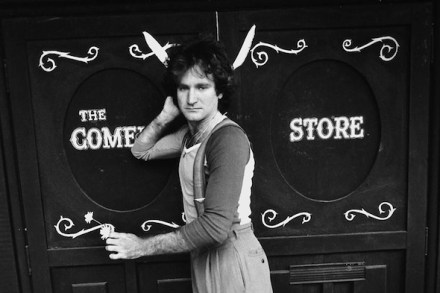
In 2001 I wrote a book called The Comedy Store (still available in some good bookshops – and quite a lot of bad ones) about the London comedy club that kick-started modern British comedy. The book was a bit of a mixed bag, but the best bits were where I shut up and let these comics talk about each other. And the comic they talked about most of all was Robin Williams. Their tales of seeing him perform for the sheer love of it, in front a few hundred tipsy punters, show what a great comic we’ve all lost. Robin Williams first played the Comedy Store in 1980, on a trip to London to dub the voice-over for Robert Altman's Popeye. The compere that evening was Alexei Sayle.

John Bishop interview: ‘My dream was to be Steven Gerrard, but he got there first’

From our UK edition

John Bishop doesn’t just tell funny stories. He also tells the sort of life story that makes you sit up and listen. He grew up on a council estate outside Liverpool and, at the age of six, visited his father in prison. By the time he was in his mid-thirties he was working in middle management at a pharmaceutical company, had three children and was going through a divorce. Today he sells out 15,000-seat arenas, is still married to his wife and no longer works in middle management. It was a Monday night and Bishop was looking for something to do. His friends were tired of him ‘crying into his beer’ about his divorce. So, aged 34, he decided to visit a comedy club for only the third time in his life.

The best of Rik Mayall (1958 – 2014), master of the grotesque

From our UK edition

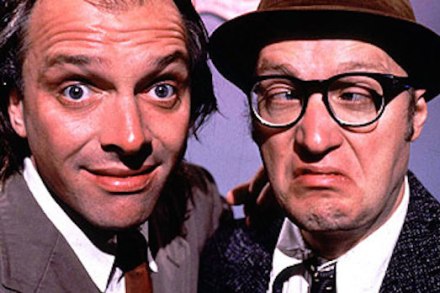
Sad news reaches us at Culture House that Rik Mayall, one of the mainstays of my TV-addicted teenage years, has died at the age of 56. A virtuoso of all that was most grotesque and loathsome in man, Mayall made his name leading memorably in a number of game-changing sitcoms, including Channel 4's the Comic Strip Presents..., ITV's The New Statesman and BBC Two's The Young Ones and Bottom. The delight with Mayall was that the more odious his characters became the more mesmerising he got. Here are some highlights: 1. Richie, Bottom A lot of people didn't get Bottom. I loved it. It was like a cross between Beckett and Feydeau. And well before I knew who either Beckett or Feydeau were, its sweaty nihilism worked a treat on me. It still does: 2.

Michael Craig-Martin pokes a giant yellow pitchfork at the ordinary

From our UK edition

Visitors to Chatsworth House this spring might wonder if they have stumbled through the looking-glass. The estate’s rolling parkland has been invaded by an army of vibrantly coloured, outsized garden tools, whose outlines seem to hover, mirage-like, over the landscape. These painted-steel 2D ‘sculptures of drawings’ are the brainchildren of the conceptual artist Michael Craig-Martin. Craig-Martin finds poetry in the everyday and here he has taken 12 commonplace objects — a wheelbarrow; a spade; a lightbulb — and transformed them into something extraordinary. He also believes that context is everything when it comes to art and the works have been carefully positioned.

Radio that makes you feel the wind on your cheek

From our UK edition

After a walk in Richmond Park beset by rush-hour traffic, the Heathrow flight path and a strange swarm of flying ants (strange because so early in the year), it was unsettling to come back in and switch on and listen to Kirsty Gunn’s spring walk for this week’s The Essay on Radio 3 (which I heard as a preview but you can now catch on iPlayer). Gunn lives in Sutherland in the far north of Scotland close to the River Brora, and has a view from her back windows that stretches for 500 square miles with no other house or sign of human life in sight. ‘There’s nothing out there,’ Gunn told us, ‘except space and emptiness, light and land — and the weather.

Monty Python’s dancing circus

From our UK edition

For those who are worried that five men in their 70s might struggle to bring the kind of energy befitting a sell-out show at the O2, have no fear. The Pythons have commissioned some ‘lovely dancers’ to give the show a little extra pizazz. When Mr S asked Michael Palin how rehearsals were going, he said they haven’t started yet for fear that the old timers might ‘peak too early’. ‘But we’ve got lovely dancers and lots happening on the screen - lots of glitter and dazzle - so it won’t be just old guys trying to get into costumes we fitted into 50 years ago.’ The dancers will also be taking the audience’s attention away from the fact that the Pythons aren’t as supple as they used to be.

The BBC is more scared of offending Muslims than gay people

From our UK edition

Just to ring the changes, I’ve written about the BBC and political correctness for the mag this week. Yeah, yeah, I know – you haven’t heard enough about that subject. But one of the writers of the 1970s situation comedy It Ain’t Half Hot, Mum has complained that aunty isn’t showing the series any more as a consequence of political correctness. My suspicion is that it isn’t being reshown because it was humourless unmitigated crap, but there we are. The bigger issue, though, is the one raised by the excellent (for a Blairite) Dan Hodges. As it happens, I was invited onto this show and now wish I had accepted. The irony of it all seems entirely lost on the BBC. Thank god they’re going to get rid of the channel entirely.

The talent and tragedy of Richard Pryor

From our UK edition

The troubles of Richard Pryor’s life are well known — from his childhood in a brothel to his self-immolation via crack pipe — but arranged in a biography their impact is renewed. So grotesque was his upbringing that an early encounter with a dead baby in a shoebox warrants but a single sentence in David Henry’s and Joe Henry’s addictive, frenzied book (Furious Cool, Algonquin Books,£17.99, Spectator Bookshop, £16.19). The authors are fans who have the tendency to swoon, and they hold back from condemning Pryor’s numerous wrong turns (he was a serial wife-beater who fled responsibility wherever he found it). But that hardly matters when there’s so much to pack in.

The harrowing, inspiring life of Andrew Sachs

From our UK edition

Comedians always like to claim that they started making jokes after childhoods made harsh by poverty; that at a formative age they were tormented by appalling cruelty and neglect. Griff Rhys Jones had to leave Wales at the age of six days, for instance. Nevertheless, the Chaplin family could afford a maid in Kennington. The Leeds of Alan Bennett and the Morecambe of Victoria Wood always sound cosy — as does the Hadley Wood of Eric Morecambe; and there was not much wrong with Barry Humphries’s salubrious Melbourne, though I concede it has been knocked flat by ‘developers’ since. But with Andrew Sachs the horrors were very real. Aged eight, ‘I stood open-mouthed as a number of men, wielding wooden clubs, shattered the front of a shoe shop.

Isn’t Obama’s Two Ferns interview just a bit crap?

From our UK edition

Have you seen Barack Obama's appearance on the satirical interview show Between Two Ferns? What did you think? According to some pundits, it is amazingly funny. Obama is the 'best Between Two Ferns guest ever', says Oliver Franklin at GQ. I must be missing something, because I found it painful and somewhat depressing. There a couple of quite good moments, granted - such as when Obama is busy plugging Affordable Healthcare and the host, Zach Galifianakis, says 'Is this what they mean by drones?' - but the rest is just a bit crap. It is weirdly off, too. At times Obama, trying to be dead pan, just seems to miss the point, and in some moments it looks as if he is having a sense of humour failure. I do get that the key to Two Ferns is that it is awkward.

Douglas Adams’s big idea

From our UK edition

Had he not died 12 years ago, Douglas Adams would have been 61 yesterday. Google produced a doodle in his memory, and the Guardian published an interesting piece which declared that Adams remains the king of comedy SF, before going on to argue that he was unique, pretty much the only writer in that genre. Take a bow Mr Adams; you’re top of a league of one. But, in a way, Adams was, or very nearly was, unique. The Hitchhiker’s Guide to the Galaxy and its sequels are comedies of ideas flavoured with lashings of silliness: the restaurant at the end of the universe and Marvin the Paranoid Android, a robot beset by depression because he never uses his planet-sized brain – how gloriously silly and how very clever. How unique, almost.

The comedy club theory of dictatorship

From our UK edition

Have you ever wanted to know how dictators stay in power? Try visiting a comedy club. I went to one the other night. The acts varied in quality. No one died on their backside, no one stormed it, the audience went away happy. But at a couple of points the thing happened, the thing that gives you a clue about dictators: the comedian picked on a member of the audience. In fairness they were both minor examples. One was the compère assessing how a line had gone down. Two guys in their fifties sitting at the side had laughed. ‘Wow, even you two liked that,’ said the compère. ‘Look at you, Waldorf and Statler there.’ Everyone laughed, including Waldorf and Statler, and the evening moved on.

A solution to the BBC problem – break it in two

From our UK edition

Monday’s episode of The Unbelievable Truth, in case you missed it, featured comedians Marcus Brigstocke and Rufus Hound. I did miss it, partly because I read about how Hound thinks David Cameron wants to kill your children, and I just couldn’t face the jokes about the Daily Mail and ‘hoards of Romanians!’ Even Charlie Brooker’s Weekly Wipe has become unbearable. I gave up half-way through the last two episodes I attempted, one of which was entirely about how stupid and neanderthal Ukip are and the other which contained a slot just as big explaining how anyone hostile to further migration from eastern European was simply an idiot and that’s it.

Is a new art form being born on Woman’s Hour?

From our UK edition

In a comic-strip cartoon, beads of water apparently radiating outward from the head of one of the characters indicate embarrassment. Lines flying horizontally from a character, all in one direction and tailing off with distance, indicate rapid movement in the opposing direction. Every western child knows this; but were you to show the cartoon to a Tuareg nomad in the Sahara, these ciphers — which are really more a form of hieroglyph than a depiction of any recognisable object — would be meaningless. Likewise in a film, cutting between scenes  would totally confuse our Tuareg, who would wonder why we had apparently left one place and gone suddenly to another.

An utterly charming, totally bonkers short novel

From our UK edition

This utterly charming, totally bonkers short novel is something from another age. There are elements of A Handful of Dust (the young girl trapped reading Dickens), of Rebecca (the undervalued companion of a cantankerous employer), of fable and fairy tale and even of Restoration comedy. Victoria, young, pretty, big-bosomed, is the companion of a blind man of letters who lives in considerable style in a house in Italy. Her mother is drunk, her employer eats only eggs and dislikes women. Escape she must, and she does so via a vapid young man who falls swiftly in love with her, marries her and conveniently dies. Enter Lettice, a mother-in-law direct from Hades.

Don’t flog a dead parrot – leave Monty Python in the past

From our UK edition

You can’t go home again, as the Americans say. It’s worth running that adage, taken from Thomas Wolfe’s unfinished novel of 1938, past those zealots who snapped up 20,000 tickets for Monty Python’s reunion at the O2 Arena in 43 seconds when they went on sale this week. Four more dates were immediately inked in, with more to follow, one feels certain, as Python fever covers the globe. What a horrible prospect. The Python team are not horrible. Goodness gracious, no. In four BBC series between 1969 and 1974 they were often outstandingly funny, in a way that nobody had been funny before.

Final call for Propaganda: Power and Persuasion at the British Library

From our UK edition

For the first time in years, I thought of Tony Hancock. In the ‘Blood Donor’ episode of Hancock’s Half Hour, Hancock exits a doctors’ surgery singing the words ‘coughs and sneezes spread diseases, catch the germs in your handkerchief’ to the tune of Deutschland, Deutschland Ueber Alles. I have only seen this clip once or twice, but evidently it made a lasting impression because there it was, in my mind’s ear, on being confronted by a 1940s anti-flu poster at the British Library’s propaganda exhibition. Propaganda: Power and Persuasion features more persuasion than power. Goebbels and Uncle Sam are represented, but do not dominate. Indeed, the curators challenge the notion that propaganda is negative or a necessary evil when at war.

Burlesque is not as bad as stripping. It’s far worse

From our UK edition

A female friend asked me to a burlesque night she had organised. She honestly thought I would enjoy it. ‘Come and see naked women who aren’t being exploited,’ she said. My friend said this because I sometimes hide from the world in the dark caves of Hackney, where ladies collect pounds in a pint glass and then turn around a pole with all the joie de vivre of a rusty weathervane in a light gale. On a wet weekday afternoon there are typically six or seven punters in these stews, who half-watch the show while drinking lager, munching crisps and thumbing through Loot or watching the cricket on the screen in the corner. I like these places. Flesh, alcohol, crisps, cricket, literature — the five pillars of civilised manhood, all accessible from one bar stool.

The Wit and Wisdom of Boris Johnson, edited by Harry Mount – review

From our UK edition

It’s just a guess, but I suspect that the mere sight of this book would make David Cameron gnash his tiny, perfect dolphin teeth until his gums began to bleed. What on earth can he do about Boris Johnson? What can any of us do? There’s something inexorable — irresistible even — about his progress,  and this slender volume of drolleries represents another small step on the increasingly well-lit path to ultimate power: what may come to be known as the ‘Boris Years,’ or even the ‘Boris Hegemony’. This book thus becomes more than merely amusing and entertaining (it’s both, needless to say); it becomes potentially significant. Future generations may ask themselves, who was this Boris Johnson exactly?

The Wright Way

From our UK edition

Continuing the domestic bliss/ tv theme, one programme I have not watched so far is The Wright Way. This is a situation comedy about somebody called Wright, as you might have imagined. It is written by the 1980s comedian Ben Elton. The show has already received a slagging from a couple of critics, largely for not being funny. I have yet to read a good review. It is on BBC One – and this, I think, is the point. Who else, other than the BBC, would commission a show from Ben Elton? Just as who would put Jeremy Hardy and Sandi Toksvig on air? Nobody, I suspect. I don’t dislike the work of these people because they are lefties, I dislike their work because it hasn’t ever been funny. (Although I suppose we should allow Ben some credit for his part in writing Blackadder.