Church

The challenges of being an England supporter in Italy

From our UK edition

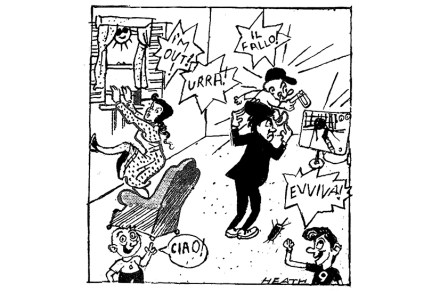
Dante’s Beach, Ravenna My fiery Italian wife Carla is not just a passionate patriot but also a devout Catholic, and so with perfidious Albion looking good and leading gli azzurri one-nil she disappeared to wash her hair and pray to the Madonna. The next day, when the dust had settled, I asked her why. ‘I was suffering so much pain that I felt like swearing and blaspheming at the inglesi,’ she said. That left me — a lone inglese — in front of the TV with our six children (aged five to 17) who feel passionately Italian despite being half English. When Italy scored the dreaded equaliser they exploded with joy and Carla returned briefly to watch the replays, wrapped in a towel and with her long black corkscrew hair still dripping with water.

Let hymn in: the silencing of indoor singing is senseless

From our UK edition

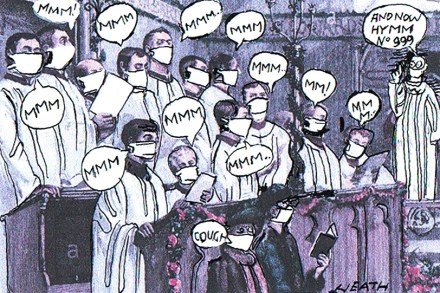
‘And now we sing our final hymn, number 466.’ Remember that? The euphoria of congregational hymn-singing? The well-organised types always had the book open at the correct page, balanced precariously on the pew. The rest of us hurriedly flicked to 466 while singing the first verse, knowing it by heart from a thousand school assemblies. ‘Our shield and defender, the ancient of days…’ I can’t believe I’m writing this in the past tense, but it has been so long — almost 15 months — since anyone not in a choir sang a congregational hymn. How I miss that light-headedness, almost faintness, of standing up after a long service and singing your heart out, filling and emptying your lungs, fortified by the tiny wafer and sip of sweet wine.

‘Spiritual but not religious’: the rise of consumerism in church

From our UK edition

I was raised Christian and the more I’ve thought about it, the more curious something about my upbringing seems. My church was constantly denying it was ‘religious’. By any objective social--scientific measures, the community was decidedly religious. Maybe we weren’t that organised (there was no website), but we recited historic creeds, we submitted to the authority of a sacred text and we practised ancient rituals. We identified with the worldwide institutional expression of the body of Christ, yet we still liked to say we weren’t ‘religious’. Throughout my childhood I was reminded in sermon after sermon that we were ‘-Spiritual but not Religious’.

In America, politics has become a form of religion

From our UK edition

When I finally head back to church this weekend, after a year of Covid-avoidance, it is going to feel a little strange. These past 12 months constitute the longest stretch of time I’ve been away since I was born. And I’m not going to lie, part of me liked the sudden plague-long dispensation. I’ve become used to the lazy, empty, gently unfolding Sundays. They’ve grown on me. I could live like this, it occurs to me — as so many others do, all the time. So why go back? When I ask myself what exactly I’ve missed, I realise it isn’t a weekly revelation. I don’t expect to feel something profound every time I go to Mass — because most of the time I don’t, and rarely have.

Sturgeon suffers courtroom blow over church lockdown rules

From our UK edition

The Scottish government has suffered a major reversal in court over its Covid-19 regulations. The Court of Session has found its blanket ban on public worship to be unlawful. In January, Nicola Sturgeon closed places of worship across Scotland ‘for all purposes except broadcasting a service or conducting a funeral, wedding, or civil partnership’. She said at the time that, while ministers were ‘well aware of how important communal worship is to people… we believe this restriction is necessary to reduce the risk of transmission’. Canon Tom White, parish priest of St Alphonsus in Glasgow's east end, and representatives of other Christian denominations, sought judicial review.

How the Church of England can bounce back from its Covid crisis

From our UK edition

The bishop of Manchester has warned that many Church of England churches are unlikely to survive the pandemic. The normal trickle of church closures (around 25 per year) is set to become a steady stream in the next few years. 'I suspect the pace (of closures) will increase as a result of Covid', the Right Rev David Walker has said. It will be a sad loss to the nation’s social fabric if hundreds of churches become flats, or offices, or are demolished. But there is another possibility. The pandemic has highlighted our need to invest in local communities, and this is an opportunity to do so.

Vicars like me are struggling in lockdown

From our UK edition

A year of living through a pandemic has taken its toll on the best of us. Vicars like me are no exception.  As a healthy and normally upbeat 52-year-old, this feeling of gloom is frighteningly new. Anecdotal stories from clergy friends tell a similar story to my own: the urge is to curl up and mask the misery with binge marathons of Netflix box sets. But this brings only short-term relief. A cursory look at social media posts show that a good number of vicars are struggling to keep it together.  The pressures on vicars come from every quarter. Some vicars have been landed with the impossible task of maintaining empty churches as elderly volunteers withdraw to shield or isolate.

Closing churches again would be a big mistake

From our UK edition

It’s somehow not that surprising to find that the Bishop of London has gone on Twitter to suggest that churches should consider closing. Sarah Mullally wrote:  'The situation is serious in @dioceseoflondon do read the request from @londoncouncils and consider the seriousness of the situation as you take your local decisions.' Well, thanks for that. Her observation is plainly intended to push for closures; it’s the only possible way of interpreting her contribution. And duly, she led the news this morning. She’s following Sadiq Khan here, mayor of London, who, when he declared a state of emergency yesterday, called for places of worship to close.

A woke church is doomed to fail

From our UK edition

My church attendance leaves something to be desired and I can’t cite Bible verses for every occasion. Yet for as long as I can remember, I have been a staunch supporter of the Christian church. But while I’m always willing to speak up for the church, it is not always willing to defend itself. Iceland became a Christian country over a thousand years ago. Here, as in other Western countries, the teachings of Christianity and the work of the church have been enormously influential in shaping our societies. Yet all too often nowadays, the church in Western societies is silent on the issues that matter. All too often, it fails to offer even a basic defence of Christianity and Western values.

Why has England banned worship?

From our UK edition

Over the weekend, more than a hundred religious figures from across the different faiths launched a legal challenge against the ban on communal worship in England. They claim the Covid restrictions are a violation of their basic human right to freedom of religious expression. Leaders from the Anglican and Catholic churches, as well as the Muslim Council of Britain, are in agreement on how unfair they view the ban. It's difficult to think of a cogent argument against their position.  For background, I am an atheist. Raised in a Catholic family, I never truly believed, even as a small child. Atheism has been something that has been with me throughout my whole life. Yet the argument that those of faith should be allowed the freedom of communal worship is compelling.

What should you charge for a virtual conference?

From our UK edition

From time to time, every industry must adapt to some inconvenient technological advance. Suddenly, some part of what you offer can be reproduced or distributed in a new form. The temptation is to ignore the issue and hope it goes away. But if you don’t act, eventually some competitor, existing or new, surely will. Reinvention is a painful process. Hollywood’s reaction to the advent of television followed the five stages of grief: denial, anger, bargaining, depression, acceptance. The same emotions played out in the response of the music industry to the arrival of digital downloads and streaming. Churches will have noticed that online congregations are larger than physical ones In retrospect, some of this looks absurd.

Will coronavirus hasten the demise of religion – or herald its revival?

From our UK edition

On Saturday evening, Christians will prepare for an Easter unlike any other. With every church closed, from St Paul’s Cathedral to the meanest country chapel, Anglican worshippers will be directed to a website where lay leaders, priests and bishops will hold a ‘virtual vigil’ ending at dawn on Easter Sunday. In Westminster Cathedral, the mother church of Catholics in England and Wales, a deacon will sing the great Easter proclamation known as the Exsultet. But this year, when the final syllable dies away, he will look out into the nave and see row upon row of vacant seats. It’s faith, but without the faithful. It’s happening the world over. This week Jewish families were forced to celebrate the Passover Seder without guests for the first time.

Letters: Why coronavirus is so hard to investigate

From our UK edition

Corona mysteries Sir: John Lee highlights the issue of dying of seasonal flu vs dying of coronavirus when assessing attributable deaths (‘The corona puzzle’, 28 March). The obvious solution would be a high autopsy rate. However, autopsies on known or suspected coronavirus deaths are not being done in case they lead to mortuary technologists and pathologists becoming infected. (Tuberculosis, HIV and even rabies infections are easier to prevent in mortuary work than coronavirus.) This contributes to a lack of information about how coronavirus affects people. In the long term, it also seems unlikely that anatomical examination of the dead will revert to its pre-coronavirus autopsy rate of 17 per cent of all deaths (in England and Wales).

The psychological and economic dangers of enforced idleness

From our UK edition

‘Lourdes shrine closes healing pools as precaution against coronavirus,’ says a discouraging headline in the Catholic Herald. Jesus ‘made the lame to run’ and ‘gave the blind their sight’, but Christians are not like Jesus, however much they may try to imitate him. We lack miraculous powers; and so, in matters of life and death (though not of the afterlife), we must defer to the civil power. On Tuesday, our neighbour rang for my wife, who is a churchwarden, and asked: ‘Shall I open the church as usual this morning?’ After some rummaging on the diocesan website, she found that the answer, following Boris Johnson’s broadcast the night before, was ‘No’. The same applies to the Catholic church I attend.

Dear Mary: How can I foil a notorious place-swapper at my daughter’s wedding?

From our UK edition

Q. I am arranging the seating plan for my daughter’s wedding and have a problem with one of her guests who is notorious for swapping her place to insert herself between ‘better’ people and thus disrupting the whole scheme. There will be 20 tables of eight at the dinner and I will be too busy to keep an eye on her. What do you suggest, Mary? — Name and address withheld A. You can outwit this disruptor by substituting a pseudonym, say Harriet Belafonte, for her own name on the grand plan at the door. Her name will not appear and so she won’t know which place name to swap.

American Catholicism is going back to the future

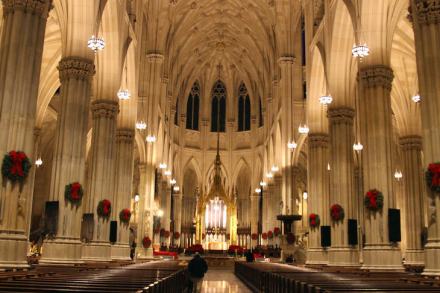
A couple of years ago, in high summer, my wife and I attended Mass in St Patrick’s Cathedral, as we do every time we visit New York. It is, in general, a bracing experience for Catholics who have been paddling in the tepid pools of Irish Catholicism. The celebrant, a middle-aged man with the physique and personality of a matinee idol, gave a startling sermon about the gospel of the day, Matthew 10:34, in which Jesus declares, ‘I have come to bring not peace but a sword.’ In his homily, the priest tore into sentimental notions of Christianity and the corruptions of concepts such as compassion and mercy.

catholicism