Church

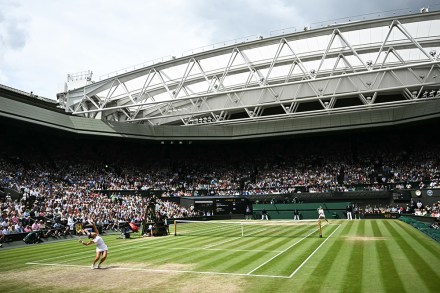
Dear Mary: What should I do if the view’s no good with my free tickets to Wimbledon?

Q. Around this time of year a friend, who gets hold of tickets through an agency, usually asks me last-minute to Wimbledon. The trouble is it’s hard to know whether she has good seats. One year was perfection as we had shaded middle-tier seats, but last year we had an obstructed (pillar) view and I would rather have watched at home. I am sure there are those among her friends who would love to be there in any kind of seat so how, without sounding ungrateful or spoilt, can I ascertain what’s on offer before accepting? – H.S., London SW6 A. First familiarize yourself with the court layouts and seat numbers. Then, if she invites you, say: “What an incredible coincidence. I have just been speaking to X (a fictional friend). X has also managed to get last-minute seats.

Wimbledon
hat

Why do men think it’s acceptable to wear a hat in church?

There’s often a traffic jam in front of the Battle of Britain window in Westminster Abbey and I recently found myself jockeying for position with a man wearing a baseball cap. A hat, in church! I thought I ought to say something, but as I was with an official guide, I decided it perhaps wasn’t my place. A very English cop-out, I confess. Then I saw a second man in a cap and, hat-radar activated, I started counting. And stopped at seven. Clearly, it was impossible that seven male hat wearers had all slipped unnoticed past the Abbey’s considerable security and, equally clearly, there must be a new attitude to hats in church and I hadn’t received the memo. I thought I’d check with the Very Reverend Dean.

How to save our churches 

From our UK edition

Easter is being celebrated by millions of families across our country. It’s one of those moments when we should come together, pause and remember what really matters. As a mother with a very busy job, I value this time with my children more and more each year. It is a time for faith, family and fun. Britain is a Christian country. Our values, our customs and many of our greatest institutions were shaped by Christianity. That is why, for so many people, going to church at Easter still matters. I teach my children that it is not just a ritual. It is part of who we are. That is why this is a good time to talk about churches. Churches matter. They are not just places of worship.

The science of marriage

“Those whom God hath joined together, let no man put asunder.” With this stern admonition, the Church has long been a fervent defender of marriage. But as religion has faded as a social force, so too has marriage.  Does it much matter if people choose to shack up together instead of tying the knot? What is lost if some men want to be incels or some women decide a husband is a bothersome surplus to their needs? The problem is that all lifestyles alternative to marriage serve to undermine it. And like other major social institutions, marriage is not some arbitrary cultural construct like a federal holiday. Rather, it rests on genetically shaped behaviors that evolution has written into the human genome because of their survival value.

Marriage

Go to church

It’s often noted that American society is becoming ever more politicized and polarized. Those who once imagined themselves uninterested in politics find themselves dragged into America’s culture wars. Small children now carry placards and attend political marches. Max Horder and Danit Sara Finkelstein explain the extent to which social media has played a part in this growing radicalism, not just because of the ideological echo chambers we now inhabit, but due to the mindset online algorithms create: rewarding outrage, encouraging extremism. Nuance and balance are anathema; shock and division set each day’s tone.

spiritual

Owen Matthews, Bijan Omrani, Andrew Hankinson, Laurie Penny & Andrew Watts

From our UK edition

29 min listen

On this week’s Spectator Out Loud: Owen Matthews says that Venice’s residents never stop complaining (1:11); Bijan Omrani reads his church notebook (7:33); Andrew Hankinson reviews Tiffany Jenkins’s Strangers and Intimates: The Rise and Fall of Private Life (13:54); as 28 Years Later is released, Laurie Penny explains the politics behind Alex Garland’s film franchise (18:25); and, Andrew Watts provides his notes on Angel Delight (25:09). Produced and presented by Patrick Gibbons.

How Pope Francis kept the faith

From our UK edition

As timing goes, a pope simply can’t do better than to die just after Easter Sunday. The moral of the thing hardly needs saying. Francis died in Christ and will share His Resurrection. In fact, that’s exactly what several bishops have been observing today. But Francis also had his Good Friday. He was desperately ill in the Gemelli hospital in February, being very close to death in particular on 28 February. But he pulled through with all the drugs and therapies possible, and went triumphantly on. For that’s what he did. That popemobile trip round St Peter’s Square yesterday, the meeting with J.D.

The Francis effect

From our UK edition

Pope Francis was a man of remarkable complexity who cultivated an image of utmost simplicity. He began the moment he first stepped out on the balcony overlooking St. Peter’s Square in plain white papal attire, without the traditional red mozzetta covering his shoulders, and greeting onlookers with a homely ‘buona sera’. The following day, he was photographed settling his hotel bill. Instead of moving into the Apostolic Palace, he opted to live in a Vatican guesthouse, the Casa Santa Marta. This was also seen as a sign of the new Pope’s humble style. But the decision was more complicated than it seemed: the Casa Santa Marta’s rooms aren’t drafty monastic cells; the Apostolic Palace isn’t exactly the Hotel de Russie.

World leaders pay tribute to Pope Francis

From our UK edition

Pope Francis has died aged 88. At 7.35 a.m., the Vatican announced that Pope Francis had ‘returned to the house of the Father’ at his residence in the Vatican’s Casa Santa Marta. Cardinal Farrell, who announced the death, added that Francis ‘taught us to live the values of the Gospel with fidelity, courage and universal love, especially in favour of the poorest and most marginalised’. Tributes are already pouring in from political and religious leaders around the world. These are the messages that have been sent so far: J.D. Vance, the US Vice-president Vance, the last statesman to meet Francis, having been granted a brief audience with the pontiff yesterday morning, wrote: I just learned of the passing of Pope Francis.

Pope Francis and the Vatican reckoning

From our UK edition

Modern popes, for better or for worse, tend to be defined in soundbites. John Paul II’s clarion call of ‘Be not afraid’ became emblematic of his invitation to young Catholics to embrace their faith and his rallying of the West against the spectre of international Communism. Benedict XVI’s great theological career, and his term as a pope in the model of priest and professor, remains summed up in his simple declaration that Deus caritas est. For Francis, who has died at the age of 88, the world will likely remember, in the immediate weeks after his death anyway, his often quoted, though often misrepresented, motto of ‘who am I to judge?

My rules for church readings

From our UK edition

It is that time of year when people in churches across the land have to face the difficult question of how to read scripture out loud. I count myself a bit of an expert in this, not because I have had to do it many times for some 35 years, but because I have seen everything go wrong that can go wrong. It is like the fear that engulfs me when-ever an unaccompanied treble kicks off the first verse of ‘Once in Royal David’s City’ at the service’s start. If the treble goes off-key in that solo verse, one of the great black holes in the universe opens up – for the choir and conductor must swiftly decide whether they should begin their next unaccompanied verse in the original key, or resign themselves to whatever key the treble has arrived at.

What The Spectator taught Benjamin Franklin

From our UK edition

Christmas came early this year. No, I’m not moaning about the carols that my local café started piping at the beginning of September (although that’s enough to enrage any priest). This year my first proper Christmas moment occurred two weeks early when a lovely couple chose to have not one but two Christmas carols for their wedding. We hadn’t even hit December before I found myself in the curmudgeonly position of muttering ‘Except Easter’ as a full church belted out the line ‘This holy tide of Christmas all other doth efface’. It was all very jolly, even if I felt momentarily Scroogelike. Not that this was the most amusing of the winter weddings that we’ve held at my church, St Bartholomew the Great in West Smithfield.

Why it’s time to go back to church

From our UK edition

Somewhere in the midst of the hurly-burly antics and preoccupations of life, I think maybe, I’m probably a Christian. Not the type who sings in church with his eyes shut, but an extremely moderate, unthinking Anglican for whom the prospect of the existence of nothing is too painful for words. That makes me the sort of Anglican who starts to pray once the 747 has been in freefall for six seconds or more over the Atlantic, or the type that looks heavenward when Harry Kane is about to take the most important penalty in the recent history of English football. As a result, the Great Being plays precious little part in my day-to-day life; I fear I’m essentially Godless.

Setting the record straight on the Latin Mass

Actor Shia LaBeouf is known for being pretty…let’s call it outlandish. The “controversies” section on his Wikipedia page is hefty. He comes off in interviews as intense, impulsive, and potentially explosive (he once reportedly made a fan cry because she asked for his autograph). He’s being sued by his ex-girlfriend over abuse allegations and just welcomed a child with his on-again-off-again wife. Then there’s his full-torso tattoo. Now, LaBeouf is back in the headlines, but for once it isn’t for anything “scandalous” (despite what Slate might claim).

The Russian Orthodox Church eyes Ukraine

Christopher Hitchens, allergic to the idea that secular regimes might actually be more bloodthirsty than religious ones, infamously attempted to blame the atrocities of Stalin’s Soviet Union on the Russian Orthodox Church. It was an end run worthy of the NFL Hall of Fame, and no doubt Hitch would be attempting something similar if he’d lived to see Russian President Vladimir Putin’s invasion of Ukraine. He would be wrong, but as Putin fights to reclaim territory once held by the Soviet and tsarist empires, the church appears to be conducting its own parallel campaign of spiritual imperialism. There’s little doubt Putin sees the church as politically useful.

Letters: It’s time for the common cup to return to communion

From our UK edition

The Bull of Oman Sir: There was one significant omission in the cast of characters mentioned by Charles Moore in his notes on the Sultan of Oman’s armed forces (Notes, 19 February): General Sir Timothy Creasey KCB . The omission is all the more surprising given the key role Margaret Thatcher played in getting General Tim to take up the Sultan’s invitation to go back out to Oman as deputy commander in chief and chief of defence staff. Having been instrumental in achieving a satisfactory resolution of the insurrection in Dhofar as a senior loan service officer, General Tim was highly regarded by the Sultan but he was not keen to take up the offer of direct employment.

Bring back communion wine

From our UK edition

The Church of England has always been clever at producing theology to suit itself. If we don’t start protesting, we may never get communion wine back again. Too many risk-averse clergy have discovered how efficient, hygienic and cheap it is just to give us a wafer each. They explain it away by reminding us that ‘Christ is sacramentally and equally present in both the bread and the wine, so if you receive only one, nothing is lacking’. ‘But it’s so unfair,’ I want to hiss at the presiding priest when I see him or her having a sip of wine ‘on behalf of the congregation’. ‘It’s one rule for you, another for us.

The churches must stay open

From our UK edition

Hooray for Cardinal Vincent Nichols, who used the one day of the year when his pronouncements are amplified by the season to 'sincerely appeal that [the government] do not again consider closing churches and places of worship.' He said in a BBC interview he believed it had been demonstrated that the airiness of churches meant they are 'not places where we spread the virus'. Mind you, Catholic churches weren’t as bad as the Church of England This is, of course, entirely sensible. It was nuts for churches to close at the start of lockdown, at least as spaces for prayer if not for communal worship. Pretty well any church is 'Covid-safe', in that there’s lots of room for people to spread themselves out.

Why I’m paying my daughter to go to church

From our UK edition

It would be weird if my 13-year-old daughter didn’t say she was an atheist. It’s what you say in our culture when you’re that age. To be honest it would creep me out a bit if she was all pious. But she is getting confirmed into the Anglican faith. This is a piece of hoop-jumping that her parents have decided to require of their children. I went for coffee with the vicar to ask if my daughter could join the classes. I admitted that she was a bit reluctant. In fact, it was a mixed picture. Whenever I mentioned confirmation she professed her atheism, but when I didn’t mention it for a couple of weeks she asked when the classes were starting. She is not entirely averse to attention, even if it is directed at her eternal soul. Her church-going to date has been patchy.

Justin Welby is missing a trick on climate change

From our UK edition

Justin Welby urges us, echoing Deuteronomy, to 'choose life', so that our children may live. It is an apt use of scripture, in the face of the climate emergency. But his performance on Radio 4 this morning was far from impressive. The Archbishop of Canterbury spoke of the need for ‘meaningful sacrifices’, but when asked which ones he was making he sounded a bit muddled, as if he was not ready for such an obvious question. His first answer was ‘recycling and all that’, a locution with an air of irritation, like a man too often nagged to take the bins out.  Can’t Lambeth Palace afford daily sausages? Asked about meat, he said he had cut down, but mainly for health and financial reasons. (Can’t Lambeth Palace afford daily sausages?