Christmas

An outpouring of jaunty black comedy

From our UK edition

In 2005 Xandra Bingley published Bertie, May and Mrs Fish, an extraordinarily lively and enjoyable memoir of her childhood on a Cotswold farm during the second world war. Much of the writing was glancing rather than straightforward, its narrative not strictly chronological, while its title hinted at something not fully explained in the text. Dispensing altogether with conventional punctuation, the book contained not a single comma or quotation mark, using instead ellipses. This was brilliantly imitative of both the clipped speech of its upper-class characters, particularly when facing disasters large and small, and the hell-for-leather pace of lives spent galloping on horseback across the Gloucestershire countryside.

The chaotic thrill of a horse auction

The story of Harry deLeyer and his horse Snowman reads like a Disney classic. DeLeyer was a Dutch immigrant farmer who bought Snowman at auction with his last $80 in the 1950s . Snowman was an unpedigreed plowhorse, already old by competitive riding standards, and likely headed for the glue factory when deLeyer saw promise in his strength and spirit. They went on to become one of the most successful pairings in the history of showriding, taking home the Triple Crown of national titles in 1958. The horse world has changed a lot since then. Both training and breeding are highly scientific across all pursuits, from showriding to racing.

Why I’m keeping my Christmas decorations up until February

From our UK edition

It feels like the 57th day of January. Last week the coldest temperature of the winter so far (-12.5°C) was recorded about 20 miles west of my house. And according to every newspaper and social media feed I have scanned since new year, I should be purging my body of toxins by eating ‘plant-based meals’, abstaining from alcohol or otherwise giving up any semblance of comfort and joy. But there is another way. This may be ‘the worst time of the year… the very dead of winter’, as T.S. Eliot described the season in ‘Journey of the Magi’, but we are still in Christmastide – right up until 2 February, or Candlemas.   Twelfth Night used to be about fun and misrule, incorporating elements of the Romans’ midwinter festival Saturnalia.

Britain’s lack of trains on Boxing Day is shameful

From our UK edition

Among all the perfidies of public transport in Britain (a nation that can build a £40 billion railway based on the premise that the outskirts of Acton counts as a ‘central London’ terminus), perhaps the most ludicrous of all is this. On 26 December, a day when millions of us need to move about, no trains run. HS2 makes me angry. But I’ve spent every festive period of my adult life feeling positively dyspeptic about the meek acceptance with which we tolerate the almost complete lack of trains departing or arriving at any UK railway stations on Boxing Day. We are an absolute, solitary outlier in this regard. Even in Italy, where Christmas stretches lazily from Christmas Eve until Epiphany, there’s a skeleton timetable on 26 December.

Tea with a twist: the army’s curious Christmas drink

From our UK edition

On Christmas morning, as you make your first tea or begin mixing your eggnog, spare a thought for our armed forces. Since the 1890s, they have been starting Christmas Day with a drink that sounds more like a bizarre hangover cure than a festive pick-me-up.  Known as ‘Gunfire’, the drink is made of one part rum to three parts black tea. By tradition, the beverage is taken hot and is served by senior officers to junior soldiers, making it one of the few occasions in which the ordinarily inflexible roles of the military are reversed.  Although no one is quite sure how Gunfire got its name, the most compelling theory, according to the Royal Norfolk Regimental Museum, comes from an encyclopaedia compiled by Major R.D. Ambrose.

Santa Trump’s Christmas economy cheer

I hate to be the bearer of good news, but the US economy is doing quite well. A delayed government report shows that third-quarter GDP grew at 4.3 percent, hardly a record, but still healthy, the highest growth rate in two years. Last week’s inflation report showed a lower-than-expected number, and wage growth is exceeding inflation. Consumer spending is up, and, yes, the stock market is booming. Happy days are here again. The sky above is clear again. Many accounts on my X feed, which are either run by Democratic partisans or Iranian trolls or both, say that food-pantry lines are reaching record numbers this holiday season, and that poverty and homelessness are increasing even as the rich get richer. “Trump lies,” they said. Yes, and the sun is hot. What’s the point?

Trump

This Christmas, listen to Mary Did You Know?

A popular and poignant Christmas song, written late in the previous century for a church’s holiday program, incites passionate criticism from those who disagree with the way it phrases its message. Since first being recorded in 1991, “Mary, Did You Know?” has been performed by soloists and groups ranging from Carrie Underwood and Dolly Parton to Pentatonix, CeeLo Greene and Kathleen Battle. The lyrics are a series of questions to Mary, Jesus’s mother, asking whether she knew during his infancy about the profound impact he would make as an adult. Yet that powerful literary device annoys those who believe the song demeans its subject.

I’m a Jew who loves Christmas

From our UK edition

On more than one occasion, I have found myself being lectured by non-Jews (always men) about why I am incorrect in my Jewishness. Judaism is a religion and I can’t be Jewish if I am an atheist, some say. The ones that accept the atheism then feel compelled to categorise me as a ‘cultural’ Jew whose identity is defined by rituals and customs passed down over the centuries. And then there’s the stern mystification about the relatively minor role that Hanukkah plays in the spiritual calendar for Jews. It is hard for some to realise that while it involves lights and wintry nights, Hanukkah is not remotely the equivalent of Christmas. Nothing in Judaism is.

The quiet joy of spending Christmas alone

From our UK edition

The first thing I should tell you about my relationship with Christmas is that I’m not saturated in essence of humbug. My approach to a big family Christmas is the same as my relationship with Mexican food: if it’s put in front of me I’ll enjoy it, but I probably wouldn’t ever purposely seek it out for myself. With no family to speak of within 200 miles and with a fiancée who usually has to work on Christmas Day at her job as an NHS intensive care unit nurse, I’ve spent quite a few recent Christmas Days on my own in London. On the first year in particular, I admit I did slouch around the house with a face like a farrier’s anvil.

Spare us from the snarky Christmas bauble

From our UK edition

I have been scouring the internet for a Christmas bauble for my mother-in-law. I have fond memories of the blown glass baubles of my childhood – the little wooden cabin in the trees, covered in powdery snow; the half papaya, its orange cocoon concealing bright purple seeds inside. Last year I bought myself a glass bauble of Big Ben which, though perhaps not traditional, is still charming. We have a red post box too, which occasionally disappears and turns up in my son’s Lego set.  This year, though, I ventured to Etsy for a bauble and was shocked by what I found. The first one that caught my eye was a cartoon-like depiction of the nativity, with a speech bubble pointing to the babe in the manger and saying: ‘Spoilers: he dies.

Dessert wine isn’t just for pudding

From our UK edition

At the end of the 1970s, when I had my first taste of wine, the choice was limited. It was either cloyingly sweet German Liebfraumilch, or something from the Don Cortez or Hirondelle types, both of which were sour and brash. That, younger readers, was how bad things were, and why many of us during that time stuck to lager and lime. When Le Piat D’Or came on the market, it was, frankly, a relief. But things have changed, including my palate. Sweet or semi-sweet wines can be delicious, and bear no resemblance to the cheap German variety of my youth. Many moons ago, invited to my first posh dinner party, I was bowled over when served a lightly sweet Riesling with a fruit crumble. Riesling is a key component in Liebfraumilch, but not all Liebfraumilch is Riesling.

A snob’s guide to last-minute Christmas gifts

From our UK edition

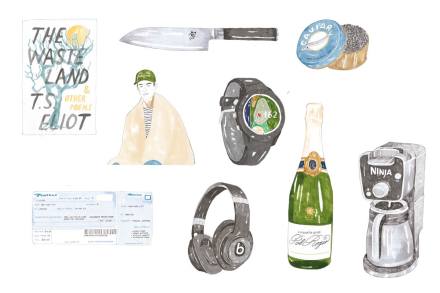
The algorithm got me in the end. It began with recipe content, and once I was hooked on food influencer videos, I began to be pummelled with adverts for attractive pots and pans, then clothes, and from there an ever-widening vista of objets and objects by turns pretty or useful and occasionally both. The result, apart from frittering away a certain amount of money on non-essential cardigans and kitchen gadgets, has been the development of a ruthless taste and approach to e-commerce. I want to have, and want to give, nice things, and increasingly I know where to get them. I am also hopelessly disorganised, a snob and far from awash in cash. If you’re anything like me and have yet to get your gifts sorted out, read on.

‘Have Yourself a Merry Little Christmas’ is far from merry

From our UK edition

Here is a great festive pub quiz question for you. Which film was the song ‘Have Yourself a Merry Little Christmas’ written for? It’s likely, particularly if you’re below a certain age, that your first reaction will be surprise that it was written for a film in the first place. That’s a reflection not so much of the failure of the film in question – Meet Me in St Louis, which was the second highest-grossing film of 1944 – but of the enduring popularity of the song itself. In 2023, it was the 11th most played holiday song, according to the American Society of Composers, Authors and Publishers. But just as the song has transcended the film, it has become unmoored from its original meaning.

Hold on to your peppermint mochaccinos – the Rockettes are not from New York City

In some ways, it feels like I stepped off the plane at JFK from London mere days ago – wide-eyed, naive and still convinced that “winter” would be charming and cozy rather than a six-month endurance test in avoiding frostbite. Yet here I am, somehow entering my sixth year of participating in the annual pageant that is the New York holiday season: that weeks-long spectacle beginning with the first delicate whiff of PSL-something and ending in the far-too-slowly receding hangover on an insultingly arctic New Year’s Day. The first year, Covid-tinted and therefore emotionally reminiscent of a half-deflated Macy’s parade balloon, was not what one might call festive. But things have really picked up since.

rockettes

The joy of Jell-O

My grandmother lived on a Christmas tree farm in Indiana. December weekends meant hauling evergreens, pulling needles from our socks and pretending I was far more help than hindrance. But the real event – the thing the whole month orbited – was Christmas Day dinner: the good china, the stiff grace and the quiet family rule that no one under 20 offered up an opinion unless asked. The table was a study in American aspiration: a ham glossy with cloves, wassail steaming on the hob, potatoes whipped into obedient fluff, canned cranberry sauce still bearing its aluminum-molded rings… and always, inevitably, the Jell-O. There were several, because my family believed in abundance, even when the abundance quivered. Aunt Deb and Uncle Fritz arrived with their famed Jell-O eggs.

How to cater for the dreaded Ozempic Christmas guest

From our UK edition

A close relation of mine is taking Ozempic. I shan’t name them or give anything else away other than to say this: they are set to ruin our Christmas lunch. They know it, and we know it. Welcome to British Yuletide 2025 – a country where more than 1.5 million people are estimated to be using GLP-1 agonists such as Ozempic, Mounjaro and Wegovy, with the vast majority (90 per cent) obtaining the drugs privately. NHS analysis of Ozempic hotspots reveals Leicester, Thurrock in Essex and the Wirral to be where users congregate. Clearly, they haven’t done an analysis of private users in Oxfordshire where I live.  This being so, we are locked in a curiously modern etiquette conundrum.

Why religious societies succeed – with Rory Sutherland

From our UK edition

35 min listen

Advertising guru – and the Spectator's Wiki Man columnist – Rory Sutherland joins Damian Thompson for this episode of Holy Smoke. In a wide ranging discussion, from Sigmund Freud and Max Weber to Quakers and Mormons, they discuss how some religious communities seem to be predisposed to success by virtue of their beliefs. How do spiritual choices affect consumer choices? Between Android and Apple, which is more Protestant and which is more Catholic? And what can modern Churches learn from Capitalism? Produced by Patrick Gibbons.

How I won over a Scrooge-like New Yorker

Like all men, my dear friend Chris Black is an absolutely terrible person to shop with. He behaves only marginally better than a boy toddler. As we stood on the street outside Fortnum’s, this New Yorker’s greeting to me was, “I’m not really a Christmassy kind of person.” How anyone could say this when they are about to enter the Father Christmas of department stores is beyond me. Fortnum & Mason, with its crimson carpets and twirling mahogany doors, counters groaning with marzipan and chocolate and its gracious staircases and red-coated butlers transport even the most jaded shopper to a gentler time when Christmas shopping was an “outing,” one that you dressed up for, before people had even imagined scroll-and-click retail.

The agony of the village Christmas drinks party

From our UK edition

Sometime in mid-October, my husband and I begin our annual deliberation: should we host a village Christmas drinks party? The conversation is almost invariably instigated by my charming husband who, mindful of all the invitations we have shamefully yet to reciprocate, feels that we ‘ought to do it this year, at least’. Almost invariably, I am the voice of dissent.  The arguments I give against are motivated by two competing – but not entirely dissimilar – emotions: vanity and concern. Vanity because I worry that my house is neither big enough nor grand enough for the sort of event I have in mind (think something along the lines of a reception at St James’s Palace, complete with hot and cold running staff and Old Masters jammed on to every wall).

Matthew and Camila McConaughey’s signature Christmas cocktail recipe

Our Santa Pants cocktail is one of our go-to holiday pours when hosting at this time of year. Made with our organic tequila and ginger beer, cranberry juice and fresh lime, it brings all the sparkle and cheer of the season. It is like Christmas in a glass. And while the world doesn’t need another celebrity tequila, it could use a shot of fun. So this Christmas, enjoy yourself and keep the holiday spirit flowing. Here’s how to make it. Ingredients – 60ml Pantalones Organic Tequila – 60ml cranberry juice – 15ml lime juice – Top with ginger beer – Garnish: sugar rim, cranberries, rosemary Rim the edge of a rocks glass with a lime wedge, dip the rim in sugar to coat and set aside.