China

MPs in the dark about Beijing’s threats

From our UK edition

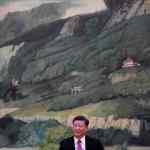
Following the killing of Sir David Amess, there has been much discussion in recent weeks about the safety of elected representatives. But while the public conversation has largely focused on radicalised loners, constituency surgeries and online abuse, Steerpike fears that the commentariat have overlooked the dangers still posed by hostile nation states to parliamentarians here in Westminster – particularly those who speak out about China. Earlier this year Mr S reported that MPs who have been sanctioned by Beijing for speaking out on the regime's human rights abuses have received 'zero substantive help' from the Foreign Office.
Cold War, hot planet

From our UK edition

Chelyabinsk is one of the most polluted places in the world. On 29 September 1957, an explosion ripped through the nearby Mayak nuclear plant — which processed plutonium for the Soviet Union's atomic bombs — casting a cloud of highly radioactive debris across the central Russian region. Despite communist officials keeping the disaster tightly under wraps, tens of thousands of people were, eventually, evacuated from the worst-hit villages, and vast swathes of the surrounding area have been closed to the public. More than half a century on, the nuclear fall-out is now the least of the ecological worries.

China’s great log forward

From our UK edition

Every year, China plants trees over an area the size of Ireland. The country may be the biggest polluter on Earth, but its reforestation efforts are enough to make Saint Greta look twice. In the last decade, the ‘Great Green Wall’ project has cost more than £73 billion, and the country aims to expand its forest cover to 24 per cent by the end of 2025 (the total area of the five largest European countries combined). So this week’s announcement that China has signed up to a deal to end deforestation by 2030 together with world-leading tree-cutters like Brazil and Indonesia is not, in fact, a huge surprise – or commitment – on Beijing’s side.

Peng Shuai and the limits of China’s #MeToo movement

From our UK edition

China’s #MeToo movement has taken a step closer to the centre of power in Beijing, after sexual abuse allegations by a top Chinese tennis star were made against a man who until recently was one of Xi Jinping’s closest henchman at the pinnacle of Communist party rule. The tennis star, Peng Shuai, made the allegations against Zhang Gaoli, who until 2018 was vice-president and a member of the seven-strong Standing Committee of the Party’s Politburo, the country’s highest ruling group. Peng alleged in a post on her Weibo social media account that Zhang had assaulted her at the beginning of an affair that lasted from 2012 to 2017.

Don’t let China’s climate sins cloak its crushing of Hong Kong

From our UK edition

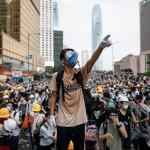
China’s failure to bring anything new to COP26 surprised no one. The world’s worst carbon emitter offered no advance on President Xi Jinping’s earlier promise to reduce coal use after 2025 and bring overall emissions to a peak in 2030 — thereby negating for at least a decade much of the rest of the world’s efforts to clean up the planet. But spotlighting China as a climate sinner should not be allowed to cloak its other villainhood, as an abuser of human rights: so let’s not forget Hong Kong. The fate of the once-British enclave and its future as an international business centre have been much on my mind lately.

National Trust members fight back

From our UK edition

At the National Trust’s annual general meeting last week, the voting was much more unusual than the public will have learnt from media reports. In most resolutions, the numbers voting exceeded 100,000. In past years, the figures have been lower than 40,000. The reason for this high turnout was the controversies of the past 18 months. Motions about the erosion of curatorial expertise and the ill treatment of Trust volunteers would have won easily had not the chairman exercised the right to use the discretionary proxy votes which the Trust’s curious governance permits. Without these, the rebel resolutions would have been more than 15,000 votes ahead.

India is going to keep polluting. They can thank China

From our UK edition

Mumbai India is the last major global polluter to set a date to go carbon neutral. In a surprise announcement on Monday, Prime Minister Narendra Modi told COP26 that his country will hit this target by 2070. That doesn't mean India is going to start cutting emissions any time soon. India’s ruling Hindu nationalist party, the BJP, believes it has the right to use coal to stimulate economic growth. The country argues that its per capita consumption of non-renewables is still a fraction of West's. Faced with the task of quadrupling its power output by 2050, the country's coal production is expected to increase by 28 per cent over the next ten years.

China’s energy crisis

From our UK edition

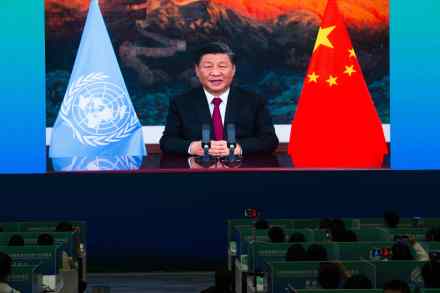
The absence of Xi Jinping from COP26 in Glasgow this weekend should strip away any illusion that China is a serious partner on climate change. It also points to another intriguing possibility – that we may be witnessing not Peak Carbon, but Peak China. The Communist party may be facing the sort of decline it wishes on the West, and as with the climate, the impact could be dangerous and unpredictable. By staying at home China’s leader can concentrate on what has become an urgent priority for his government: massively ramping up the production and import of coal to solve the energy crunch his increasingly unsustainable economy is facing. That might have been a bit of a conversation stopper around the dinner table in Scotland.

The rise and fall of Jack Ma

From our UK edition

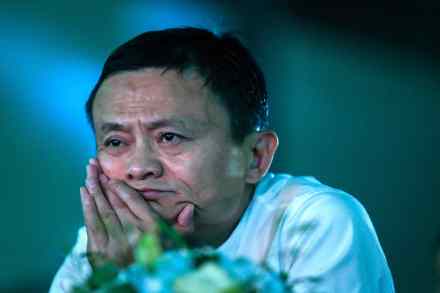
Jack Ma used to give rock star performances for his employees at Alibaba, Asia’s biggest online commerce company. He once dressed as Michael Jackson. But those halcyon days are gone. Over the last year, China’s richest man has had his wings clipped by the Chinese Communist party. The flamboyant Ma has only made a handful of public appearances (prompting rumours of a ‘disappearance’ at the hands of the CCP). This week, it transpired that Alibaba has almost halved in value — losing a record $373 billion over just the last 12 months. Ma’s downfall can be traced back to a misjudged speech he made in Shanghai this time last year.

Can Beijing buy the Taliban?

From our UK edition

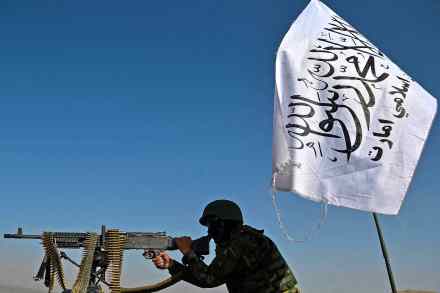
China is seeking a grand bargain from the Taliban: eliminate the groups Beijing says are stirring up trouble among its Muslim Uighurs in exchange for massive aid to rebuild Afghanistan. It sounds enticing for both sides as they sit down in Doha this week, but there are numerous questions about whether either can deliver, and a good chance that China will become the next imperial power sucked into the ‘graveyard of empires’. Mullah Abdul Ghani Baradar, the Taliban’s deputy prime minister, and Wang Li, China’s foreign minister, are reportedly meeting in the capital of Qatar just as the Taliban faces a growing number of attacks from Isis-K, a provincial affiliate of Islamic State. Baradar is insisting that the security situation is ‘under control’.

Maybe Hawaii should be independent

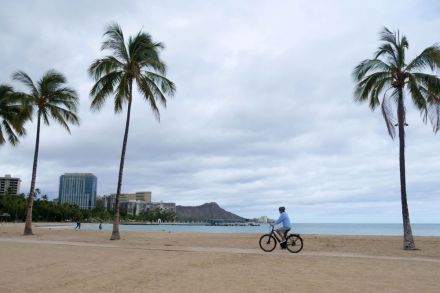
When you’re a writer, there’s no such thing as a vacation — there’s just visiting a new place with the potential to gather more material. Lucky for me, my most recent destination happened to be Hawaii. It’s a fascinating place, and if you didn’t already know it was a US state, it would be easy to mistake it for a distinct English-speaking country, albeit one with obvious and deep American influences. Oahu, the most urbanized island and home of the capital city of Honolulu, is shaped by an idiosyncratic mix of native Hawaiian, East Asian and midcentury American culture. Hawaii resembles a Pacific Island nation at least as much as it does the American mainland.

Parliamentarians plot to ruin China’s G20

From our UK edition

It’s a big week for fans of high politics and hobnobbing. Prior to the launch of Sunday’s COP26 shindig there is first the small matter of the G20 summit in Rome. And while the attention of many attendees – chief among them Britain’s Boris Johnson – will no doubt be on green gambits and climate diplomacy, there are fears that other crucial issues risk being overlooked in the dash towards Net Zero. Chief among these are the various abuses committed by President Xi’s China towards the Uyghur Muslims and the effective destruction of Hong Kong. Xi himself is not expected to physically attend the summit, not having left China since the Covid pandemic began in January 2020.

The car industry’s China crisis

From our UK edition

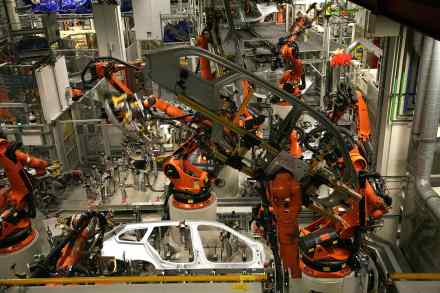
New cars could soon start disappearing from Britain’s forecourts, with the latest supply chain crunch threatening to cripple the global motor industry. It’s a crisis that once again delivers a stark warning about the dangers of over-dependence on China and the costs of succumbing to Beijing’s predatory trade practices. The automotive industry is currently facing a critical shortage of magnesium, which is an essential raw material for the production of aluminium alloys, including gearboxes, steering columns, fuel tank covers and seat frames. Stockpiles are running low, there is no substitute for magnesium in the production of aluminium sheets, and China has a near monopoly on the market.

LSE takes £1.5 million from China

From our UK edition

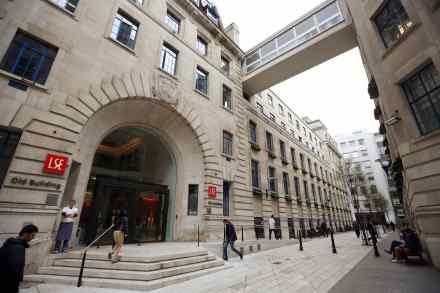
Boris Johnson might insist that the UK will not ‘pitchfork’ Chinese investment but it seems not everyone in government agrees. Liz Truss, the new Foreign Secretary, has made headlines today for saying what many on her back benches believe — that Britain cannot be dependent on China and allow it a role in our nuclear plants or the G7.  That fundamental divide on how to approach Beijing is not merely confined to Westminster, but rather something that extends across industry, civil society and of course, academia. One of the ways the Chinese Communist Party has sought to extend its overseas cultural influence is by Confucius Institutes.

How to counter China

From our UK edition

When another country does something to upset the Chinese Communist party, it gets accused of ‘a Cold War mentality’. This is psychological projection, in Freudian terms, a defence mechanism which projects onto others the negative aspects of one’s own self. But the CCP is right in a way: we should have more of a ‘Cold War mentality’ or at least a ‘values and systems war’ mentality. China is not the Soviet Union. We never co-operated with the USSR on trade and investment or science and technology. We do with China. Indeed the CCP sees itself as fighting a ‘values and systems war’.

Wuhan clan: the price I paid for my lab leak exposé

From our UK edition

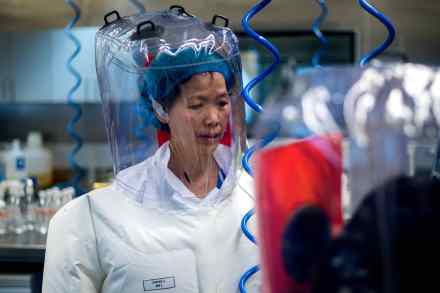
On 12 March last year, I texted a trusted source connected to Australia’s foreign intelligence agency. ‘What do you think about the theory that the virus came from a virology lab in China? Does that have credibility? I know it’s officially a conspiracy theory but China is not exactly a picture of transparency so I thought it’s possible.’ He replied to say he knew someone ‘very involved in the observation of that lab and its activities’ and it was a definite possibility the virus leaked from the facility. It was a surprising response because, at the time, this view contradicted every utterance by scientists and world leaders, who insisted the virus had a natural origin. Most media outlets dismissed the lab-leak theory as a conspiracy.

There is no Russia-China axis

From our UK edition

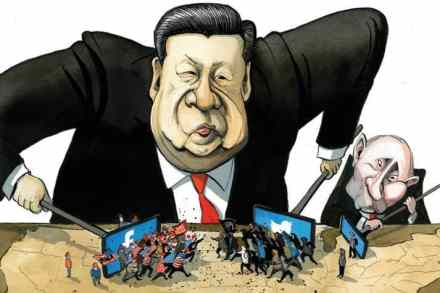
You should be careful what you wish for, because you might just get it, so the old cliché goes. In diplomacy at the moment, it seems you should be careful of the threats you prepare for, because you may end up producing them. There is a growing trend in the West towards treating Russia and China as some single, threatening ‘Dragonbear’ (a reference to the two countries' national animals). This underrates the very real tensions between Moscow and Beijing, but risks pushing them even closer together. The most recent case in point was Nato secretary-general Jens Stoltenberg’s interview in the Financial Times, in which he criticised ‘this whole idea that we either look Russia, or to China… because it goes together.

The sleepwalkers

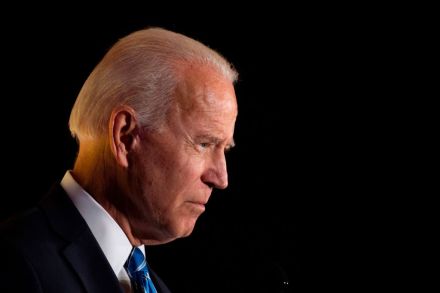
It is customary for presidencies to lose vitality and purpose in their last months. It is unprecedented for a presidency to lose its way in its first year, and when it still holds a majority in both houses of Congress. The Biden presidency has donned Jimmy Carter’s cardigan of shame in only nine months. If, that is, it ever was the Biden presidency. It was sold from the get-go as the ‘Biden-Harris presidency’. Double-barreled names are an inveterate mark of snobbery, and in this case the snobbery is that of the higher tokenism. Even the Democrats’ own members didn’t want Harris on the card in 2020. Harris’s symbolic merits as a woman of color seem to have been outweighed by her blatant falsity and opportunism.

biden
inflation labor

The numbers game

The most important macroeconomic development of the last three decades has been the extraordinary growth of the Chinese economy. In 1990, it was largely a subsistence peasant economy with a negligible footprint in world trade. China now provides the largest share of world exports, and by some standards has already become the world’s largest economy. In 1990, the wage of an average Chinese worker was perhaps 1/40th of that of an American worker. By 2020, it was just about a quarter: a tenfold gain in just 30 years. Before the 18th century, all societies were basically subsistence peasant agricultural societies with a small upper layer of landowning nobles and clerics. Then the Industrial Revolution began.

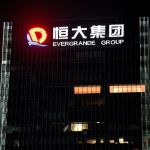
Evergrande

Evergrande illusions

At the height of the 2008 financial crisis I was invited to an off-the-record media lunch with a famous investor. I was taken aback when one of the world’s most successful capitalists announced that the crisis showed the Chinese had a superior economic model. China has tried something different from traditional capitalism, with its reliance on the ‘hidden hand’ of the free market. Since the first economic reforms in 1978, the heavy hand of the state has grown and modernized the economy with staggering results. If you believe the data, eight hundred million Chinese people no longer live in poverty and China has averaged 10 percent growth a year since reforms began.