Ceramics

Damien Hirst should burn down his gallery 

From our UK edition

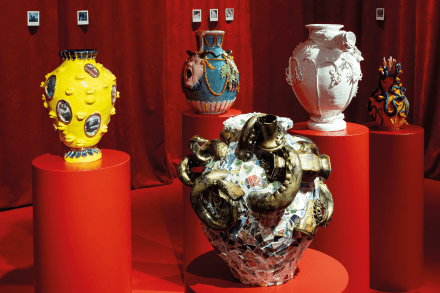
I love my friends at the loucher fringes of the art world, but every now and again, someone does something so obviously stupid that it calls certain such ties into question. Last week, a pal’s poor judgment engendered a Salo-grade spectacle so nightmarish that I can’t bring myself to elaborate. Suffice to say: some parties present will never shake off the trauma; and that the instigator was extremely lucky to avoid castration. It gets worse, too. I’d just returned from Margate, where I’d spent ages taking notes on the locale’s second-most-famous artist: a noisy, blue-haired ceramicist called Lindsey Mendick (b.1987). Mendick is fluent in the art-historical resonances and material subtleties of her chosen medium.
The joy of willow-pattern ceramics

From our UK edition

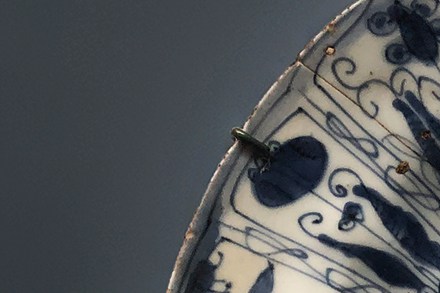
My granny used Spode willow-pattern crockery for everyday use. There was another grander service for Sunday lunch, also blue-and-white chinoiserie: Booths dragon, picked out with a gold border. Willow pattern evokes for me the taste of slightly stale ginger biscuits, which I liked very much, and coronation chicken, which I was less keen on. The idea of owning a table service now seems close to antediluvian; too formal and too much washing-up, although this was a ritual that mattered greatly to Granny. People now prefer plates that give a dull clunk when flicked, rather than fine china’s dulcet ping. Such changes of fashion were a factor in the 2008 closure of the Spode factory in Stoke-on-Trent, which had been producing willow-pattern plates since the 1790s.

The depth of Edmund de Waal

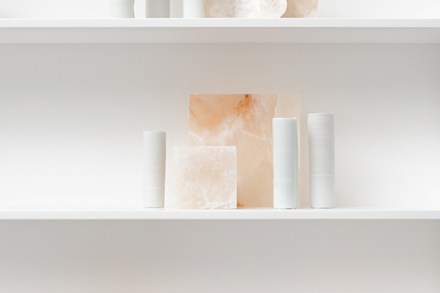
“I’m very, very proud of making pots,” says Edmund de Waal. “I don’t call myself a conceptual artist.” He is putting the finishing touches to an exhibition of ceramic sculptures at Gagosian’s Beverly Hills gallery. Around the walls are sleek, tiered vitrines filled with porcelain vessels, along with a sequence of smaller gold-painted boxes – “reliquaries,” as de Waal calls them, inspired by the early Renaissance master Duccio. “I hate the word minimalism. I find it completely useless as a term.” In the last 20 years, de Waal has risen from the status of a humble ceramicist to become one of Britain and America’s leading contemporary artists, best known for his multipart installations of pots.

This exhibition made my companion gasp

From our UK edition

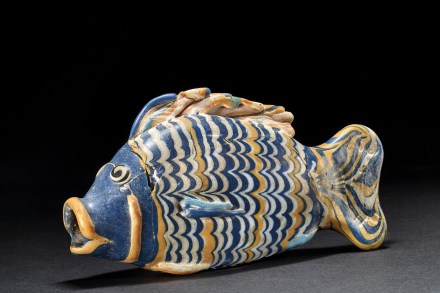
Numerous research academics have contributed to this highly cogent show celebrating the craftspeople of Ancient Egypt. My pre-teen companion, though a big fan of Egypt, was still slightly hesitant about whether this would be the most interesting angle. It began with a 4,000-year-old stele, or tombstone, on loan from the Louvre, praising the sculptural and painterly skills of an artisan called Irtysen, about whom, of course, nothing more is known. The perennial problem. General information, however, came thick and fast. We learned that a cooperative of skilled workers was a hemut, and a singular skilled worker a hemu.

William Morris’s debt to Islam

From our UK edition

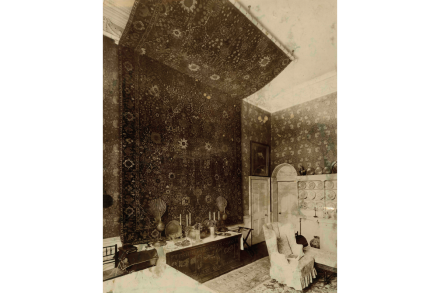
When William Morris was born in Walthamstow, in 1834, it was little more than a clump of marshland at the edge of the Epping Forest. This was the terrain of his free, frolicsome childhood, and it would forever form his image of humble, Edenic England, uncorrupted by the industrialist’s yoke. About the only thing that remains of this prelapsarian Walthamstow, amid its railway lines and brownfield sites, is the family home where Morris grew up, in some splendour – now a gallery dedicated to his artistic legacy. ‘To us pattern designers, Persia has become a holy land, for there our art was perfected’ The landscape has been supplanted, and much of the population transplanted.

Cambridge in crisis, Trump’s wicked humour & the beauty of AI ceramics

From our UK edition

53 min listen

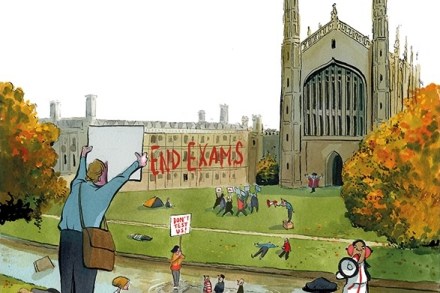
This week: Decline and Fall – how our greatest universities are betraying students.Our greatest universities are betraying students, writes David Butterfield, who has just resigned from teaching Classics at Cambridge after 21 years. What went wrong? First, class lists of exam results became private, under alleged grounds of ‘data protection’, which snuffed out much of the competitive spirit of the university. Now even the fate of examinations hangs in the balance. Grade inflation is rampant, and it is now unheard of for students to be sent down for insufficient academic performance. For students, the risks have never been lower.

Could AI lead to a revival of decorative beauty?

From our UK edition

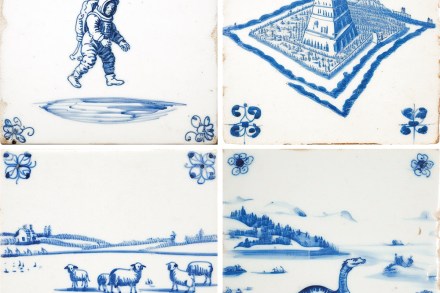
In front of me is what appears to be an authentic Delft tile. The surface of the tile is mottled, and painted on to it is a picture of a man. The blue tones blur and fade into the edges. Delicate brush strokes are visible if you peer closely. It looks as though it were made many years ago. Except it wasn’t. It was designed this morning by artificial intelligence and created in a small factory near Stoke-on-Trent, using some of the most advanced printing technology available. ‘Josiah Wedgwood would have loved what we are doing… I suspect William Morris would have hated it,’ says Adam Davies, the co-founder of the company creating these tiles.

The craft renaissance

From our UK edition

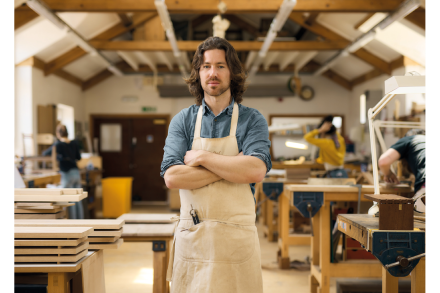
As long ago as the 1960s, the poet Edward James was worried that traditional crafts were dying out. Having frittered much of the family fortune he had inherited, aged five, on supporting struggling surrealists (he commissioned the Mae West lips sofa and lobster telephone from a scuffling Dali) and on backing shows starring his actress girlfriends (‘very wealth-consuming,’ he admitted, ‘because invariably they flopped’) then creating an 80-acre sculpture garden in the Sierra Gorda mountains of Mexico, the man described as ‘the last of the great eccentrics’ decided in his late fifties to invest his remaining money in something more sensible.

Valuable reassessment of British art: Barbican’s Postwar Modern reviewed

From our UK edition

Notoriously, the past is another country: what’s more, it’s a terrain for which the guidebooks need constantly to be rewritten. That’s one attraction of the new exhibition Postwar Modern at the Barbican. It’s a survey of what might seem all-too-familiar territory: British art in the two decades that followed VE day. Yet it succeeds in revealing numerous half-forgotten or undervalued movements and people, the good, the bad and – most intriguingly – candidates for reassessment. The decades that followed the second world war were marked by dreary austerity, perhaps explaining the tendency for the art to be coloured oatmeal, beige, grey and brown. But this was also a time of dawning hope, increasing prosperity and growing optimism.

The bizarre art of Scottie Wilson deserves to be better known

From our UK edition

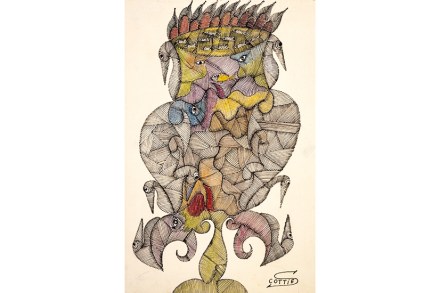
On eBay I have an alert set for ‘Scottie Wilson’. Nine times out of ten, it’s a diamanté Scottie dog from the jewellers Butler & Wilson. Once in a while, it’s a gem. Scottie Wilson didn’t think much of journalists. Art critics were ‘just jugglers — dodgers’. The sort of people who went to art shows — his or anybody else’s — could be counted on to go about ‘blabbing a lot of stupid muck. A lot of blah blah. They get paid for it too!’ Which makes it tricky to write about Scottie (always Scottie, never Wilson). You just know he’d light a cigarette and scowl. I came late to Scottie.