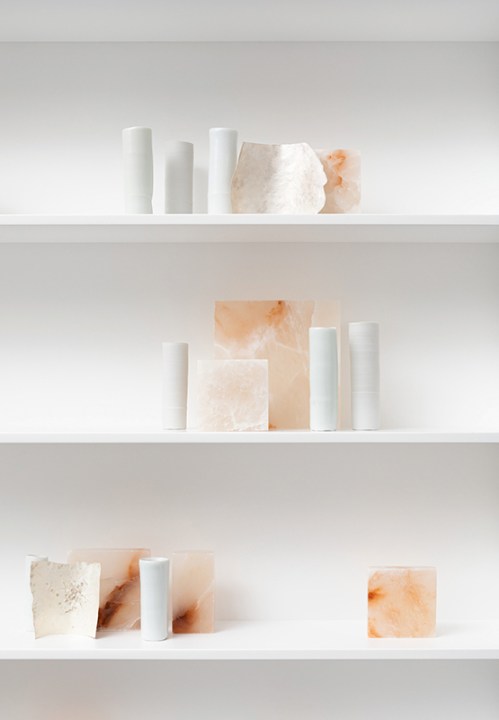


“I’m very, very proud of making pots,” says Edmund de Waal. “I don’t call myself a conceptual artist.” He is putting the finishing touches to an exhibition of ceramic sculptures at Gagosian’s Beverly Hills gallery. Around the walls are sleek, tiered vitrines filled with porcelain vessels, along with a sequence of smaller gold-painted boxes – “reliquaries,” as de Waal calls them, inspired by the early Renaissance master Duccio. “I hate the word minimalism. I find it completely useless as a term.”
In the last 20 years, de Waal has risen from the status of a humble ceramicist to become one of Britain and America’s leading contemporary artists, best known for his multipart installations of pots. And yet he continues to stand somewhat apart from the art scene, as an artisan and writer who didn’t go to art school. “The rather fabulous practice of making pots – glazing them and firing them – grounds me in such a profoundly different world, which is a world of alchemy and things going wrong and other disciplines.”
The Gagosian show last fall opened to coincide with a year-long installation by de Waal at the Huntington Library, Art Museum and Botanical Gardens – a 200-acre idyll in the Los Angeles suburb of San Marino. The idea for a project was planted ten years ago, as he wandered through the grounds with the Huntington’s associate director, Robert Hori. “Robert waved his hand in a wonderful kind of way and said, ‘You must do something here.’ I was beautifully baffled by the invitation to even think about it. I was coming out of a very intense time after The Hare with Amber Eyes was published [the memoir of his Jewish ancestry, which became an international bestseller]. I was doing a lot of stuff in Vienna and Berlin. I couldn’t quite see why I would be here.”

We met in the open-air café of the Huntington on the day of the exhibition’s opening. De Waal has an easy-going, animated demeanor – his innate diffidence tempered by an apparent willingness to think aloud, a refusal to lapse into platitudes. “I’d never really done anything serious about my life in Japan,” he says, explaining how he hit upon the idea for a sequence of displays centered upon migration and exile. The century-old Japanese Garden struck him as “a landscape and a place where it’s not Japan, and yet it is Japan” – an apt setting for thinking about his own cultural separateness from the place that became formative for him.
De Waal was born in Nottingham in 1964. He grew up in Lincoln and Canterbury: his father, an Anglican priest, served as dean of Canterbury Cathedral from 1976. When he was 16, de Waal met Sen Sōshitsu XV, Grand Master of Urasenke – one of the principal households associated with the teaching of the tea ceremony – who had come to Canterbury to perform the ritual. “I was already seriously making pots as a youngster, every day, every hour, and so Japan was absolutely the polestar – the place of attraction.” The meeting with Sen proved pivotal. “I was talking to him afterwards, and he said, ‘If you’re so serious about Japan, why haven’t you been?’ I was 16! But then, when I was 17, he sent me a plane ticket.”
De Waal left school early to go travelling. His teachers were furious, but he had a guaranteed place to study English at Cambridge, which he deferred for two years. “There’s every reason to want to run away from home. You don’t need much to make you want to escape. I left without doing any more of my A-levels. I went to Japan – went to America.”
He stayed in Japan for six months, working as an apprentice to a master ceramicist. “That was amazing because it was making pots, the tea ceremony, calligraphy.” He lived with his great uncle, Iggy (Ignace) Ephrussi, and Iggy’s partner Jiro. “I had this completely new family who adopted me. It was an extraordinary cosmopolitan world – these two men who had lived together since 1952. Opera twice a week in Tokyo.” Iggy was the custodian of a collection of small Japanese carvings or netsuke that had been hidden from the Nazis in his family’s Viennese palace (de Waal tells the story in The Hare with Amber Eyes). The collection, now with de Waal in south London, has been a touchstone for his art and writing.
In 1988, aged 24, he moved to Sheffield. He knew no one in the city but wanted “to find a place where I could begin to work seriously.” It was here that he began experimenting in earnest with porcelain. In the early 1990s, he went back to Japan, partly to research a book on the potter Bernard Leach. For a long time, he operated outside the art sphere. “I was in my thirties. I was bloody poor. No one was buying my pots.”
Then, in 1995, he held an exhibition at a Knightsbridge boutique called Egg. “It was run by an amazing woman called Maureen Doherty, who died a few years ago. She worked with wonderful fashion designers and was a great friend of architects and writers. And she said, ‘What do you want to do?’” He decided to arrange his ceramics in a different way. “I’d made lots of porcelain vessels, and I just put them on the floor. Suddenly I was allowing myself to do something I’d always wanted to do. It was the first thing I ever named: Cargo.”
In the decades since, he has staged exhibitions in institutions around the world, from the Kunsthistorisches Museum in Vienna to the Frick in New York. And yet he remains something of a quizzical foreigner in the art world. “I don’t know where I stand,” he says, in relation to the category of contemporary art. “But I know exactly who I am. I can move into worlds and out of them. I do lots of stuff with musicians, which is a joy. I look at the projects that I do, and I think how massively privileged I am to work with so many extraordinary collections and museums. I’m just starting a project with the Musée d’Orsay, to do with restitution.”
De Waal has risen from being a humble ceramicist to become one of America’s leading contemporary artists
In the ceremonial tea house overlooking the Japanese Garden at the Huntington, de Waal has created a sanctum sanctorum into which visitors may peer, but not enter. Black porcelain vessels have been arrayed in vitrines, set into walls of burnt oak. Only gradually does the structure reveal itself: a precisely modulated “still life” within the frame of the Japanese structure. Is he concerned or even inhibited by conversations around “cultural appropriation” – by the notion that artists or writers should stick within their own cultural terrain? “No,” he replies, with emphasis. “I absolutely get that there can be relationships of power – power based on gender or background or wealth or racial identity. At the same time, there’s an incredible breadth of generosity and welcome and shared learning that can only happen through displacement.”
De Waal’s father, Victor, hailed from a refugee background: de Waal’s paternal grandmother, who had been born into the Jewish Ephrussi family, came to Britain before World War Two; she had met her husband, a Dutch businessman, in Paris in 1928. On the other side, his mother hails from generations of Englishness. “There’s settledness, and then there’s massive, anxious, complicated displacement – a collision of different kinds of belonging.”
The installation at the Huntington, which runs until October 26, spans three sites – the Japanese and Chinese gardens and the art museum. In the latter, de Waal has created a temporary library entitled “on sanctuary.”
“The idea was, what would happen if you brought together poems in original languages, and in translation, of people who have been displaced and have found their way to America?” Libraries, he points out, are “inherently risky places where all methodologies fail. And they should fail, because reading is such a bizarre, such an extraordinary personal act.” By necessity, there will be gaps and anomalies: “Why on earth is this person here, or why on earth is this person not here?”
The spaces between things – and the losses incurred by time – have long fascinated him. In the dining room of the art museum, he has laid out a series of plates from a Meissen porcelain dinner service that was shattered by the Allied bombing of Dresden in 1945. Over the past decade, an expert in the Japanese art of kintsugi, working in de Waal’s studio, has reassembled the fragments. Thick seams of gold run through the original painted designs – kintsugi, “golden joinery,” repairs broken pottery with powdered gold.
His installation in the pavilion of the Chinese garden, the largest component of the project, is “a coded history of the world through porcelain.” Vitrines set into a free-standing structure contain an array of intact pots and jagged shards. Most are white or off-white, a few tinged with the green-blue celadon hue that has become one of his hallmarks. Fragments of text skitter across the walls, interrupted by smears of porcelain or flecks of gold paint. The words “And the story of decoration” hover close to three vitrines filled with broken Wedgwood porcelain – the words appearing ironically partial, as though this could never be the full story.
“Polemically, it’s about the migration of ideas, objects and their generative power, the passing on of wealth across borders,” he says, acknowledging that there is always a political dimension, at one level, to what he makes. But he is allergic to attempts to advance a political position, to expound a set of principles, through art or literature. “It’s fascinating how ready people are to lay it all in front of you. The virtue signaling is terrible.” And the same goes for exhibition making: “I can’t bear overly didactic exhibitions. They set my teeth on edge and they fail. They fail the objects, they fail the pictures, they fail the storytelling.”
In the main hallway of the art gallery is a series of monolithic benches hewn from black Kilkenny marble. They are seductive, improbably comfortable objects. Each has been inset with a silver slab inscribed with a fragment of poetry. The text is unreadable, unless one consults a QR code, but then the gesture reflects de Waal’s affinity for hidden or deeply embedded meanings. “Stephen Greenblatt nailed it when he said a good exhibition should have resonance and wonder. I’m all for resonance – damn it, of course I am. But wonder. What an interesting word.” The benches are inducements to precisely this kind of contemplation. He notes with approval that the museum guards have been resting on them from time to time. “If I have anything on my gravestone, it’ll be: he allowed people to sit down in exhibitions.”
This article was originally published in The Spectator’s February 2, 2026 World edition.






Comments