Brexit

Brexit and cru bourgeois

From our UK edition

Acouple of lawyers were disagreeing about a matter which could become increasingly relevant. Could a sitting president pardon himself? But there was a further aspect to this question. A friend of mine who has known Mr Trump for 20 years and who likes him detects a weakening in his mental powers. One of our number was a distinguished neurologist. Pressed to overcome his intellectual scrupulousness about television diagnosis, he thought it not impossible. So are we dealing with dementia, or is the President of the United States just demented? Might it be early stage Alzheimer’s, or merely chronic Trump-heimer’s?

Europe’s blind spot

From our UK edition

In Paris in December, I sat with a journalist friend in a café on the Boulevard Auguste-Blanqui and listened to him explain to me why a no-deal Brexit would be a catastrophe for Britain. It had to do with an article his newspaper had published about the Mini. You might think they were typically British cars, he said, but the plant where they were made in Cowley belonged to BMW! The steering wheels were assembled in Romania! The tail lights came from Poland! So? I asked. Brexit was about leaving the EU, not making globalisation un-happen. Who do you think wants to close the Mini plant? Britain does not want to damage its export sector any more than Romania or Poland wants to shut down a factory that provides the livelihoods of thousands.

Salute the rich who choose to pay their taxes

From our UK edition

Paying tax — which many of us have been doing this week before HMRC’s 31 January deadline — is a citizen’s duty, not an act of virtue. But for the very rich it is also a choice, since with the help of expensive advisers they can duck it or pay very little of it by using complex avoidance devices and offshore havens. So if they stay onshore and pay up, we should salute their good citizenship — if only to encourage others like them who might lighten the tax burden for the rest of us. In that context I was pleased to see two of this column’s controversial heroes of modern capitalism in the Sunday Times list of the UK’s 50 highest taxpayers.

Those who warn of Brexit unrest invite it

From our UK edition

There’s a famous (or infamous) method of negotiation or interrogation called ‘Good cop, bad cop’. You’re probably familiar with the idea. An individual whose cooperation is sought is approached by an apparently reasonable negotiator whose friendly advice is to co-operate because if he doesn’t then his colleague, who has a nasty temper, may fly into a rage — in which case our friend cannot answer for what this dreadful fellow might do. The good cop holds himself out as anxious to protect the individual from somebody much worse than himself. He does not of course condone this person’s behaviour in any way, but he’s sadly beyond his control.

When things fall apart | 31 January 2019

From our UK edition

It’s becoming clear that the travails afflicting all the major players in The Archers, Radio 4’s flagship drama, are intended by the soap’s writers (and new editor Jeremy Howe) to reflect what’s going on in the country at large, Ambridge as a microcosm of our imploding nation. As Home Farm is sold to absentee landlords with no interest in farming the land, reducing Brian and Jennifer to a terraced cottage on the green, and Ambridge’s stately home Lower Loxley Hall veers into chaos with the son and heir in jail and the business on the brink of disaster, even Brookfield, the Archers’ homestead, is standing on the edge of a financial precipice.

Why reawaken the IRA?

From our UK edition

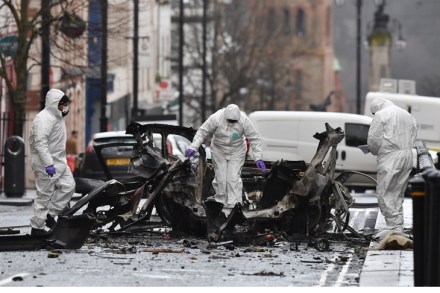
When politics goes round in circles, the columnist inevitably revisits issues that would have been sorted if only everyone read The Spectator. So: back to the Irish border — a demarcation that takes up no geographical space, but has still mysteriously dominated a dozen years of my life. Oh, well. What’s one more afternoon, then? Derry’s recent car bomb underscores a curious omission in all the Brexit argy-bargy about a ‘hard border’. Throughout, neither May, nor Barnier, nor even Varadkar ever utters the letters I, R and A. Yet the scummy residue of this vanquished potato blight lies at the heart of the hysteria about hypothetical border infrastructure that could present a ‘target’. Decorously, no one ever says target for whom.

Eurosceptic fears grow over a potential customs union pivot

From our UK edition

After refusing to meet with Theresa May until she ruled out a no deal Brexit, Jeremy Corbyn finally held talks with the Prime Minister this afternoon. Accompanied by members of his inner circle – Seumas Milne and Karie Murphy – the Labour leader used the meeting to put May under pressure on the customs union. Corbyn discussed with May the best way to secure a Brexit deal which can command a majority in the Commons – arguing that this was by moving to support a permanent customs union between the UK and EU. However, depending on who you speak to, there are varying reports of how that suggestion was received. A spokesman for Corbyn insists that May showed a 'serious engagement in the detail' of Corbyn’s proposal for a customs union with the EU.

This is Brexit’s La La Land moment

From our UK edition

From Venezuela to Zimbabwe, the noise that defines failing states is the wail. It’s not our fault, their leaders cry. We are the victims of a foreign conspiracy, fifth columnists and saboteurs. The most obvious and least discussed consequence of last night’s capitulation by the British Prime Minister to the right of her party is that the Tories are building a conspiracy theory of their own, as they prepare to whine and blame everyone but themselves for the crisis they have brought on Britain. If it is teaching us nothing else, Brexit has at least shown us that 'taking back control' never means taking on responsibility.

The three problems with changing the Brexit backstop

From our UK edition

The EU only functions as a collection of 28 nations – minus one on 29 March – because of its streamlined, centralised processes. And that efficient bureaucratic process was magnificently on display in two years of negotiation between the Article 50 taskforce of the European Commission, led by Michel Barnier, and the UK government. It culminated in the legally binding Withdrawal Agreement that was signed off at the end of last year by all EU government heads, including Theresa May.

Theresa May’s biggest Brexit battle is still to come

From our UK edition

The morning after the night before finds the Tory party still in good spirits. There is a sense of relief that the party managed to find something that all but 18 of them could vote for. It was no small achievement to get nearly every Tory MP into the same lobby on Europe with Brexit only 59 days away. But the harder part is still to come. First, Theresa May has to get something from Brussels and then she has to get it through the Commons. But May’s victory last night has brought her time. She’ll hope that she can get something from the EU and that the longer both no deal and a lengthy extension to Article 50 remain possible outcomes, the more MPs will come round to her agreement as the least worst option. May has no guarantee of success.

Theresa May’s Brexit deal has come back from the dead

From our UK edition

At long last, something changed in the House of Commons tonight; at long last Theresa May had something that could, with only a little squinting or wishful thinking, be considered something close to a good day. Her deal, the withdrawal agreement backed by her Government and agreed with the EU, that seemed moribund less than two weeks ago, has new life. It may not be entirely healthy but it has, remarkably, enjoyed some kind of resurrection.  The choices available to parliament, and by extension the country, are becoming clearer. Now that MPs have rejected the Cooper-Boles amendment that would have placed some obstacles in the path of the default No Deal scenario, we are left with what was always most likely all along: the deal or no deal at all.

Jeremy Corbyn’s petty Brexit speech undermined the Labour leader’s claim to be serious

From our UK edition

Jeremy Corbyn scolded a Tory MP during his opening speech in the Commons debate on Theresa May's Brexit Plan B, telling the backbencher that his intervention hadn't added anything to the seriousness of the occasion. How odd, then, that the way the Labour leader conducted himself throughout his speech also ended up fitting that criticism perfectly. The Labour leader's response was dominated not by a careful critique of the Prime Minister's strategy for getting a new Brexit deal agreed with European leaders and then accepted by the Commons, but by his petty refusal to take an intervention from a backbencher on his own side. Angela Smith, who has long been openly hostile to Corbyn, repeatedly stood up to ask him to give way. Corbyn repeatedly ignored her.

What Labour’s support for Cooper’s Brexit amendment means

From our UK edition

Labour is now backing the Cooper amendment. It will whip its MPs to vote for this amendment which would require the Government to request an extension to Article 50 if no agreement can be reached with the EU. The aim of the amendment is to prevent a ‘no deal’ Brexit on March 29th. However, in a sign of the divisions within Labour over the issue, the party will then seek to amend Cooper to reduce the length of the extension from nine months to three. (Ironically, nearly everyone in Whitehall expects Article 50 to be extended for a few months even if a deal gets through in the next couple of weeks because of the amount of time it’ll take to put the withdrawal agreement into domestic law). With Labour’s backing, Cooper is highly likely to pass.

Can the Malthouse Compromise break the Brexit deadlock?

From our UK edition

After the European Research Group announced on Monday night that they would not get behind the Brady amendment to replace the backstop with alternative arrangements, it looked as though the grand plan to salvage Theresa May's deal was on the rocks. Now there is a new proposal doing the rounds which has the backing of both senior ERG members – including Steve Baker – and the support of Remain-leaning Tories including Nicky Morgan. Dubbed the Malthouse Compromise (in honour of housing minister Kit Malthouse who helped broker the proposal) it lays out an alternative to the backstop. The proposal is comprised of two parts. Plan A is to reopen the Withdrawal Agreement and renegotiate the backstop.

Brexit would have been Flashman’s finest hour

From our UK edition

With the 50th anniversary of the publication of George MacDonald Fraser's first Flashman novel, how would Thomas Hughes’ school bully have handled British politics today — and who’s most like our favourite literary cad? Given recent allegations of sexism and bullying in the Commons, Flash would have found himself at home. If Westminster is a boarding school, Flash would be among the prefects, pushing around the sneaks, sots and brown-nosers, and paying court to those further up the greasy pole. ‘Kiss up, Kick down,’ as they say. Flash is always at his best in a total fiasco, so Brexit would have been his finest hour.

May urges Tory MPs to give her something to battle for

From our UK edition

Theresa May has met Tory MPs tonight in a last-ditch effort to try and persuade them to vote for the Brady amendment tomorrow. She said that she would go back to Brussels and push for ‘fundamental changes’ to the backstop. But to do that, she needed to be able to show the EU that parliament was behind her—and so, MPs had to vote for the Brady amendment. May said that the government would whip in favour of Brady, essentially making it government policy. (Some in the room, though, say that May suggested in one answer that this would be subject to Cabinet agreement). Getting the Brady amendment through will be an uphill task. As Katy reported earlier, the ERG is currently not planning to vote for it.

It’s no wonder young people are falling out of love with Corbyn

From our UK edition

One of the ironies of contemporary British politics is that many younger voters – some of whom are so opposed to eurosceptic baby boomers that they accuse them of ‘stealing their future’ – are also enamoured with Jeremy Corbyn. The Labour leader is, after all, a eurosceptic baby boomer who some still speculate might have secretly voted Leave at the referendum. But a poll out today suggests that the Corbyn coalition is finally beginning to creak under the weight of this contradiction. According to an Opinium survey, commissioned by For our Future’s Sake (FFS), the student wing of the People’s Vote campaign, just 23 per cent of 18- to 34-year-olds approve of Corbyn’s handling of Brexit; 37 per cent are opposed.