Brexit

Snobs and mobs agree on the cost of a second referendum | 22 January 2019

From our UK edition

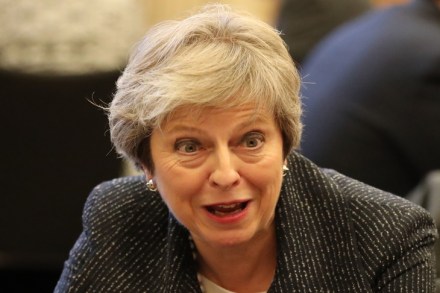
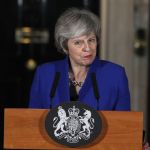
Britain moved a step close to Weimar yesterday when the Prime Minister used the threat of terrorism to get her way. Being a conservative woman of the upper-middle class, Theresa May did not precisely mimic the cries of ‘there will be blood’ that come from the right’s more deranged corners. You don’t talk like that if you want to get on in Thames Valley society. Rather the Prime Minister issued her warning in the careful language of a bureaucrat. ‘There has not yet been enough recognition of the way that a second referendum could damage social cohesion by undermining faith in our democracy,’ she said. You would have missed her intent behind this seemingly bland statement unless you had been paying attention to the noise that surrounds her.

Jeremy Hunt proposes a plan to make the backstop time-limited

From our UK edition

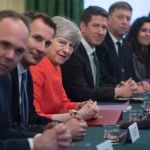
Cabinet today was not as dramatic as some had expected. No one argued for ministers being allowed a free vote on the Cooper / Boles amendment. Indeed, I’m told the Chief Whip’s plea for ministers to stick to collective responsibility went unchallenged. Perhaps, the two most interesting contributions came from Jeremy Hunt and David Gauke. Gauke questioned the government’s new approach. He said he was worried that even if the government did get something on the backstop, there still wouldn’t be enough Tory MPs backing the deal for it to pass. While Hunt argued that the best thing for the government to do was to get parliamentary support for a plan on time-limiting the backstop.

Theresa May is using Jeremy Corbyn to avoid blame for her Brexit mess

From our UK edition

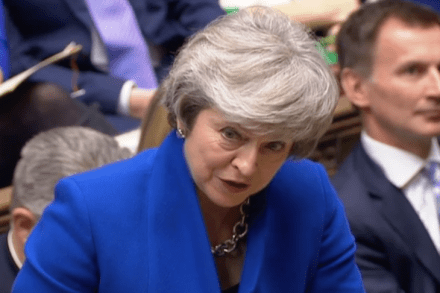
The Commons has grown rather used to Theresa May giving an update on Brexit each Monday afternoon, and still more used to the Prime Minister offering precious little in the way of new information each time she does so. Today's statement was a little different, in that May is now asking MPs for more information, rather than MPs turning on her and accusing her of not telling them anything. She laboured rather heavily on the point that Jeremy Corbyn has so far refused to attend the cross-party talks designed to work out an agreement that the Commons can stomach, introducing it early in her statement, and returning to the point again after the Labour leader had finished talking.

The Prime Minister’s Brexit plans are all the same: run the clock down to 29 March

From our UK edition

The Prime Minister’s plans B, C , D and E are all the same: run the clock as close as possible to 29 March, Brexit Day, so that enough of the critics to her Brexit plan blink at the risk of either crashing out with no deal or seeing Brexit cancelled such that it passes at the last. In two words, the Brexit strategy is 'Tick Tock'. Yesterday’s conference-call cabinet meeting was a masterclass in Theresa May as bulldozer and ministers 'sitting back', according to one of them.

The problem with backing out of Brexit

From our UK edition

Are we suffering a national humiliation? There has been a lot of commentary – not least from elements of the Remain-supporting press – about how the UK has become an international laughing stock. Papers in other countries have joined in the chuckling. Recent events have not been good for our reputation for stability and sanity. However, the one thing that the UK could do to destroy what international credibility it has left, is to change its mind on Brexit, and go back to the EU asking whether we can stay after all. Our national humiliation would be complete. We would be the employee who stormed out publicly, insisting to everyone that they could make it on their own, only to beg their employer to take them back.

May goes back to the backstop

From our UK edition

Today’s Cabinet conference call was more illuminating in terms of direction of travel than the details of what Theresa May is actually going to do. It is now clear that May’s approach is to try and put the Tory DUP alliance back together by getting something on the backstop rather than trying to find some cross party consensus. One of the reasons for this is that the Labour leadership’s reluctance to play ball makes it very hard to get the numbers for any compromise deal. I am told that David Lidington, who had been leading the cross party talks, reluctantly acknowledged this point. As one Cabinet Minister put it to me, ‘This kills the system’s desire for a customs-union style solution.

Why a customs union is looking less likely

From our UK edition

Immediately after the government’s crushing defeat on Tuesday night, a slew of Cabinet Ministers thought that it was inevitable that Theresa May would have to make some kind of concession on the customs union to get a deal through parliament. But, as I say in The Sun this morning, this option has run into two obstacles. First, Corbyn and McDonnell aren’t playing ball. Without their blessing, there is no way you could get 116 Labour MPs to vote with a Tory PM. Secondly, it has become clear that agreeing to a customs union would not only split the Tory party, lead to at least one Cabinet resignation, but would also—according to one senior Cabinet Minister—lose the support of 40 MPs who voted for the deal on Tuesday night.

Is this finally Boris Johnson’s moment?

From our UK edition

Once more unto the breach, dear friends, once more. That was the message of Boris Johnson’s speech this morning at a JCB factory in Staffordshire. He admitted this week that he regretted bottling his leadership bid in 2016. This time is his last chance to have a go at swiping the ultimate prize – the keys to Downing Street – a prize he’s coveted since he was a boy. Boris’s earliest known quotation is when, asked by his sister Rachel as a child what he wanted to be when he grew up, he said, “World King.” He’s thinner and more smartly dressed than he’s been for years. That might have been influenced by the reported acquisition of his new 30-year-old girlfriend, Carrie Symonds.

Corbyn gives his verdict on a second Brexit referendum

From our UK edition

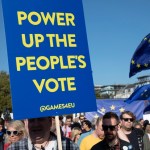
Jeremy Corbyn is under mounting pressure to back a second referendum. Labour MPs have grouped together to try and persuade their leader to side with the People's Vote campaign in order to break the Brexit deadlock. But so far, Corbyn doesn't seem keen on the idea, preferring instead to sit on the fence. The same isn't quite true of his brother, Piers, who in the early hours of this morning took to Twitter to make his views on a second referendum perfectly clear: Mr S thinks the People's Vote brigade will be hoping that Jeremy doesn't turn to Piers for advice on what to do next...

The Norway v People’s Vote fight

From our UK edition

One of the bitterest divides in British politics right now is between advocates of a second referendum and those who favour the Norway option. They both want to be the last alternative standing to no deal; and are happy to trash each other in the process. On Politics Live tonight, Tony Blair, the most prominent advocate of a second referendum, laid into the Norway option. He derided it as a ‘pointless Brexit’, as it would leave the UK following the rules of the single market but with less say in how they are made. Nick Boles, the principal Tory advocate of Norway plus, then hit back in his own interview with Andrew Neil.

What’s the real reason Greg Clark doesn’t like Brexit?

From our UK edition

To those who’ve known Greg Clark for any length of time, the transformation of the mild-mannered business secretary into the Cabinet’s most fervent Remainer requires some kind of explanation. So what's the real reason Clark finds Brexit a threat? Forget about protecting the automotive industry and manufacturing generally. The car industry is already reeling from the government’s hostile environment towards car ownership. Last year, car sales fell for the second year in a row, with diesel vehicles down 29.6 per cent. Supply was hit by testing to meet new emissions standards and demand dented by the government’s ongoing war on diesel.

Emmanuel Macron’s fear of Frexit is bad news for Britain

From our UK edition

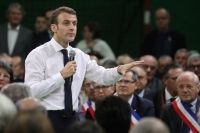
Emmanuel Macron launched his Big Debate on Tuesday and for the next two months the French people will have the chance to air their grievances in meetings and online. The consultation, in response to the Yellow Vest protest movement, has captured the media's attention but nonetheless it was knocked off the top of the news agenda temporarily by events in Westminster. There is an undoubtedly a touch of schadenfreude in the Élysée Palace at the Brexit farrago, a relief that another world leader is in torment. Macron learned that parliament had rejected Theresa May’s Brexit deal on Tuesday evening, as he was nearing the end of a seven hour debate in a Normandy town hall.

Portrait of the week | 17 January 2019

From our UK edition

Home Brexit threw politics into unpredictable chaos. The government was defeated by an unparalleled majority of 230 — 432 to 202 — on the withdrawal agreement it had negotiated with the EU. The result was greeted by cheers from demonstrators outside the House, both those in favour and those against Brexit. Labour tabled a motion of no confidence for the following day. Theresa May, the Prime Minister, said in the House after the vote: ‘The House has spoken and this government will listen.’ She said she would talk to senior parliamentarians and that the government would return to the House on Monday with proposals. This arrangement was in line with a business amendment by Dominic Grieve that the Speaker had allowed the week before.

The vote on May’s deal was less important than you might think

From our UK edition

Now that the Prime Minister’s withdrawal agreement has been decisively rejected by Parliament, the challenge, as Theresa May said last night, is to find an alternative way forward. But the reality is that the fall of the agreement is less important for the UK than widely assumed. It did not pin down any long-term trade arrangements. Even in the short term, the main gain to the UK was a transition period which now looks less essential than was the case when it was first mooted over a year ago. It is true that there is now a possibility of tariffs from March 30th but these tariffs are mostly small and the EU has stronger reasons for avoiding them than the UK. The EU exports £54.

Boles’s crazy plan

From our UK edition

At first, it seems fanciful. A backbench MP, Nick Boles, proposes to take power away from the government and place it in the hands of MPs, to prevent a no-deal Brexit. Can one backbencher usurp power in this way? It’s ambitious. But under the British system, government reports to parliament, not the other way around. Usually the distinction is moot, because government can control the Commons. But when that control collapses, every kind of mischief becomes possible. Until a couple of months ago I was director of legislative affairs under Theresa May in No. 10, where it was my job to look at parliamentary procedures. It’s quite a minefield.

Is the UK auto industry only struggling because of Brexit?

From our UK edition

The popular new narrative for the UK auto industry is that its troubles are only temporarily to do with Brexit and much more to do with misguided policies, wrong decisions and economic swings. There’s a sharp decline in demand for luxury models from pinched Chinese consumers, while diesel sales have slumped because regulators continue to penalise them despite cleaner engines, leaving manufacturers regretting model-range investments. The EU’s new emissions testing regime has caused production problems across the continent; electric vehicle sales won’t take off until governments provide more charging points; and as interest rates begin to rise, motorists are losing the appetite for buying new cars on credit.

Brexiteers are destroying their own dream

From our UK edition

Are some Brexiteers addicted to disappointment and frustration? Do they so crave the righteous indignation that flows from being thwarted that they are actively trying to sabotage their own project? How else to explain the extraordinary strategic incompetence of Tory MPs who say they want Britain to leave the EU yet behave in a way that makes it increasingly likely that Britain will not do so? Brexit-backing readers may well dismiss my thoughts on Brexiteer strategy because I am, of course, a dreadful Remainer. More accurately, I voted to remain and I believe that leaving the EU will give the UK a range of possible futures that are less economically beneficial than those we’d have if we remained a member.

How long can Corbyn hold out against a second referendum?

From our UK edition

Jeremy Corbyn is no enthusiast for a second referendum. He wants to, as his speech today suggested, hold further motions of no confidence in the government to try and force an election rather than have to decide on what other option he is going to support. But having tried and failed in one confidence motion, this is a more difficult position for him to maintain. Vince Cable has now said that Corbyn can’t rely on Lib Dem support in future confidence motions and has suggested that other opposition parties will soon take the same view. The aim of this tactic, to make clear that Labour can’t force a general election and so Corbyn needs to decide on a second referendum. Now, Labour are already attacking the Lib Dems for being prepared to prop up the Tories.