Brexit

Corbyn says May still isn’t compromising on her Brexit red lines

From our UK edition

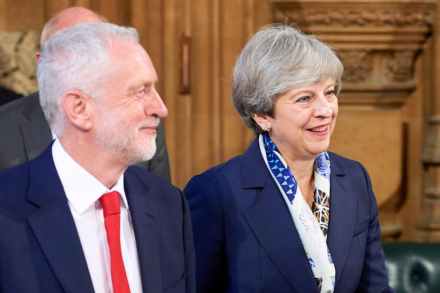
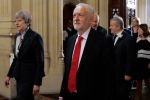
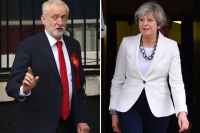
Jeremy Corbyn has insisted that Theresa May hasn't yet moved on her Brexit red lines in talks with the Labour Party. In a broadcast clip this evening, the Labour leader said: 'Well, the meetings are very long. A great deal of detail is gone into by both parties. We have people who have been on this case for several years so they're all very accustomed to it all. We've gone into it because the government at last acceded to a request I first made last September that we're prepared to talk and put forward our views, but talks have to mean a movement and so far there's been no change in those red lines.' There have been reports that the talks are moving towards an offer of a customs union, which would enrage many Conservative MPs even more.

Britain’s Brexit fate is now in Emmanuel Macron’s hands

From our UK edition

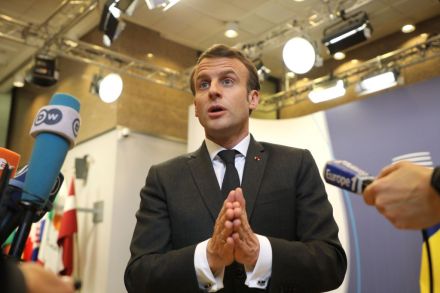
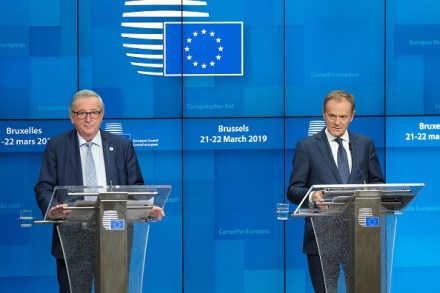
Our Brexit fate is in the hands of France's president Macron – which is "not a wholly comfortable state of affairs," in the euphemistic words of a minister. What this minister means is the Prime Minister and her close colleagues are a long way from being convinced Macron will underwrite EU president Donald Tusk's proposal for the UK to be granted a year's delay to Brexit, with a break clause to allow us to leave the EU earlier if all the political and legal niceties can be completed earlier.

Could Theresa May cancel Brexit?

From our UK edition

Is the de facto Brexit default now revoking Article 50 this week rather than a no-deal Brexit on 12 April? I ask because the Prime Minister is now explicitly saying the choice is a binary one between some version of her negotiated deal and not leaving at all (that is what she said in her sofa chat yesterday). The point is that she has no power to prevent a no-deal Brexit on 12 April by delaying Brexit; for a delay, she needs the unanimous agreement of the EU's 27 leaders. But she does have the unilateral power to prevent a no deal by cancelling Brexit altogether, by revoking the Article 50 application to leave the EU.

The Brexit headache is just beginning

From our UK edition

Pretty much everyone I meet says they want all the Brexit uncertainty to end, one way or another. But that is now impossible: even agreement - which seems remote - on some version of the PM’s deal to take us out of the EU would only be a beginning of a sort, not an end, with so much left to decide on what kind of future relationship we need and deserve with the EU. And if there is no backing from MPs for the Withdrawal Agreement that is the divorce from the EU, then we are into a series of choices whose consequences would be to lead to various forms of national and international fission.

Theresa May hints at a change in direction on Brexit

From our UK edition

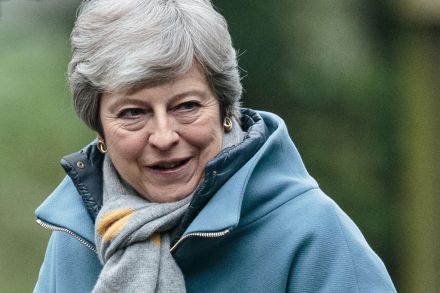
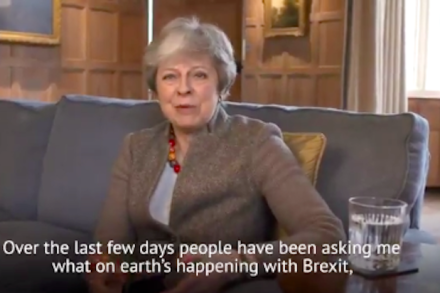
As another crunch Brexit week approaches, Theresa May has used a video message to update the public on ‘what’s happening with Brexit’. With the Sunday papers filled with angry Conservative MPs venting about her decision to enter negotiations with Jeremy Corbyn in a bid to break the Brexit deadlock, the Prime Minister uses the address to try and justify her decision. https://twitter.com/theresa_may/status/1114891046025084931?ref_src=twsrc%5Etfw Adopting a more casual tone that normal, May says that Parliament has rejected her deal three times and ‘as things stand’ there is little reason to expect MPs to back it on a fourth vote.

Are both May and Corbyn prepared to risk splitting their parties?

From our UK edition

The irony of the stalemate in the cross-party Brexit talks is that Theresa May and Jeremy Corbyn are not that far apart on the issue, as I say in The Sun this morning. They might use different language, but what they want is really quite similar. But while they may not be that far apart, their parties are. A deal would require not one of them, but both of them to be prepared to split their parties. If Theresa May was to soften her deal to try and get Labour support, she would exacerbate the divide within her own party. I am told that in the talks, the government has tried to point out to Labour that the deal does, in the backstop, effectively include a customs union. But Labour has been insistent that the phrase ‘permanent customs union’ must be in any deal.

Theresa May should let Britain leave without a deal

From our UK edition

One of the many tragedies of Theresa May’s premiership is that, having come up with a coherent policy on how to enact Brexit, she spent her prime ministerial career failing to follow it.  The words she used in her speech at Lancaster House in 2017 seemed clear enough: ‘No deal is better than a bad deal.’ It made sense to repeat this in the last Tory manifesto. She was to seek a free trade deal with the EU, but if that proved impossible, then Britain would be leaving anyway. In the event, the EU has not merely failed to offer a good deal, it has refused to offer any trade deal at all — only a withdrawal agreement that might or might not lead to a trade deal in future but which in the meantime threatens to trap Britain in the customs union indefinitely.

Has a Brexit breakthrough been reached at last?

From our UK edition

There has been considerable and widespread cynicism about the talks between the Government and Labour about a compromise that could break the Brexit deadlock. But those close to the negotiations, led today by David Lidington and Keir Starmer, believe there is at last a "plan with a chance," of securing a positive vote from MPs for the PM’s Withdrawal Agreement, without which there can be no managed exit from the EU. It would involve a Government committing to staying in the Customs Union, "dynamic" alignment with EU rules covering workers’ rights and the environment and giving the Commons a vote on whether the whole package would be subject to confirmation in a referendum. "Is all this real?" I asked informed sources. "Yes," they said.

Newport West’s by-election suggests Labour could struggle in a snap election

From our UK edition

The result from the Newport West by-election came in late last night and as was generally expected Labour held the seat, albeit with a reduced majority. As had also been expected, turnout was significantly down on the general election. Here is the full result: Candidate (Party) Votes per cent (change on 2017) Ruth Jones (Labour) 9,308 39.6 (-12.7) Matthew Evans (Conservative) 7,357 31.3 (-8.0) Neil Hamilton (UKIP) 2,023 8.6 (+6.1) Jonathan Clark (Plaid Cymru) 1,185 5.0 (+2.5) Ryan Jones (Lib-Dems) 1,088 4.6 (+2.4) Amelia Womack (Greens) 924 3.9 (+2.9) June Davies (Renew) 879 3.7 (+3.7) Richard Suchorzewski (Abolish the Assembly) 205 0.9 (+0.9) Ian McLean (Social Democrat) 202 0.9 (+0.9) Phillip Taylor (Democrats and Veterans) 185 0.8 (+0.

How talks between Labour and the Tories reached breaking point

From our UK edition

I am not sure whether it’s me or ministers who are the more naive. Because last night I was persuaded by Cabinet sources a breakthrough was nigh in talks to resolve the Brexit deadlock between the Government and Labour. But the talks are already on the verge of collapse - with each side making charges it is the other side which is negotiating in poor faith. Labour sources say the memorandum sent by the PM to Jeremy Corbyn this afternoon shows Theresa May has not shown the flexibility her colleagues expected. What has disappointed Corbyn and his Shadow Brexit Minister Keir Starmer is - they believe - the government is ruling out asking the EU to rework the Political Declaration on the UK’s future relationship with the EU.

Brexit is exposing Nicola Sturgeon’s hypocrisy

From our UK edition

Like Mother Teresa on a message grid, Nicola Sturgeon loves nothing more than going among the poor and downtrodden with a hug, some hope, and an embargoed press release. EU nationals are the latest beneficiaries of the First Minister's ministrations. The SNP leader has penned an open letter to EU citizens resident north of the border as part of her ‘Stay in Scotland’ scheme to help them secure settled status. The language is as meticulously neutral as it always is in taxpayer-funded Scottish Government initiatives: ‘As EU citizens in the UK you have had to endure years of careless indecision on what the future holds for your lives, your careers and your families...

Theresa May’s Brexit talks with Corbyn run into trouble

From our UK edition

Talks between Labour and the government over Brexit aren’t going anywhere. Labour has released a statement this evening saying that: “We are disappointed that the government has not offered real change or compromise.” The Guardian’s well informed Heather Stewart is reporting that Labour are saying that the government weren’t offering any changes to the political declaration, but just a memorandum to sit alongside the deal. This is, obviously, not enough for Labour. The impasses in these talks is not that surprising. Both sides know that a deal risks splitting their own party and the prospects of two parties being prepared to take that risk simultaneously was fairly low.

Barometer | 4 April 2019

From our UK edition

German customs The original customs union, or Zollverein, was established by Prussia along with 17 other states which make up modern Germany in 1834. Prior to that, traders crossing what is now Germany, were obliged to make multiple declarations and pay taxes as they moved across state borders. — It had taken 15 years to establish, but achieved a big step towards realisation in 1828 when Prussia formed a union with neighbouring state Hesse-Darmstadt, Bavaria formed its own union with Wurttemberg, and Saxony with Thuringian. — Not everyone was convinced. Hamburg and Bremen, which conducted much external trade by sea and made a lot of money from import duties, were not persuaded to join until 1888, by which time they had already been part of the German Empire for 17 years.

The Spectator’s Notes | 4 April 2019

From our UK edition

There is a logic in Mrs May’s late move to Labour. It is the same logic by which both parties, at the last general election, put forward very similar policies about Brexit. They need to stay together (while feigning disagreement for party reasons) to frustrate what people voted for. Just as they both said in 2017 that they wanted to leave the customs union, now both are working to stay in it. It is the same logic by which Mr Speaker Bercow has arranged for Sir Oliver Letwin to become prime minister on roughly alternate days. None of the main players really wants Brexit, but none can really say so.

Letters | 4 April 2019

From our UK edition

About the Bible Sir: I was confirmed by Richard Holloway as a schoolboy at Fettes College, and then taught by John Barton while an Anglican ordinand at Oxford University. So I was intrigued to read Holloway’s review of Barton’s latest book, A History of the Bible (30 March), and disturbed by their conclusions. Indeed, both the book and the review go a long way to explaining why the median size of a Church of England congregation is 28, and why numbers are at an all-time low. One doesn’t have to be an anti-intellectual fundamentalist to believe in orthodox biblical Christianity, or to realise that being a disciple of Christ means one cannot have a lower view of the Bible than he did.

Real life | 4 April 2019

From our UK edition

After all that waiting and arguing, I must say I thoroughly enjoyed leaving the EU. The builder boyfriend and I celebrated by popping the cork on a bottle of Denbies bubbly and flying his old yacht’s backstay union flag in the dining room window, which saves me buying curtains. The builder b drank the Dorking bubbly. I’m teetotal so I stick to fizzy water. I don’t anticipate any problems getting Perrier or San Pellegrino in the coming months but there’s always Highland Spring. Of course, if Scotland gets antsy and imposes a blockade, I will have to invest in a carbonation machine. It’s a small price to pay for freedom.

Where Brexit failed

From our UK edition

One of the many tragedies of Theresa May’s premiership is that, having come up with a coherent policy on how to enact Brexit, she spent her prime ministerial career failing to follow it.  The words she used in her speech at Lancaster House in 2017 seemed clear enough: ‘No deal is better than a bad deal.’ It made sense to repeat this in the last Tory manifesto. She was to seek a free trade deal with the EU, but if that proved impossible, then Britain would be leaving anyway. In the event, the EU has not merely failed to offer a good deal, it has refused to offer any trade deal at all — only a withdrawal agreement that might or might not lead to a trade deal in future but which in the meantime threatens to trap Britain in the customs union indefinitely.

Diary – 4 April 2019

From our UK edition

I voted Remain, and still don’t think Brexit is a good idea. However, if there were to be a second EU referendum, I would vote Leave. Not because I’ve experienced some Damascene conversion to the Brexit cause — I haven’t met anyone who has changed their mind about it and suspect these people don’t exist outside Alastair Campbell’s hysterical Remoaner mind — but because I would be so furious at a second referendum happening at all. What’s going on now is a disgrace: a House of Commons packed with Remainer MPs trying everything in its power to reverse the 2016 result or dilute Brexit so much that it ceases to resemble anything that Leavers voted for.