Brexit

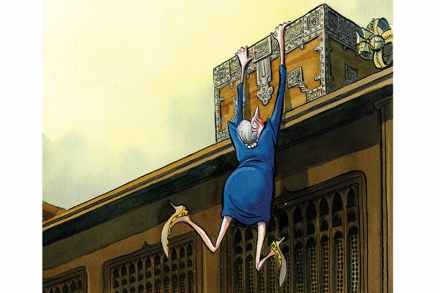
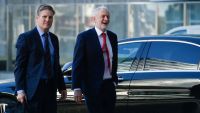
May’s bid to forge a Brexit deal with Corbyn is about to implode

There were no political decisions of any substance taken over Easter. The PM, ministers, all politicians were seemingly too exhausted to do anything but roll the Brexit egg down the hill. So all the political news is about process, after the Cabinet and shadow cabinet made no Brexit decisions on Tuesday, and the 1922 Committee (guardian of Tory party rules) could not agree whether to expedite a new procedure to evict Theresa May. The four bits of newsy stuff I have collected for you are: 1) There will be an emergency meeting of Labour’s National Executive Committee on Tuesday to decide whether the party’s manifesto for the European Elections will contain

Mark Carney’s replacement must be a Brexiteer

Almost half a million a year basic. A generous housing allowance. Lots of invitations to swanky conferences, and a fantastic office right in the centre of town. And all the last guy had to do during six years in the job was tweak interest rates three times. That works out at a million per move – and that’s before expenses. Running the Bank of England is, on the surface at least, such a cushy job I might even apply myself. We never even have a decent sterling crisis to contend with any more. And yet despite that, there are already reports that the Chancellor might have trouble finding anyone to

Richard Madeley, Brexit and the new conspiracism

A lot of people are saying that you are having an affair. I don’t know if they’re right. It’s not for me to say. I just told your husband that a lot of people are saying that. A lot of people are saying that you are a child abuser. You want me to check? Look at the court records and the sex offender register? Nah. No need. I just need to say that a lot of people are saying you are a child abuser. Why would they say it if there wasn’t something to say? You say they’re wrong. Really? A lot of people will say, well, you would say

What would the Brexit party winning the European Elections actually change?

Even with all the volatility in British politics right now, it is still remarkable that the Brexit party are favourites to win the European Elections just a week after launching. But will the Brexit party winning actually change anything, I ask in The Sun this morning. I think there are a several ways it which it will have an impact. First, it’ll make MPs more cautious about a second referendum. One of the reasons why support for the idea has grown in parliament is a belief that Remain would triumph. A Brexit party victory would challenge that assumption. Next, I suspect that Farage’s new party topping the poll would make

Letters | 17 April 2019

Moaning minnie MPs Sir: I was recently quoted in the Sun newspaper in a story about how MPs were reacting to the Brexit drama in the House of Commons. I said: ‘It feels like the Commons is having a collective breakdown — a cross between Lord of the Flies and One Flew Over the Cuckoo’s Nest. People are behaving in ways that were unimaginable even just a year ago, whether they be Remainers, Leavers or in-betweens. The Brexit madness has affected us all.’ Following Melissa Kite’s article in last week’s Spectator berating MPs for being such wastrels and using my quote as an example of ‘wimpishness’ personified, I learn we

Good Friday disagreement

The relationship between the UK and the Republic of Ireland has ‘reached a hunger-strike low’, says a new study by an academic from Trinity College, Dublin. ‘Relations have not been as tense since the early 1980s and political rhetoric that had vanished by the 1990s has re-emerged,’ the paper grimly concludes. The fragility of relations between Britain and Ireland is hard-wired into me. Having grown up ‘London-Irish’ in the 1970s and 1980s, all I ever wanted was for the two countries that define my ethnicity to get on. The Maze Prison hunger strikes of 1981 and subsequent Republican bombings in London and Brighton — where, lest we forget, the British

The Brexit backlash

One of the oddities of this parliament has been that, despite everything, the government has remained ahead in the polls up to now. But the political price of failing to pass a deal and leave the EU is now becoming apparent. Labour is ahead, Nigel Farage is back, and the right is split again. In the past month, Tory support among Leave voters has fallen by 20 per cent. In normal circumstances, such numbers would extinguish any hopes of a fourth term for the Tories. But Labour’s own divisions over Brexit and Jeremy Corbyn’s political weaknesses mean that this isn’t necessarily the case. A big argument is taking place within

Are you culture compliant?

Here’s a quick quiz to jolly up your Easter. 1. Lucy Noble, artistic director of the Royal Albert Hall, thinks ‘white male titans’ such as Mozart, Beethoven and Bach are putting the young off classical music. Is she: a) Quite right! My kids would be gagging to go to the Royal Albert Hall if only its programmes included more black female/transgender composers they’d never heard of. b) Strangling yet another great institution. Audiences are drawn by artistic excellence, not diversity box-ticking. Cambridgeshire Fire and Rescue Service says: ‘There is a historical need to diversify our workforce. The number of women operational staff has been under 5 per cent and black

How Britain can make life difficult for the EU during the Brexit extension | 15 April 2019

It is not good form for the British to be awkward and obstructive. The art of the compromise was the polite British way of doing things. Or so it used to be thought. But Europe’s axis has tilted since Theresa May’s inability to secure an exit from the EU. Jacob Rees-Mogg’s recent tweet calling for Britain to be ‘difficult’ and paralyse the workings of the EU from inside sums up this toppling of conventional etiquette. Now that the extension has been granted until 31 October with few constraints on British membership, should Britain form an awkward squad in Brussels to block Europe’s institutions? And if so, where do we look

Which way will Corbyn go on Brexit?

In September, Labour conference will impose on Jeremy Corbyn a policy of backing a second referendum in all circumstances. So, I say in The Sun this morning, what will he do between now and then? Corbyn has two paths open to him. He can either decide to embrace a second referendum now or do a deal with Theresa May so that the UK is out of the EU before Labour conference meets. If Corbyn went the second referendum route, he would ensure that Labour did well in the European Parliament elections next month as it scoops up the votes of energised Remainers while the Tories have lumps taken out of

Brexit need not tear the Tories apart. Here’s why

The political dysfunction in Parliament seems to be rubbing off on much of our commentariat. Many have concluded that the whole political system is about to undergo an earthquake as seismic and landscape-changing as anything that mere plate tectonics can conjure up. The main political parties will no longer be Labour and Tory, defined by being working class or middle class, big state or little state, socialist or free enterprise. Instead, goes the new thinking, there will be two main parties defined by being anti-Brexit and pro-Brexit (which may or may not be Labour and Conservative). Now it is easy to see why people might start to claim this. There

The Spectator Podcast: where did things go wrong for Emmanuel Macron?

While Friday may mean the end of the working week for most of us, for many in France, it means the start of a long weekend out in the streets clad in a gilet jaune. As Emmanuel Macron pushes for a tough stance against the UK in Brexit negotiations in Brussels, domestic problems continue to mount unabated. Jonathan Miller writes in this week’s cover piece that, despite initial optimism about the golden boy of global liberalism, Macron’s only major achievement so far has been to unite his country in opposition to him. He is joined on the podcast by Sophie Pedder, Paris Bureau Chief for the Economist, and author of

Some Russians think Britain’s bungled Brexit is just an illusion

It’s hardly a surprise that Russian and American views of the world differ sharply. But there is one area of unexpected congruence in Moscow and Washington: Brexit. Travelling between both capitals, it is hard to tell the difference between the perplexity and even suspicion with which Britain’s ongoing and bungled departure from the EU is being viewed. Of course, the two administrations have rather different interests when it comes to Brexit. In the United States, there is some excitement among big business about the prospect of the UK market opening up. In the main though the feeling is one of dismay about the crisis gripping one of the country’s closest allies.

Inside the Brexit Party launch: Tory anger, Rees-Mogg and ‘Treason May’

On Friday, in an inconspicuous metal finishing factory on an industrial estate in Coventry, Nigel Farage officially launched his new Brexit Party, and set out its strategy ahead of the European Parliament elections on 23 May. The message of the day was clear: the people, especially Leave voters, have been let down by the Westminster establishment, and voting for the Brexit party is the best way to show that you are angry, and willing to do something about it. Kitted out in his customary Union Flag socks, Farage hit out at the way the Brexit negotiations had been conducted so far, describing it as a ‘wilful betrayal of the greatest

Annunziata Rees-Mogg stands for Farage’s Brexit party

Nigel Farage announced the launch of his new Brexit party today, in a metal finishing factory in Longford, Coventry. As you’d expect, Farage channeled the anger many Leave voters are feeling across the country in his speech. He predicted that the Brexit party would come first in the upcoming European Parliament elections and said he had already put down a £1,000 bet on this outcome. But it was his headline choice of candidate for these elections that caused surprise in the room. Saying that he had received over 1,000 applications from people hoping to become MEPs, he introduced one of the first to be selected: Annunziata Rees-Mogg, the journalist and

Letters | 11 April 2019

All Cameron’s fault Sir: In this time of febrile political speculation, there can have been few more arresting subject headings on your Letters page than ‘Not Cameron’s fault’ (6 April). Your correspondent Mike Jeffes added to the sense of unreality by writing that ‘Cameron did nothing wrong’. You need to be neither a Remainer nor Brexiteer to follow in horror the painful result of Cameron’s opening of this Pandora’s Box in 2016. In the 2010 and 2015 elections, the subject of Europe was well down on the list of voter concerns, but with a mixture of hubris, stupidity, and narrow political interest, Cameron’s decision to call the referendum has driven

Portrait of the week | 11 April 2019

Home Theresa May, the Prime Minister, wrote to Donald Tusk, the President of the European Council, asking for an extension until 30 June of the period under Article 50 for which the United Kingdom should remain in the European Union. She hoped for parliament to agree to an ‘acceptance of the withdrawal agreement without reopening it’, perhaps through reaching a consensus by means of ‘a small number of clear options on the future relationship that could be put to the House in a series of votes’. She thought her talks with Jeremy Corbyn, the Leader of the Opposition, might reach such a consensus. Not only that, but she hoped that

Westminster’s Brexit obsession is the biggest danger for SMEs

While the House of Commons increasingly becomes an echo chamber, thank goodness that outside of Westminster life continues for UK business and the 5.7 million small and medium-sized firms (SMEs) which form the backbone of the economy. Brexit uncertainty is a concern for many of them, but eyes remain fixated on progress and the future, not politics. Brexit has become an immoveable impasse in public discourse, a distraction from the really important challenges and opportunities that the UK and Ireland face. Whilst the chaos prevails, business has become an afterthought for the custodians of the economic success of the country. The lack of focus on any other issue over the

EU elections could be a golden opportunity for Brexiters

A Brexit delayed until Halloween will be regarded as a nightmare for many. It must seem to the people who voted to leave the EU that escaping the bloc is slipping further and further away. The extension confirms their fears that the government and Brussels are prepared to re-write the rules in order to avoid a no-deal scenario, having previously pledged there would be no extension at all. One of the immediate issues now will surely be the EU elections on the 23 May, which many parties were loath to take part in. But, in some ways, the EU elections could be very helpful for Brexiters. And they could end