Brexit

Seduction and the Boris bus

From our UK edition

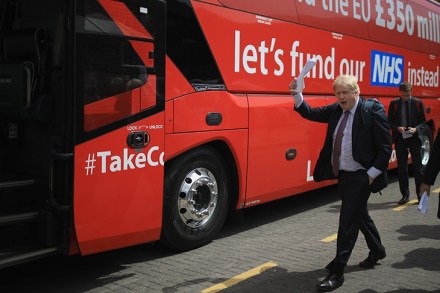
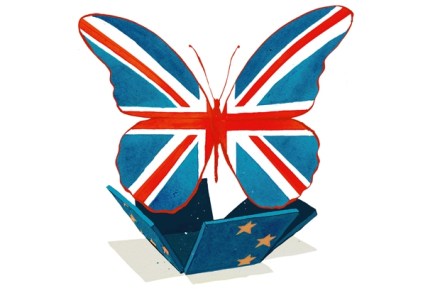
Boris Johnson is to be tried at the Crown Court on the grounds that, during the 2016 Brexit referendum campaign, he crucially affected the referendum result by arguing that the UK paid the EU £350 million a week, ignoring another interpretation that the sum was only £250 million a week. Ancient Greeks knew all about advocating one side of an issue, as a law suit exemplifies. Euphiletus was the defendant in a homicide case brought against him by the relatives of one Eratosthenes. The relatives claimed that Euphiletus had murdered Eratosthenes after luring, or even forcing, him into his house as part of a premeditated plan. But Euphiletus’s defence (we do not possess the prosecution’s case) was that Eratosthenes had been seducing his wife.

Could a Tory-Brexit Party alliance actually work?

From our UK edition

In 2013, I started promoting a tactical voting alliance between Conservative and Ukip voters. It wasn’t just about avoiding the calamity of a Labour victory at the 2015 General Election – which looked likely then – it was also about trying to secure a parliamentary majority for an EU referendum. I called the campaign ‘Country Before Party’. Given that a potential alliance between the Tories and the Brexit Party is something that almost half of Conservative Party members are in favour of, I thought it might be worth recounting my experience. Having once been a tub-thumper for this type of arrangement, I’m now less enthusiastic. It’s happened before, of course.

How I could get a better Brexit deal

From our UK edition

There are things that we can do which will change the way in which we leave the European Union. I think that, critically, one of the issues that caused me particular concern has been the backstop. And it's caused me concern for two reasons. One: as a unionist I didn't like the idea of any part of our United Kingdom being treated differently. And secondly, as someone who wants all the benefits of a full Canada-style free trade agreement I don't want to have some of the customs restrictions that are implicit in the backstop. At the last meeting at Strasbourg, the EU committed to working alternative arrangements that could obviate the need ever to go into the backstop or could ensure that we actually replace it.

How Boris and Corbyn could both be undone by Brexit

From our UK edition

When the influential Tory ERG Brexiter Steve Baker refused last night on my programme to deny Boris Johnson is closer to his position on how to leave the EU than Dominic Raab, and he would be backing Johnson, I concluded that Johnson is now unstoppable. Barring some self-inflicted cataclysm (which cannot be ruled out) – the former foreign secretary will be Tory leader and new PM in July. Because where Baker goes, a significant number of other Brexiter Tory MPs will venture too; Baker denies he is their shepherd, but the ERG MPs habitually choose the sometimes illusory safety of travelling as a herd.

Why Tories should think carefully before backing Boris

From our UK edition

In my old job as an investment banker, there were two schools of thought about how to get the best return. Long-term funds – where money was invested over a number of years; and short-term ones – which sought quick returns wherever it could be found. The Conservative party now finds itself facing a similar dilemma: wondering whether to make the short term bet – aping the Brexit Party’s push for no deal in the hope of an immediate recovery from its dire position. Or whether to take the long view: make for the centre ground while still delivering Brexit. The latter is a strategy that is riskier in the medium term but could represent better long-term success. So what should the Tories do?

Donald Trump has done Britain a favour with his NHS grab

From our UK edition

“Everything with a trade deal is on the table...so NHS or anything else, a lot more than that". That was Donald Trump talking about a possible UK-US trade deal after Britain leaves the EU’s common trade policy. Cue political drama, headlines and Conservative leadership contenders trying to work out what to say when someone asks them if they would be willing to include NHS procurement in any future trade talks. (Not for the first time, Matt Hancock was first off the blocks, tweeting to rule it out.) There will doubtless be a great deal of good analysis of what this comment means for the Tory leadership race: does it harm Boris Johnson, whom Trump has previously endorsed? I have nothing to say on that.

Why have Brexiteers stopped making the case for Brexit?

From our UK edition

For at least a year the Brexit debate has been conducted almost entirely on negative ground – arguing over how harmful it might be if we leave with no deal, or whether leaving the EU is already threatening the economy. There has been rather less discussion of the benefits of Brexit – what Britain will be able to do in the future which it can’t do as a member of the EU. It was this, after all, which won the 2016 referendum for Leave, so why have leavers been so shy about continuing to make the case for Brexit? This week, though, comes one positive contribution in the shape of a paper on the financial services industry by the Institute of Economic Affairs (IEA).

Could the Lib Dems’ anti-Brexit stance backfire?

From our UK edition

The timing of the Liberal Democrats’ leadership hustings on Friday could not have been better for Jo Swinson and Ed Davey. The two leadership hopefuls took to the lectern on an historic day when YouGov recorded the once floundering party as leading in its latest polling. This, along with the party’s recent success in the EU elections, provided an exciting backdrop for Swinson and Davey to outlay their future vision for the party. While the party’s current surge is attributable to its strong support for a second Brexit referendum, the party’s next leader must be able to craft a coherent vision and identity beyond this issue.

The Conservative Party need to look beyond Brexit if they are to survive

From our UK edition

The Conservative Party was founded 185 years ago and may not survive the next five. YouGov and Opinium both put the Tories in third place and on less than 20 per cent of the vote. They managed just 8.8 per cent in the European election, coming fifth behind the Greens and losing all but four of their MEPs. The primary cause of la crise actuelle is the government’s failure to deliver Brexit and it is to this which much of the Tory leadership conversation is addressed. However, there are other factors, structural and social, which have depressed the Tory vote and candidates to replace Theresa May are keen to prove they can win voters back to their party’s tarnished brand.

Sunday shows round-up: This country needs another referendum and I’d vote Remain, says Sam Gyimah

From our UK edition

Sajid Javid - Our priority 'must be law and order' The Tory leadership race is becoming a crowded field, with thirteen candidates now setting out their stalls as they aim for the premiership. Andrew Marr spoke to two of the hopefuls, including Home Secretary Sajid Javid. Perhaps unsurprisingly, Javid wished to talk about boosting resources for the police if he attains the country's highest political office: https://twitter.com/BBCPolitics/status/1135132342643650562 AM: If you'd had your own way, we'd have more police on the beat now? SJ: Yes... A priority must be crime and law and order... If I was leader and Prime Minister, I would want to see more police on the streets, and I think it's justified.

Watch: Sam Gyimah joins Conservative leadership contest to “broaden the race”

From our UK edition

Sam Gyimah, the former Minister for Universities who quit in protest at Theresa May’s deal, has become the thirteenth Conservative leadership candidate, announcing his decision live on air on Sky today. When asked by Niall Paterson if he would like to be the next Conservative leader, Gyimah replied "Well, yes. I will be joining the contest to be the next Conservative leader and prime minister to broaden the race." He wishes to be the champion of that cause the Tory members are crying out for: a second referendum. "There is a wide range of candidates out there, but there is a very narrow view on Brexit being discussed” he said.

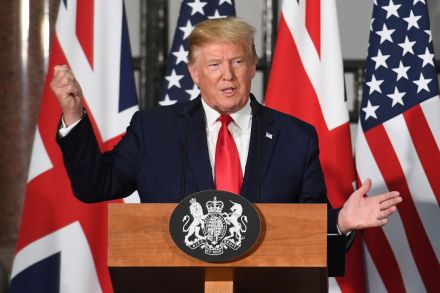
Trump pledges to “go all out” for a UK-US trade deal if Brexit talks fail

From our UK edition

The message from the EU is clear: there will be no improvement to the deal rejected by Parliament. And if talks fail? Donald Trump today makes an offer: that the United States, the UK's No 1 customer, is standing by with its own free trade deal. It needn't take even a year, he says, as he'd go “all out” so Britain can do a lot more trade with the world's largest economy. The EU's deal, he says, is anyway ludicrous: the £39bn is too much money. And why, he asks, would the UK government agreed to a two-year moratorium on signing free trade deals? In an interview with the Sunday Times, he elaborates on the art of the deal. "If they don’t get what they want, I would walk away. Yes, I would walk away.

Modern Britain isn’t fit to honour the memory of D-Day

From our UK edition

Throughout 2002 and 2003 I travelled the country, and further afield, interviewing wartime veterans of the Special Air Service for my book about the history of the regiment's early years. This adventure coincided with Britain's march to war against Iraq and, more often than not during my discussions with these old warriors, the question of the conflict arose. Only one veteran among the scores I spoke to was in favour of Britain's participation. The rest gave their wholehearted support to the soldiers sent to fight Saddam Hussein's forces, but distrusted the political reasons for their deployment. Of these men only a handful remain. I had lunch with one at the end of 2017 and although in his late 90s he was still razor sharp.

The cosmic magnetism of Trump and Brexit

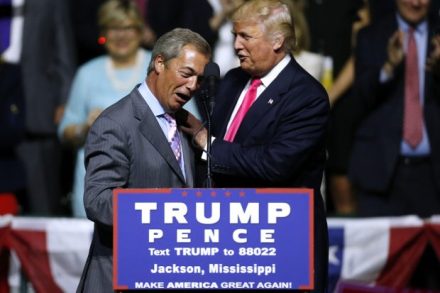
Polite British eurosceptics still insist that Brexit isn’t Trump and Trump isn’t Brexit — as if that meant anything at all. Many of us Britons like to think that our populist revolt is a more civilized affair than the one happening across the Atlantic. As London prepares to welcome President Trump next week, it may be time for the British to admit that we have been deluding ourselves. The truth is that Trump is the sun to the Brexit moon. Some mysterious cosmic magnetism always seems to pull them together. Nigel Farage might call it destiny. Look at recent history. On June 24, 2016, the day after the EU referendum, Donald Trump arrived by helicopter at Turnberry, his golf course in Scotland.

cosmic magnetism

Low life | 30 May 2019

From our UK edition

Considerate to the last, she had her order of service arranged in her mind. I sat close with my notebook. She didn’t want a eulogy, she said, but she is definite about the hymns and readings. To kick off, she would like that old Russian roof-raiser ‘How Great Thou Art’. Then, ‘Lord, For the Years Your Love Has  Kept and Guided’. And for the big finish: ‘In Christ Alone (My Hope Is Found)’. If there is to be a psalm, she would like number 121: ‘I will lift up mine eyes unto the hills, from whence cometh my help.’ Lately there’s been a funeral a week in the village church. Currently on the mantelpiece are three funeral order of service booklets commemorating deceased neighbours.

The Trump card

From our UK edition

The day after Britain voted to leave the European Union, Donald Trump arrived by helicopter at Turnberry, his golf course in Scotland. The financial markets were in crisis and David Cameron had resigned in a panic. The Dutch Prime Minister, Mark Rutte, said that Britain had ‘collapsed: politically, monetarily, constitutionally and economically’. The then candidate (still not even party nominee) Trump put it differently. ‘You just have to embrace it,’ he said. ‘It’s the will of the people. I love to see people take their countries back.’ Perhaps his advice should have been taken more seriously. Huge numbers of people, including many Americans, think that Trump is unfit for the office of president. But why do so many support him?

Portrait of the week | 30 May 2019

From our UK edition

Home The Brexit party, led by Nigel Farage, received 5,248,533 votes (out of 17,199,701 cast) in the European parliament elections, securing 29 seats — more than twice the seats won by the Conservatives (in fifth place, down from 19 seats in 2014 to four now) and Labour (down from 20 seats to ten) put together. The Liberal Democrats, with 3,367,284 votes, pushed Labour into third place by winning 16 seats (up from one). The Greens won seven seats (up from three). The Yorkshire party secured more votes than the right-wing English Democrats did in the whole country. The Animal Welfare party received more votes than the Women’s Equality party. Ukip won no seat and nor did Change UK. The turnout was 36.9 per cent, the second highest since the elections began in 1979.

Why I’m pleased that Dominic Raab isn’t a feminist

From our UK edition

Dominic Raab is not a feminist. That is the confession the Tory leadership hopeful makes in an interview in this week’s Spectator. Screams, gasps and 240 character rants have swept the internet since. Who in their right mind would reject the notion of treating men and women equally? Of course, Raab didn’t do that. He describes himself as “someone who is passionate about equality and wants a fairer society.” What Raab rejects is the term itself: feminism. And Raab is not alone. In fact, his position represents the vast majority of women in the UK. Most women don’t identify as feminists. Young women, older women, and especially women in lower income brackets actively reject the term.