Brexit

The EU’s vaccine shambles is turning into a re-run of the euro crisis

From our UK edition

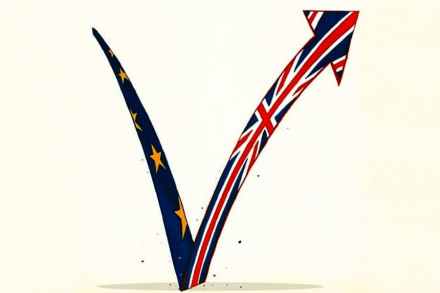
Rewind a few months, and it was all meant to be very different. With Covid-19 rampant across the world, the European Union would take charge of sourcing vaccines from the major drugs companies. Its massive buying and regulatory power, coupled with its finely-tuned administrative machine, would make sure its 440 million people were protected from the virus before anyone else. It would be a magnificent demonstration of the whole point of the organisation. The trouble is, not only has the project already started to come off the rails, it is getting worse with every day that passes. Europe’s vaccine alliance is crumbling with potentially far-reaching consequences. Europe’s vaccine alliance is crumbling with potentially far-reaching consequences.

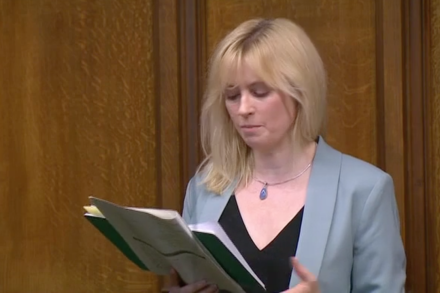
Rosie Duffield’s re-join remarks will haunt the Labour party

From our UK edition

Every party keeps on file a list of rash things politicians in other parties have said that can be used against them at a later date. Way back when I was directing Ukip’s 2014 European parliamentary campaign, I built up a ‘helpful contributions’ folder containing print-outs of gaffes and embarrassing admissions made by pro-EU MPs and MEPs. Conservative Campaign Headquarters probably has at its disposal a far more sophisticated and comprehensive digital system for logging the own-goals of its adversaries. But one thing is certain, someone will imminently be inputting an entry marked something like ‘Duffield, R. – Labour’s plan to re-join the EU’.

Boris shouldn’t be allowed to forget cosying up to Trump

From our UK edition

Eighteen months ago, I had the pleasure of telling Lee Cain, Boris Johnson’s now departed head of communications, about the nickname that the American president had come up with for Britain’s new Prime Minister: ‘Britain Trump’. My amusement was matched by the look of horror on Cain’s face. This was very much not the label that Number 10 wanted for their man in 2019, and it’s even less so in 2021. The coincidence that both men rose after uprisings at the polls in 2016 is just that, they argue – a coincidence. The ‘Johnson isn’t Trump’ case is well made by James Forsyth in the Times, and it’s right, as far as it goes. Donald Trump is one of a kind.

The FTSE is defying the Brexit doom mongers

From our UK edition

The banks would all flee. International investors would take fright. And the pound would turn into the Great British peso. We heard a lot over the last four years about how leaving the European Union would be catastrophic for the UK economy. But here is something odd. With the transitional arrangement coming to an end with the close of the old year, and with the UK now out of the Single Market and the Customs Union, and with just a loose trade arrangement with the rest of the continent that doesn’t even cover financial services, so far the FTSE is loving Brexit. True, it is only the first week of trading, and even that is not over yet, but so far the benchmark FTSE-100 index has risen from 6,500 on Monday to 6,850 on Thursday.

Portrait of the week: New year, new lockdown

From our UK edition

Home Boris Johnson, the Prime Minister, announced harsher coronavirus restrictions in England, resembling those last March, except that bubbles continued. People must work from home if they could; schools were closed and this year’s exams cancelled. Another £4 billion was directed to businesses in retail, hospitality and leisure. At Westminster, parliament was recalled. In Scotland, golf courses remained open and churches were closed. In England, churches remained open and golf courses closed. The actions came in response to a sharp rise in Covid infections, many from a variant virus. One in 50 were estimated to have the disease. At first, 44 million in England were put under newly-invented Tier 4 restrictions, but hospitalisations increased.

History shouldn’t be used against us

From our UK edition

Can you feel the fascism yet? You ought to by now, more than a week after Britain leaving the EU. So many people warned us of this moment. There was the former journalist Paul Mason, who claimed to see crowds of fascists thronging the streets of London. The former Labour spin doctor Alastair Campbell became so disturbed by our national turn that at one stage he dressed up in a sort of regimental uniform and sang a song about Boris Johnson and Dominic Cummings. And then there was the cruelly titled Lord Adonis. The once-sensible former Blairite schools minister spent recent years so apparently worried about the dangers of Brexit that he became not just hysterical but homosexual too. It has been a disturbed few years for these, among other, people.

The Brexit deal has left the City to fight for its own future

From our UK edition

‘This Article shall not apply with respect to financial services.’ That’s what it says on page 92 of the EU-UK Trade Co-operation Agreement, and my search engine has found nothing else in the monster document offering any comfort to the sector, which contributes £130 billion to the UK economy and provides more than a million jobs. That’s in marked contrast to fishing — £1.4 billion, 24,000 jobs — which gets a compromise settlement (pages 919-925, if you’re keen) accounting for every last haddock, hake and horse mackerel.

The EU must ditch its deal with China after the arrests in Hong Kong

From our UK edition

Earlier this morning, 53 democrats from Hong Kong were arrested. Their crime? Trying to win last September’s elections. As absurd as it sounds, the new reality in Hong Kong is that it is now effectively a criminal offence, under the National Security Law, for the opposition to have the audacity to try and boost its representation in parliament. 'The operation today targets the active elements who are suspected to be involved in the crime of overthrowing, or interfering (with)...the Hong Kong government’s legal execution of duties,' said John Lee, Hong Kong’s security minister. But, as he later suggested, in reality this meant that those who were arrested were simply trying to win a majority of seats in Hong Kong's legislature.

Brexit causes food shortages – in France

From our UK edition

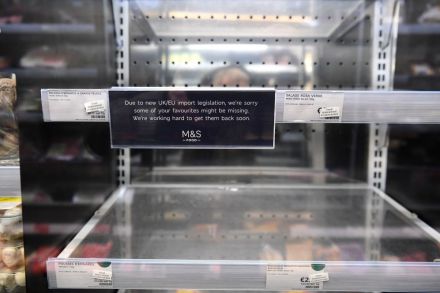
Since leaving the EU on 31 December, Britain seems to have somehow avoided the apocalyptic scenarios outlined by those most opposed to Brexit last year. There have been, so far, no long queues of lorries at Dover; the lights have stayed on; and the nation’s supermarket shelves have remained full of food. It appears that Brexit has caused food shortages in one country though. Mr S was surprised to spot today, after all the dire prognostications about Britain’s own food supply, that one shop in France is struggling to get hold of essential grub. According to the news agency Reuters, Marks & Spencer has struggled to fill the shelves of its 19 food stores in Paris since Brexit day.

Why haven’t we shut the UK border already?

From our UK edition

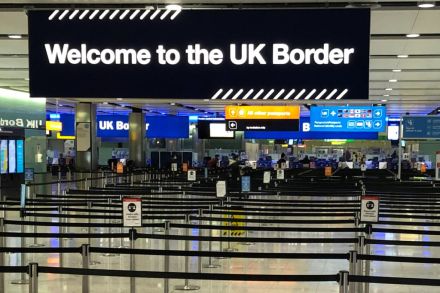
‘This country has not only left the European Union but on January 1 we will take back full control of our money, our borders and our laws,’ said Boris Johnson in October last year. The transition period is now over; we are out of the single market and customs union, which means freedom of movement of people is at an end. The UK has total control over its borders (other than the one on the island of Ireland, but let’s not go there today). So it is worth asking why the government is choosing not to exercise this right in anything approaching an appropriate manner at present, particularly when such a power is obviously of use given the harrowing Covid situation.

What Boris should do about a problem like Putin’s Russia

From our UK edition

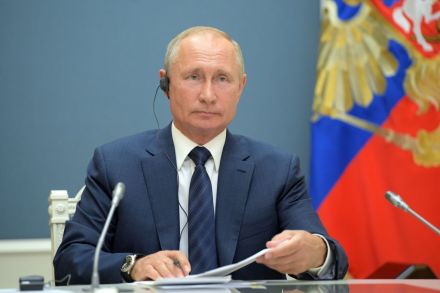
With Brexit, the arrival of a new US administration, and trade deals like the Trans-Pacific Partnership, the government’s foreign policy docket for 2021 will likely be pretty full, but in the odd spare moment, perhaps when he’s walking Dilyn, Boris might want to give some thought to his Russia policy. The great virtue is, after all, that there is pretty much nowhere to go but up. Putin’s Russia is an antagonist, and although the threat is primarily through disinformation, espionage and subversion, the first necessity is a continued firm reaffirmation of the UK’s commitment to Nato. This is, after all, not just or even mainly as a source of common military defence, but a powerful statement of solidarity.

My fellow Rejoiners are living a fantasy

From our UK edition

On New Year’s Eve at 11 p.m., the United Kingdom departed both the single market and the customs union, making the end to the country’s former membership of the EU complete. It was a moment to celebrate for Brexiteers; the commemoration of sadness for some Remainers. Or should I say 'Rejoiners' — there is no remaining now, Great Britain having departed the European Union. Many Rejoiners have set out their stalls already. ‘When they tell you to "move on" DO move on — to the long, strong, campaign to rejoin,’ tweeted Simon Schama, the historian and noted fan of the UK’s membership of the EU, ‘However hard the road, however long it takes; it starts now.

Has Brexit already destroyed Labour’s chances?

From our UK edition

Part of the soap opera appeal of politics comes from the idea that it is a competitive sport based on fine margins – with a result that will be determined by the relative performances of the teams and their captains. Under the British first-past-the-post system two major parties slug it out in an epic tussle across hundreds of seats and then one of them wins. Sometimes things are so closely fought that neither party has an outright majority, in which case one or more of the minor parties gets to choose which should be propped up. From this point of view, every policy shift or zinger soundbite thrown by Boris Johnson or Keir Starmer changes the odds as to which of them will occupy 10 Downing Street after the next election.

Theresa May gives Starmer a lesson in Brexit hindsight

From our UK edition

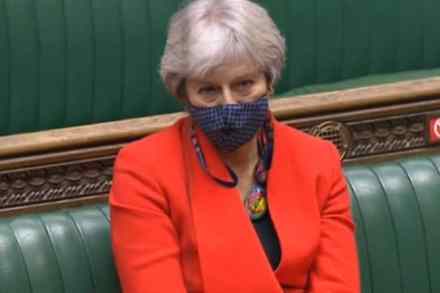
During the debate over Boris Johnson's Brexit agreement in the House of Commons today, Theresa May chastised the Labour leader over his criticism of both her deal and the current deal.  Appearing to be the only MP in the chamber wearing a mask while waiting to speak, the former Prime Minister heard Starmer wish for a better Brexit agreement, while accepting that he will whip his MPs to vote for Boris’s ‘thin deal’. These words stirred something within May as she thought back to the numerous painful meaningful Brexit votes under her watch. Back then, Starmer was shadow Brexit secretary and played a key role in moving the official Labour position to backing a second referendum rather than May's deal.

Why Boris would like Brexit to continue

From our UK edition

After all the parliamentary drama of the past four and a half years, the final Commons phase of Brexit is passing with remarkably little drama. Boris Johnson knows his agreement will be voted through this afternoon and, following the European Research Group decision, with nearly universal Tory support. Johnson’s speech was upbeat, as he sought to declare the deal a triumph. He pointed to the exclusion of any role for the European Court of Justice, the speed with which the deal had been done and the fact it was zero tariff, zero quota. In a sign of the fight to come, Johnson had to fend off multiple points of order from Ian Blackford, the leader of the Scottish National Party, who sought to critique the compromise on fishing.

Starmer is about to make a big mistake in backing Boris’s deal

From our UK edition

Keir Starmer has announced he is whipping his Labour MPs to vote for Boris’s Brexit deal in the House of Commons today. There are two likely reasons behind this decision: firstly, to make himself seem like a Labour leader who is a grown up, after Corbyn’s teenaged politics; secondly, to demonstrate that Labour accepts Brexit in order that it may win back Leave voters in red wall seats at the next general election. But there is a big problem with this calculation. While all of Starmer’s Brexit options are difficult ones, he may be about to enact the worst of the lot. A no-deal situation would have allowed Keir Starmer to claim that as prime minister he would be able to get the Brexit deal from the EU that Boris evidently could not.

The shrewd calculation behind Sturgeon’s Brexit u-turn

From our UK edition

As political journeys go, it’s akin to Jeremy Corbyn quitting his allotment to grow marrows on an Israeli settlement. Nicola Sturgeon, a lifelong pro-European since June 24, 2016, has decreed that the SNP will vote against the free trade pact agreed by the UK and the EU. This is quite the turnaround. Sturgeon has previously said ‘a no-deal Brexit is a catastrophic idea’, warned of ‘the dire economic consequences of a no-deal Brexit’, described ‘the nightmare scenario of a no-deal Brexit’ and urged the UK Government ‘not to countenance in any way a no-deal Brexit’.

Britain should now brace itself for a barrage of Brussels red tape

From our UK edition

Should we be worried that the UK didn’t get all that it wanted for financial services in the UK-EU Trade deal, as the PM mentioned to the Sunday Telegraph? Financial services are our biggest export industry by some margin, including to the EU, as well as (arguably) our biggest taxpayer, so anything that hampers it could have serious economic repercussions. The EU for its part has said that it will consider in its own time if it will grant ‘equivalence’ to UK financial services, making it easier for UK based institutions to serve customers in the EU, and will only do so if it is in the EU’s interest. The Chancellor, Rishi Sunak, has already unilaterally granted EU equivalence status, providing continuity for EU financial services companies operating here.

The trouble with Erasmus is not just the cost

From our UK edition

It was curious to see the explosion of outrage over the UK no longer participating in the Erasmus scheme. We were told it broadened young people’s horizons by sending British undergraduates to study at a European university. We were told our young people are being deprived of this opportunity. But having spent my pre-politics career working with young people, Erasmus and deprivation are not things I’ve ever associated with one another. The outrage is largely coming from a collection of the firmly middle class and affluent anti-Brexit folk – TV broadcasters and QCs among them.