Brexit

This is just the start of the Brussels-Britain bust-ups

From our UK edition

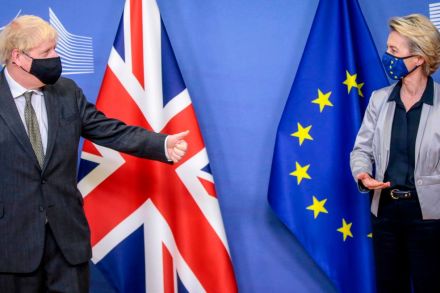
This is a crucial year for the UK’s two most important relationships, I say in the magazine this week. If the Johnson/Biden diplomatic relationship has got off to a better start than expected, the same cannot be said of the post-Brexit UK/EU one. The alignment between Johnson and Biden on climate change, Russia and China is helping the alliance. This relationship should become closer still given the two side’s agreement on China, the most important geo-political issue of the decade. The EU will attempt, often in not particularly edifying ways, to assert itself as the bigger partner.

The vaccine row shows the EU doesn’t understand contract law

From our UK edition

The EU rejects 'the logic of first-come first-serve,' said the EU's health commissioner Stella Kyriakides. 'That may work at the neighbourhood butcher's but not in contracts, and not in our advanced purchase agreements'. Contract law is an area of law I know well. And it is not a political comment to say the commissioner is wrong. We don't know precisely what the contract between AstraZeneca and EU member states says. But the EU did publish another vaccine supply contract here. All this makes it very difficult to see what case the EU has In any would-be-case involving this contract, the EU has two massive hurdles to jump. Firstly, contractors undertake to use their 'reasonable best efforts' to manufacture enough supply.

Britain will prove more Biden-friendly than the EU

From our UK edition

This is a crucial year for the UK’s two most important relationships. The Anglo-American alliance, our strongest diplomatic and security partnership, now needs to adjust to a new president in the White House. Meanwhile we are also starting our new relationship with the EU. The question is: can the two sides move on from the wrangling of the Brexit negotiation? To great relief in British diplomatic circles, the new US administration and the UK have got off to a good start. Joe Biden has shown that he is keen to move on from the Donald Trump era.

How the EU vaccine row could escalate

From our UK edition

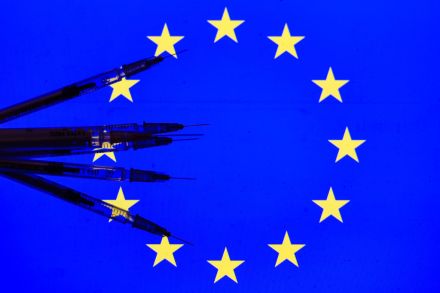
The EU is now insisting that AstraZeneca use vaccine produced at its UK site to make up for a shortfall in its supplies to the EU. This is likely to kick off a major row as the UK went to great trouble to ensure that it had first refusal on all the Oxford vaccine produced in the UK. Indeed, AstraZeneca’s willingness to accept that condition is a major reason why Oxford ended up partnering with them. It is not hard to see how this situation could escalate. The EU is already saying that companies should notify them before exporting vaccine out of the bloc, and the German government is going further, calling for full on export controls on vaccines.

The EU is blaming everyone but itself for its vaccine debacle

From our UK edition

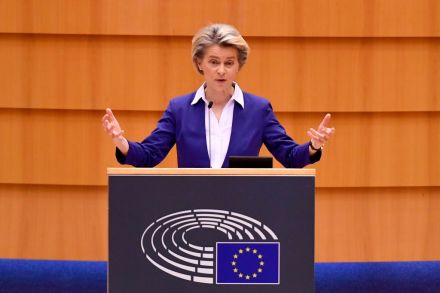
Something has gone badly wrong with the EU's rollout of the Covid vaccine. Yet in its response to this debacle, Brussels seems determined to double down, engaging in behaviour of the pettiest kind as it blames everyone but itself for what has happened. 'The companies must deliver', Ursula von der Leyen, the EU commission's president said this week, as she announced the launch of a 'vaccine export transparency mechanism'. In reality, this plan to oblige companies to notify the commission when vaccines leave the EU (into Britain, for example) is an attempt to pile pressure on the pharmaceutical firms who have given us the only way out of the situation we find ourselves in.

Are we heading for a golden era in British-Indian relations?

From our UK edition

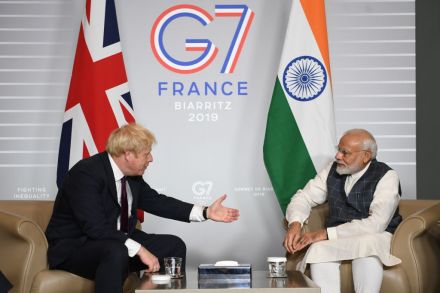
Britain's departure from the EU presents an exciting opportunity to build on old alliances around the world. Nowhere is this more true than in the UK's relationship with our old Indian friends.  India was preparing to roll out the red carpet for Boris Johnson this week. Being India’s annual guest of honour at their Republic Day celebrations is equivalent to the Buckingham Palace treatment or the Bastille Day invitation. Soldiers on double-humped camels, anti-satellite weapon systems on display and giant papier-mâché tableaux tributes to Mahatma Gandhi parade down New Delhi’s ceremonial boulevard that was once lined by statues of Britain’s kings and viceroys.

The rise of the super pessimist

From our UK edition

Covid isn’t the only thing to have developed a dangerous strain in the UK; pessimism has also mutated and is on the rise. BBC news recently reported in horrified tones that the economy had contracted 2.6 per cent in November, barely mentioning the fact that this was largely down to the nation being in lockdown. I don’t know what our national broadcaster has up its sleeve next but I’m expecting a dambing connection between home schooling and black market valium. That kind of contraction during lockdown is actually something to be proud of. The resilience of British consumerism during this last year has been this generation’s Dunkirk. Instead of hopping in tiny boats we’re resolutely buying tiny dresses for parties we’ll never attend.

Has Covid killed the EU’s dream of open borders?

From our UK edition

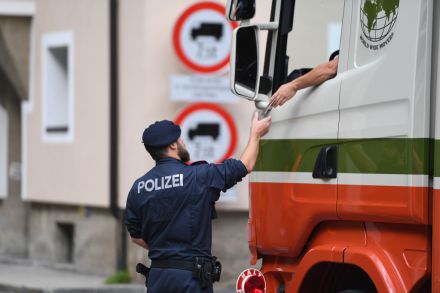
‘All non-essential travel should be strongly discouraged both within the country and of course across borders,’ Ursula von der Leyen, head of the European Commission, has said. As a result of the Covid crisis, the dream of open borders across the continent of Europe has never seemed so imperilled. Meanwhile, a post-Brexit Britain has the ability to flex its borders as much as it chooses. To some Brexiteers, this alone makes Brexit worth it. The Schengen agreement was signed in 1985 and became pan-EU in 1999, meaning that, from then on, any country without an opt-out needed to allow free movement of people from any other signatory country (almost all of the rest of the European Union).

Britain is right to play tit-for-tat with Brussels over the EU ambassador

From our UK edition

It is petty, small-minded, mean-spirited, and childish. It is certainly not difficult to think of a few adjectives to describe the UK’s decision to refuse diplomatic status to the European Union’s mission in London. Diplomats, and European ones in particular, take matters of status, protocol and etiquette very seriously, and the snub looks, on the surface at least, designed to diminish our closest neighbour. The ambassador for, say, Mozambique, or Honduras, has full diplomatic recognition, but not the person representing the 440 million strong trading bloc on the other side of the English channel. Wars have been started over lesser slights.  But hold on. Sure, you can argue that the UK is being silly. But so is the EU.

Britain’s copyright law is a mess

From our UK edition

Copyright often seems like a joke. Most of us infringe it constantly, and publicly, without a second’s thought. With the advent of the internet, the public uploads countless videos, music, photographs, art, and a whole host of other things without the permission of the creators. Even large organisations get away with it. A few years ago, for example, the National Trust posted a picture of an unusual, heart-shaped honeycomb to social media, claiming it had been made by bees at one of their properties. It went viral, but it wasn’t actually theirs. Luckily for them, the beekeeper who took the photograph didn’t press the issue. Even creators, whom the system was created to benefit, are often blissfully unaware of the rules.

Farewell to my dear friend Richard, the very best of us

From our UK edition

I heard the shocking news last week that one of my oldest friends — Richard Edwards — had died suddenly of a stroke. He was just 54 and a picture of health. I met Richard in 1988 when we were both PhD students at Cambridge. He had got the second-highest First in English in his year and was thought to have a brilliant academic career ahead of him, but as the year wore on it became clear that neither of us were particularly attracted to the scholarly life. Instead of dragging ourselves off to the library every day to ‘do the reading’, we would sit in his room drinking wine, making each other laugh and luxuriating in our mutual dissipation.

British opera companies and orchestras must start investing in native talent

From our UK edition

Early in 1946, two men boarded a train at Euston and went trawling for talent. Audition notices were posted at town halls up and down the land: singers wanted, no experience required. Two thousand applied. One town after another, they lined up for Karl Rankl, Covent Garden’s music director, and David Webster, its general manager. Those who sang in tune were hired, £8 a week for chorus, £40 for soloists. An organist in a Harrogate church was appointed chorusmaster. ‘At Carmen rehearsals,’ recalled Constance Shacklock, a farm girl from Nottinghamshire and future star, ‘none of us had ever seen a Carmen before, let alone sung one.’ By mid-year, Covent Garden had a credible opera company.

Will the next generation wonder what the fuss over Brexit was about?

From our UK edition

Robert Tombs’s new book is not long: 165 pages of argument, unadorned by maps or images. But brevity is good, and we pick it up expecting much insight, because its predecessor was so wonderful. In The English and Their History (2015), Tombs, a scholar of French, not English, history, boldly saw the wood where specialists saw only the trees. Surely, he said, England should have a history of its own. The election had just signalled that England-and-Wales might soon be a separate polity for the first time since 1707. Tombs delivered a timely and gripping investigation of this land, so filled with marks of continuity, yet prone to occasional, apparently inexplicable, bouts of implosion.

Why the ECJ still has a role to play in Britain’s lawmaking

From our UK edition

Now that Britain has left the EU, we are no longer bound by the European Court of Justice. Some may view that as something to celebrate. Yet there may also be downsides. The ECJ is the final court of the EU. It hears lots of cases about EU member states who break EU law. It then reaches conclusions which form case law. All 27 members of the EU are bound by this, but Britain, outside the EU, is not. But here’s the catch: some of those decisions might actually be good ones. The solution is that we should borrow these good ones for ourselves. English law is a magpie. We pick up shiny bits of ‘good law’ that other places have and we make them ours. It is what lots of sensible sovereign states do, and there is nothing wrong with this. There is no copyright in law.

Why does Keir Starmer always play it safe?

From our UK edition

Keir Starmer’s keynote speech at the Fabian conference today was focused almost completely on foreign policy. The thrust of the Labour pitch was that Starmer is ‘pro-American but anti-Trump’. Given Corbyn’s tendency to see the United States at the Great Satan, this marks a huge shift in Labour’s foreign policy outlook. However, the speech was also classic Starmer and not in a good way: correcting the most obvious mistakes from the Corbyn era but going absolutely no further. I should take a moment to applaud Starmer for at least pivoting Labour back to a foreign policy position that is sensible and won’t stand in the way of the party trying to win elections again.

France’s vaccine problem

From our UK edition

France is the only permanent member of the UN Security Council not to have developed a coronavirus vaccine, and it hurts. USA: two; UK: one; Russia: one; China: one, France nul points. To make matters worse, France also has an embarrassing international ranking in the number of its citizens it has vaccinated.  ‘France is the laughing stock of Europe’, cry a range of politicians and media. How is this possible in the land of Louis Pasteur, the French ask themselves? Even discounting Edward Jenner a century before Pasteur (whom France’s health minister graciously acknowledged), the French see this as the continuation of the country’s ‘déclassement’, a relentless historical decline from better days.

Reforming workers’ rights is an upside of Brexit

From our UK edition

Of all the arguments put out against Brexit during the bitter referendum debate, one of the least convincing was that it would give a UK government the opportunity to repeal employment law, thereby impoverishing Britain and its people. Jeremy Corbyn once asserted that a Conservative government would turn the country into a 'low-wage tax haven'. That is an interesting concept, which like the chemical element Seaborgium might theoretically exist but which has yet to be discovered in the real world – most tax havens seem to be pretty wealthy, at least compared with similar countries which haven’t set the fiscal and regulatory conditions to attract businesses and wealthy individuals.

We’re starting to see a new foreign policy for Brexit Britain

From our UK edition

What will Brexit Britain do differently? This is going to be the most important question in our politics for the next decade. If the answer is that nothing much will change, it would be hard to argue that the disruption of the past four and a half years has been worth it. But if Brexit means the country becomes quicker at adapting to changing circumstances, then the electorate’s decision in 2016 will have been vindicated. The quick decision to remove VAT from tampons and sanitary towels is a small, early sign of how Brexit enables parliament to respond more directly to public pressure. The decision not to join the EU’s vaccine procurement programme let us move faster with immunisation: the UK has currently vaccinated more people than France, Italy and Germany put together.

Sell bitcoin, buy Tesla

From our UK edition

Which is madder, bitcoin at $41,500 — oops, make that $31,000 on Monday — or Tesla shares at $880 apiece? Don’t get me started on the crypto-mania in which the Financial Conduct Authority has warned gamblers ‘they should be prepared to lose all their money’. But Tesla, relatively speaking, is a real thing: a California-based carmaker which has expanded the frontiers of the electric vehicle market that’s going to become huge in the next decade and could soon make carbon--fuelled road transport extinct. Put that way, it’s not so surprising — in tech stock terms — that investors should value Tesla higher than the rest of the US auto industry combined.