Boris johnson

. . . and I won’t be Boris Mark II

As soon as votes were counted in the race to be Tory candidate for London mayor, Zac Goldsmith’s problem became clear. He had won comfortably, but just 9,200 party members bothered to vote — compared with the 80,000 who took part in Labour’s contest. Goldsmith praised his party for a ‘civilised and constructive’ debate, unlike the ‘divisive and vicious’ battle won by Sadiq Khan. But if Labour can call on a machine whose activists outnumber the Tories by nine to one, the Conservative candidate faces a real disadvantage. The size of Khan’s vote, Goldsmith thinks, is deceptive and swollen by trade union members. But in May, he concedes, ‘They will be out en masse, combined with the Corbyn-istas. So yes, they know that this matters.

I won’t be Corbyn’s man in London . . .

Sadiq Khan has long been known as one of Labour’s most pugnacious politicians: someone who likes to fight, and likes to win. The son of a bus driver, he became a human rights lawyer, entered parliament in 2005 and that same year was named newcomer of the year at The Spectator’s parliamentary awards. He ran Ed Miliband’s leadership campaign in 2010 and led Labour’s fierce — and surprisingly effective —campaign in London last year. Now, his sights are set on reclaiming City Hall for Labour and persuading even those on the right that he is the natural heir to Boris Johnson. ‘I want Spectator readers to give me a second look,’ he says, when we meet in the House of Commons.

From Lord Sewel to Karen Danczuk, 2015 was the Year of the Cad

Now that former Central Office favourite Mark Clarke has been banned for life from the Conservative party, he could pursue a career in copy-writing. He seems to have a twisted aptitude for that sort of thing. When leading the Tories’ general election RoadTrip 2015 of young activists, many of them peachy girls, Mr Clarke was said to have had the slogan ‘Isolate, inebriate and penetrate’. Though he denies the bon mot, his approach was apparently wildly successful — which is more than can be said for his attempts to land a parliamentary seat. Several women, including at least one serving cabinet minister, fell for this plausible smarmer over the years.

Dear Mary solves problems for Nicky Haslam, Nigel Slater, Professor Mary Beard and others

From Nicky Haslam Q. Being considered something of a guru on the subject of things common, can you advise me how to finesse the host or hostess who asks, challengingly, ‘I suppose you think my twinkling decorations/strings of cards/mulled wine/sushi/antler headband/children are terribly common?’ A wan smile won’t suffice. A. Say, ‘Yes I do. You’re so clever to be in the vanguard. Common is the new chic.’ From Nigel Slater Q. With each passing year (I am nearly 60, for heaven’s sake), I am finding it increasingly difficult to lie convincingly. This is a particular problem when unwrapping presents. The grateful words flow from my lips like warm jam from a spoon but what appears on my face is ‘Seriously, how could you?

Cameron’s great escape

The last time David Cameron sat down with The Spectator for an interview, he was on a train and looking rather worried. There were just weeks to go until the general election and the polls were not moving. At the time, almost no one — and certainly not him — imagined that he was on the cusp of a historic election victory that would not just sweep the Tories to power but send Labour into an abyss. This time, we meet on another train. But he’s far more relaxed, reflecting on winning The Spectator Parliamentarian of the Year award and recalling how election night brought him some of the ‘happiest hours’ of his life. These occurred in the men’s changing room at Witney Leisure Centre.

London Notebook | 10 December 2015

I’ve spent much of the autumn and winter shooting my new TV series for BBC1. New Blood looks at the so-called ‘Y’ generation and focuses on two 25-year-olds who fight crime but who spend as much time worrying about their university loans, finding somewhere to live, arguing with each other and trying to kick-start their careers. It’s been fun watching our two young stars — Mark Strepan and Ben Tavassoli, watch those names — grow into the parts and I’ve thrown everything at them. They’ve cycled and run miles, been shot at, drugged, kidnapped, drenched, tortured and blown up. They’ve jumped off the roof of a hotel, escaped from a burning car and fought naked in a Turkish hammam. To their credit, they’ve never once complained . . .

The politics of envy has failed

Last week I put £25 on Lady C to win I’m A Celebrity… Get Me Out of Here. At 25/1, I thought it was quite a good bet – until she withdrew for medical reasons. For those not watching the 15th series of the jungle reality show, Lady C is Lady Colin Campbell, a self-proclaimed ‘socialite’ and author of several royal biographies. Some of her fellow contestants, such as ex-Spandau Ballet frontman Tony Hadley, have accused her of not being a ‘real lady’, but they don’t have a clue, obviously. They mean she swears a lot, which hardly disqualifies her from being a toff.

Lord Sugar to Boris Johnson: ‘you need a whack, mate’

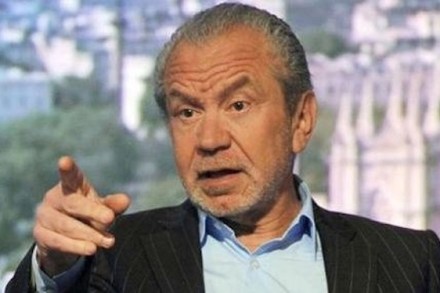
Faced with the prospect of Jeremy Corbyn one day becoming Prime Minister, Lord Sugar said that if elected, we should all move to China. Strong words from the Apprentice star -- who quit the Labour Party after the election over its 'negative' stance on business, yet he doesn't seem all that happy with Britain under Tory rule either. Today Sugar told the Mayor of London that he needed a 'whack' after the millionaire businessman found himself stuck in traffic. 'I have been sitting in Lower Thames st for a bloody hour,' he moaned in a tweet directed at Boris Johnson. 'What a bloody joke, it's getting worse.' It's thought that the delay was in part caused by the East-West Cycle Superhighway. https://twitter.

Boris shows a hint of Euroscepticism — but he still can’t beat Mary Beard

Thank God for Mary Beard. Sure, she’s wrong about Jeremy Corbyn. She was wrong about 9/11. She’s wrong about plenty. But let’s talk about what matters. She’s right about Ancient Rome. It’s rare to see Boris Johnson lose a popular vote. Last night, Beard trounced him at the Intelligence Squared Greece vs Rome debate, winning the day for Rome with a 9% swing. This was also a fundraiser for one of the most worthy educational charities I know: Classics for All encourages access to ‘elite’ classical subjects in state schools, teaching teens that you don’t have to be Bullingdon material to 'get' Boethius.

Islamic State are clear about their values. Are we clear about ours?

Here we go again. The same mantras are dusted down: we must be more assertive of our values, less tolerant of extremism, we must challenge Muslim separatism more effectively, demand better integration. And in my opinion the same root question is somewhat evaded: what exactly are our values? It is easier to assume that this is obvious – and it gives an impression of toughness. For example Boris Johnson today: ‘This is a fight we will one day inevitably win – because in the end our view of the human spirit is vastly more attractive and realistic than theirs.’ But what is our view of the human spirit? What is our ideology, our creed? There are various words we can reach for – freedom, democracy, liberalism, maybe enlightenment.

Who will influence the EU referendum? Martin Lewis, not June Sarpong

The Money Saving Expert Martin Lewis is apparently the most trusted voice on the EU referendum, according to a new poll. James Morris from Greenberg Quinlan Rosner, who was also Ed Miliband’s former pollster, has examined the state of the referendum campaign and reports that it is very close. According to Morris’ research, 45 per cent believe Britain should remain in the EU, compared to 42 per cent who would vote to leave — a result that is within the margin of error. 11 per cent are undecided. This polling also shows a big difference in voting intentions among different demographics and age groups.

Club class won’t fly any more

I’m getting a lot of abuse on Twitter for saying that having been a member of the Bullingdon is more of a hindrance than a help in contemporary Britain. My comment was a response to a piece by Charlotte Proudman in the Guardian on Monday that Oxford and Cambridge’s drinking clubs ‘cement the succession of power and influence in Britain among a narrow elite’. In response to my claim, numerous people have pointed out that the Prime Minister, the Chancellor of the Exchequer and the Mayor of London were all members of the Bullingdon. The problem with this rebuttal is that merely pointing out that Cameron, Osborne and Johnson are successful politicians doesn’t, by itself, prove their membership wasn’t a hindrance.

Boris Johnson’s diary: Amid the China hype, remember Japan

Frankly I don’t know why the British media made such a big fat fuss last week when I accidentally flattened a ten-year-old Japanese rugby player called Toki. He got to his feet. He smiled. Everyone applauded. That’s rugby, isn’t it? You get knocked down, you get up again. And yet I have to admit that I offered a silent prayer of thanks that I didn’t actually hurt the little guy. They aren’t making many kids like Toki these days; in fact they aren’t making enough kids at all. If you want proof of the rule that nobody knows anything, look up a 1988 bestseller called Yen! Japan’s New Financial Empire and its Threat to America.

Will Theresa lead the Out tribe?

[audioplayer src="http://rss.acast.com/viewfrom22/thedeathoffeminism/media.mp3" title="James Forsyth and Isabel Hardman discuss whether Theresa May will lead the Out campaign" startat=1050] Listen [/audioplayer]Who is the most politically interesting member of David Cameron’s cabinet? There’s a good case to be made for Michael Gove. He is as intent on reforming the justice system as he was our schools. If he succeeds, it will be the biggest transformation in Britain’s approach to criminal justice since the Roy Jenkins years. The prison population will begin to fall.

Exclusive: Boris declares that Japan is relaxed about Britain leaving the EU

Boris Johnson has recently returned from a tour of Japan. His diary of the trip appears in this week's issue of The Spectator: Frankly I don’t know why the British media made such a big fat fuss last week when I accidentally flattened a ten-year-old Japanese rugby player called Toki. He got to his feet. He smiled. Everyone applauded. That’s rugby, isn’t it? You get knocked down, you get up again. And yet I have to admit that I offered a silent prayer of thanks that I didn’t actually hurt the little guy. They aren’t making many kids like Toki these days; in fact they aren’t making enough kids at all. If you want proof of the rule that nobody knows anything, look up a 1988 bestseller called Yen!

Theresa May defends Jeremy Heywood’s Heathrow meddling

Sir Jeremy Heywood has been caught meddling in government matters again. The BBC’s Laura Kuenssberg reveals that the Cabinet Secretary wrote to ministers before party conference season to warn them against speaking out on expanding Heathrow Airport while a decision is still being taken. Heywood helpfully said it was fine to reiterate statements made pre-July but they should keep schtum on anything new now, in fear of opening the door to a legal challenge. For a senior civil servant to dole out orders to ministers in this way is pretty irregular— with one member of the cabinet telling the BBC it was ‘unprecedented’.

Boris Johnson’s history of violence

Oh dear. With Boris Johnson needing to mount a political comeback pretty soon in order to have any hope of stopping George Osborne's bid to be the next Conservative leader, the Mayor of London could do with some good PR. So unfortunately an incident that occurred on his trip to Japan is unlikely to prove helpful. Johnson was filmed knocking over a 10-year-old Japanese schoolboy during a 'friendly game' of rugby. With the boy, who is called Toki Sekiguchi, saying that he only felt a little pain,  Mr S suspects he may have got off lightly given Boris Johnson's history of violence. 2. Last year during a charity football match, Johnson took down a nine-year-old as he went in for the ball with an over-enthusiastic tackle. https://vine.co/v/Oq6JqQqqdgr 3.

Tory harmony is threatened by the EU referendum

For all the leadership positioning, one of the striking things about Tory conference in Manchester was the level of agreement about what the party’s strategy should be. There was almost no one calling for the party to move right. Instead, the emphasis was on how the party could expand its electoral coalition. Boris Johnson and George Osborne may have very different styles, but the argument of their speeches was essentially the same: the Tories have to show that they are the party for low paid workers. This determination to look for new converts, which was the defining feature of David Cameron’s speech too, is a product of the election campaign.

This is the Tories’ golden chance to seize the centre ground

Political party conferences have, in recent years, felt like an empty ritual. They used to be convened in seaside towns, so grassroots activists could find affordable accommodation. Now they are usually held in cities, so lobbyists can find better restaurants. Activists have been supplanted by members of the political class who are charged £500 a ticket. In the fringe debates, speakers face a volley of questions from people paid to ask them — on pensions, subsidies for green energy and the like. Politicians spend all day talking to journalists, and real politics vanishes. This year, however, politics has returned.