Book review

A little loving irony

From our UK edition

It doesn’t mean much to say that Renata Adler’s journalism isn’t as interesting as her novels — almost nothing is as interesting as Renata Adler’s novels. In 2013, the American publishing house New York Review Books reissued her two slim novels Speedboat and Pitch Dark. These had been cultish hits when they were first published, 30 years earlier, and it was easy to see why. They are excellent skewers of the complacency and pomp of American society and fashion: funny, manic, memorable and made up of tiny, brilliant scenes. ‘Her husband had invented a calorie-free spaghetti from seaweed,’ she writes of one party guest: ‘He was the world’s yet unacknowledged living authority on seaweed and its many uses. She was quite eloquent about it.

The raffish toff with a winning Formula

From our UK edition

Max Mosley’s autobiography has been much anticipated: by the motor racing world, by the writers and readers of tabloid newspapers, by social historians, and by lawyers, whom one imagines perusing it with nods, frowns and the occasional wince. Mosley is a barrister of Gray’s Inn, and it was as a lawyer that, with his friend Bernie Ecclestone, he came to dominate motor racing. Their association began in 1964, when Mosley was a pupil in Lord Hailsham’s chambers and Ecclestone was the country’s top used-car dealer, said to be able to value an entire showroom at a glance.

Detroit’s new colonials

From our UK edition

In the opening sentence of this subtle and finely poised novel, the narrator, Greg Marnier, known as ‘Marny’, admits that he ‘was never much good at telling stories’. By the end he is accused of having a ‘confessional streak, but no real desire to explain yourself’, while realising that ‘everything people do, everything they say, is just a clumsy form of self-defence’. He is a singularly obtuse and convincing character — a thirtysomething lecturer with no sign of tenure. Then a chance encounter with a rich college friend leads him to re-locate to Detroit.

The real theatre of war

From our UK edition

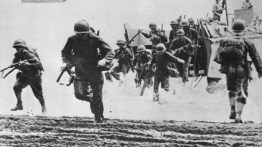
The history of ‘great events’, Voltaire wrote, is ‘hardly more than the history of crimes’. Physically, the war in Asia was the second world war’s greatest event. The Asian theatre, much of it water, was seven times larger than the European theatre. America’s mobilisation was the most complex in history, Japan’s crimes among the most sadistic. Metaphysically, the atomic consummation altered our relationship to our habitat. Yet only three comprehensive, single-volume accounts of the war in Asia have appeared — until now the most recent being Ronald Spector’s Eagle Against the Sun in 1985.

One helluva racket

From our UK edition

For a music fan, the quiz question, ‘Who wrote “This Land is Your Land”?’ might seem laughably easy. Yet if you answered ‘Woody Guthrie’, I’m afraid you only get half marks. Guthrie did write the lyrics, but following his normal practice he set them to an existing melody — in this case that of the Carter Family’s ‘When the World’s on Fire’, which they’d got from their friend Lesley Riddle, who may well have found it somewhere else. None of which, in 2004, stopped Guthrie’s copyright-holders from threatening a satirical website with a lawsuit when, like Guthrie himself, it put new words to the same tune. And if that doesn’t sound shameless enough, try this.

Toxic fun with Mum and Dad

From our UK edition

In 2008, when Taylor Wilson was 14, he created a working nuclear fusion reactor, ‘a miniature sun on earth’. At 17 he entered his home-made radiation detector for inspecting cargo at the Intel International Science and Engineering Fair; his project was entitled ‘Countering Nuclear Terrorism: Novel Active and Passive Techniques for Detecting Nuclear Threats’. In a field of 1,500 entries, it swept the board. Winning the war against terror isn’t Taylor’s only ambition. He plans to provide affordable, sustainable energy for the whole planet, not to mention beating cancer. Aged 11, he watched his beloved grandmother withering from lung cancer, and became convinced that it was up to him to do something about it.

The man who wrecked New York

From our UK edition

It is something of a mystery why the Bodley Head has decided to publish Robert Caro’s The Power Broker in Britain more than 40 years after the initial appearance in the US of this classic work — but better late than never. Caro’s remarkable portrait of New York City’s master planner Robert Moses merits publication in any language, at any moment in time. For its scope extends beyond Moses, fascinating though he was as a person, builder, wrecker, and manipulator of men and money. Caro’s ambition — in a journalistic sense equal to Moses’s ambition in architecture, park creation, and road and bridge construction — is greater than conventional biography.

Carrying on regardless | 25 June 2015

From our UK edition

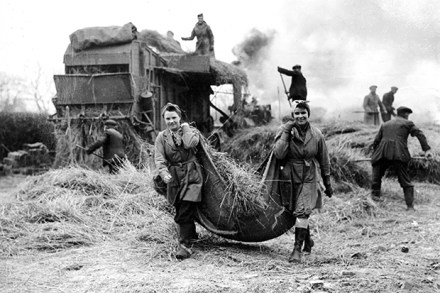
This big, bristling, deeply-furrowed book kicks off with a picture of the British countryside just before the second world war. Apparently we then grew only 30 per cent of our food, horses did most of the work and a lot of the land, criss-crossed by empty roads featuring the occasional pony trap, had been abandoned to weeds and brambles. Move on a year or two and millions of acres had been brought under the plough. Tennis courts, golf courses, railway embankments, school playing fields and even the lawns of large houses had been turned into vegetable plots or corn fields. Barbed wire blocked the beaches, church bells only rang to warn of imminent invasion and ornamental church gates had been carted off to be turned into tanks.

Social climbing through the basement

From our UK edition

This book has brought out my inner Miliband. A punitive mansion tax on all properties with garden squares in Notting Hill? Hell, yes! Friends, I’d go further: flight taxes on trips to Mustique; VAT at 27.5 per cent on Stella McCartney running shoes, Daylesford groceries, Yogalates classes, Vita Coco coconut water, almond milk and chia seeds. All prep schools which attract paparazzi shooting supermodels dropping off their children to be abolished, and little Fox and Memphis sent to the nearest inner-city comp not yet turned into an academy. As for iceberg basements: a direct payment of £1.5 million to the treasury for one storey, £2.5 million for two, £4.15 million for three. Call it the Tax Titannica.

Sex, violence and lettuces

From our UK edition

There is something cruelly beautiful, delightfully frustrating and filthily gorgeous about a Scarlett Thomas novel. Two family trees open and close this book: one shows what the characters think they are and how they are related, the other what they are revealed to be. How the couplings shift is less important than the chains of desire that cannot be mapped or taxonomised. The Gardener family is reeling from and sneakily plotting about the death of great-aunt Oleander, owner of Namaste House, a retreat for whack jobs and slebby failures. But her will leaves them confounded. This family of botanists are each given a seed which might flourish into death or enlightenment. It might explain their genealogy, and the deaths of four of their forebears.

Licence to kill

From our UK edition

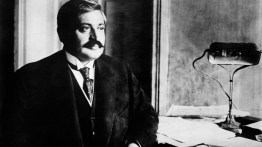
One morning in March 1921 a large man in an overcoat left his house in Charlottenburg, Berlin, to take a walk in the Tiergarten. A young man crossed his path, drew a pistol and shot him in the neck. Emitting a groan ‘like a branch falling off a tree’, he fell dead. The assassin ran, but was arrested by the crowd. ‘What do you want?’ he asked. ‘I am Armenian, he is Turkish. What is it to you?’ The victim was Talat Pasha, erstwhile interior minister of the Ottoman empire and convicted war criminal. His nemesis was Soghoman Tehlirian, engineering student and agent of the Armenian Revolutionary Federation. Talat topped the ARF’s list of targets: revenge for the genocide of some 1.5 million Armenians between 1915 and 1917.

Into the blue

From our UK edition

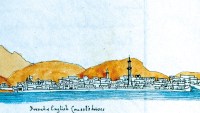
Jenny Balfour Paul is an indigo dye expert. She has written two books on the subject, and lectures around the world. A librarian alerted her to the mention of the colour, and the plant it comes from, in the journals of a long-forgotten sailor and indigo hand. That day a ten-year love affair began. Thomas Machell was born near York in 1824, a son of the manse. At the age of 16 he went to sea, scrubbing the decks of a merchant ship. After numerous adventures he settled in India, initially working for the Bengal Indigo Company, then transferring to plant and harvest coffee in Kerala. He was a curious, observant man who became fluent in both Arabic and Hindi, and, unlike many servants of the Raj, travelled widely off the beaten track.

‘It’s always wrong to starve’

From our UK edition

‘My mother and father named me Aron, but my father said they should have named me What Have You Done, and my uncle told everyone they should have called me What Were You Thinking.’ So begins, with bitter Jewish humour, this involving book set largely in the Warsaw ghetto. There is a hint of unnerving pastiche in this, but it is a sentence that finds an echo in the compassionate words of Jim Shepard’s hero, Janusz Korczak, in the final sentence of the book. Korczak was a real figure, a paediatrician who ran an orphanage in Warsaw, moved with it into the ghetto and, despite being offered several chances of escape, stayed with his charges when transported to the extermination camp at Treblinka.

The hardest man of all

From our UK edition

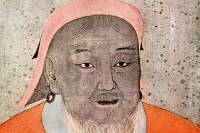
From the unpromising and desperately unforgiving background that forged his iron will and boundless ambition, Temujin (as Genghis Khan was named at birth) rose to build an empire that was to range from Korea and China, through Afghanistan, Persia and Iraq and eventually to Hungary and Russia, constituting the largest contiguous land imperium in history. His was an extraordinary, epic story and Frank McLynn does it full justice in a vivid, page-turning biography. The author portrays well the extreme hardship of the nomadic life for Genghis as boy and man on the arid Mongolian steppe, where temperatures range between 100 degrees Fahrenheit and minus 43, and where ‘one can be hit simultaneously by winds from the Siberian tundra and desert storms from the Gobi’.

The devils’ advocate | 25 June 2015

From our UK edition

Jeremy Hutchinson was the doyen of the criminal bar in the 1960s and 1970s. No Old Bailey hack or parvenu Rumpole, he was the son of Jack, a distinguished practitioner in the same field, and Mary, a Bloomsbury Strachey. An Oxford undergraduate who acquired a criminal record along with a PPE degree (he accidentally shot a policeman with an air pistol), married first to Peggy Ashcroft, he moved throughout his life in the upper echelons of English liberal intellectual society, and was elevated, while still in practice, to the House of Lords. The brief biographical sketch at the outset of this book, littered with names of those whose paths he crossed, including T.S.

Filling in the Bloomsbury puzzle

From our UK edition

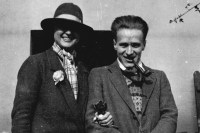
In March 1923 a large birthday party was held in a studio in Bloomsbury. It is often assumed that the eponymous Group was habitually glum or intense; but there were a lot of parties. The artists were Vanessa Bell and Duncan Grant, and the birthday was David Garnett’s 31st. David (known as Bunny) was a handsome, fair-haired fellow of bisexual charm, beloved by Grant, among others. His second novel, Lady into Fox, inspired and illustrated by his wife, Ray, had been a literary sensation the year before. There was much energetic dancing, and a floorshow was provided by the Russian ballerina Lydia Lopokova, Maynard Keynes’s wife, and by Harriet Bingham, a new friend of Bunny’s, a recent arrival from a very different world.

Dick Whittington for the 21st century

From our UK edition

Novels of such scope and invention are all too rare; unusual, too, are those of real heart, whose characters you grow to love and truly care for. The Year of the Runaways has it all. The action spans continents, taking in a vast sweep of politics, religion and immigration; it also examines with tenderness and delicacy the ties that bind us, whether to family, friends or fellow travellers. Judges of forthcoming literary prizes need look no further. Rose Tremain’s The Road Home described the experience of an Eastern European immigrant arriving to look for work in England. The book (which is among Tremain’s finest) was a powerful corrective to the notion that such migrants have an easy time of things.

Salvation through music

From our UK edition

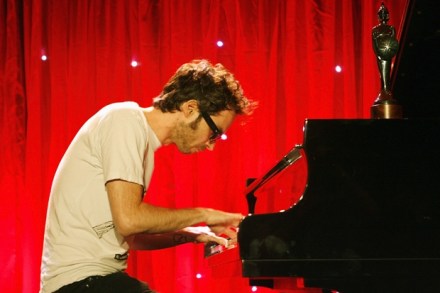
Ours is the era of everybody’s autobiography. Bookshops groan with misery-lit memoirs — Never Let Me Go, Dysfunction Without Tears — which dilate on anorexia, alcoholism, cruel bereavement. When is a life worth telling? B.S. Johnson, the London-born novelist (and tireless chronicler of himself), put the most revealing sexual details into his autobiographical novels of the 1960s. They might have amounted to mere solipsistic spouting, were the writing not so good. James Rhodes, a 40-year-old classical musician, was repeatedly raped at his London prep school in the early 1980s. In his memoir, Instrumental, Rhodes tells how he found salvation in music and became one of our leading concert pianists.