Book review

The glory that was Greece

From our UK edition

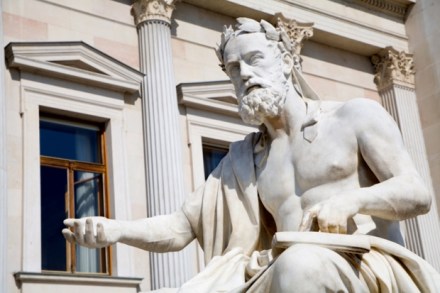
Financial crises are nothing new in Greece. Back in 354 BC, at a time when Frankfurt was still a swamp, the Athenian general Xenophon wrote a briefing paper designed to help his city negotiate the aftermath of a disastrous war. His proposals mixed supply-side reform with Keynesian stimulus. The regulatory powers of Athenian officials, so Xenophon suggested, should be streamlined and enhanced; simultaneously, the city should invest in increasing its commercial and housing stock. The economy, boosted by these measures, would also benefit from encouraging foreign investment. ‘Imports and exports, sales, rents and customs’: all would then surely flourish.

The song of the sirens

From our UK edition

The first mermaid we meet in this intriguing, gorgeously produced book is spray-painted in scarlet on a wall in Madrid, holding a heart not a mirror. Not your average mermaid, then; but as the folklorist and playwright Sophia Kingshill delves further into their complex cultural history, it becomes clear there’s no such thing. Mermaids can be gorgeous but deadly, like the ones in Pirates of the Caribbean who lure sailors into the sea, then bare their horrible fangs and move in for the kill. They can be vulnerable, like Ariel in Disney’s joyous The Little Mermaid. They can be harbingers of storms, or symbols of female inconstancy.‘It’s always a risk to meet a mermaid,’ writes Kingshill.

Between Heaven and ‘L’

From our UK edition

A.N. Wilson has had a tempestuous journey on the sea of faith. His first port of call was St Stephen’s House, in Oxford, the Anglo-Catholic seminary where he trained for ordination in the Church of England. He jumped ship at the end of his first year and travelled to the wilder shores of atheism, writing the polemical pamphlet Against Religion: Why We Should Try To Live Without It. Unable to follow his own advice, he created a niche for himself as the biographer of influential Christians such as John Milton, Hilaire Belloc, Nikolai Tolstoy, C.S. Lewis and John Betjeman, while also penning studies of the life of Jesus and the mind of St Paul.

Master of vitriol

From our UK edition

‘Genuine invective is an almost lost art in our wild satirical age,’ Dennis Potter complained in New Society in 1966. Now, as the British Film Institute celebrates the life and work of ‘the writer who redefined TV drama’, Oberon Books, with perfect timing, offers this collection of Potter’s critical abuse in journalism and interviews at its most constructively eloquent. The Art of Invective essentially complements Humphrey Carpenter’s magisterial biography and all those DVDs of the plays that can still galvanise what Potter called ‘the palace of varieties in the corner of the room’. He believed that television, with its vast, all-inclusive audience, was a potentially powerful means of promulgating true democracy.

Bringing Camus to book

From our UK edition

In 1975 the Nigerian novelist Chinua Achebe, in a lecture at the University of Massachusetts, identified Joseph Conrad’s Heart of Darkness as the work of a racist. Achebe objected to a story that used Africa as a setting for ‘the break-up of one petty European mind’, and depicted Africans as nameless savages. Achebe’s lecture — a masterpiece of special pleading, false analysis and anachronism — is now established as a founding text in the post-colonial school of criticism. On reading the cover blurb for The Meursault Investigation, one might have the impression that in this debut novel, Kamel Daoud, a native of Oran, has carried out a similar assault on Albert Camus’s first novel, L’Etranger (translated as The Outsider).

Between duty and desire

From our UK edition

Coup de Foudre has a line from Antony and Cleopatra as its epigraph: ‘Some innocents ’scape not the thunderbolt.’ In this new volume of stories from the American writer Ken Kalfus no one, innocent or guilty, can be counted safe. The novella which gives this collection its title is an audacious fictional riff on a real-life scandal: the arrest of Dominique Strauss-Kahn, head of the IMF, favoured candidate for president of France, arrested and charged with sexually assaulting a hotel chambermaid in New York. Couched in the form of an email apologia to the maid, this is like the story of Red Riding Hood told by the wolf.

Double thinking, double lives

From our UK edition

This hefty volume is misleadingly titled. It is not an escapist sort of travel book, ushering the visitor around the homelands and houses of the Italian literati. It is a selection of the author’s previous literary articles, mostly book reviews for the New York Review of Books and the London Review of Books, and believe me it is hardly a sunshine ramble or a splash in the pool. On the contrary, it is an immensely learned, elegantly written rehearsal of the significance of 23 Italian writers, from Dante in the 13th century to Antonio Tabucchi in our own, and as such it amounts I think to an assessment of the Italian sensibility as a whole. Nobody is better qualified than Tim Parks to guide us through such an experience.

When the journey, not the arrival, mattered

From our UK edition

Most current writers on railways don’t want to appear at all romantic lest they be shunted into the ‘trainspotter’ siding. But Michael Williams is unafraid to state the obvious fact about Britain’s railways, which is that they were far more attractive in the past: It is sometimes tempting to wonder if, deep in every railway operations HQ, there is a department whose sole job is to think up ways of corroding the experience of passengers. Here are seats that don’t line up with windows, garish plasticky train interiors, an incomprehensible fares system, a cacophony of endless announcements.... In The Trains Now Departed Williams celebrates ‘the best of what is gone from our railways’ in 16 vivid, highly readable chapters.

Their heads in the clouds

From our UK edition

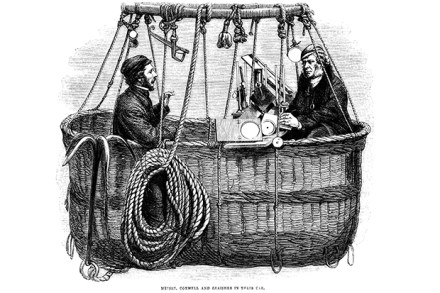
As I got into a Brighton taxi this morning, my driver’s first words were ‘apparently it’ll clear in a couple of hours’. I gathered — of course — that he was talking about the morning mist. ‘It’s almost gone already up in town.’ A conversation about weather prospects is hardly uncommon in British taxis, and we launched into this one with no preamble at all (he hadn’t said hello), as though invisibly picking up the thread of a conversation already in progress, a perpetual, life-long discussion about whether it’ll rain tomorrow filling in as the default whenever nothing else is being said. It’s odd. And in The Weather Experiment, Peter Moore tells us how we got here.

A little loving irony

From our UK edition

It doesn’t mean much to say that Renata Adler’s journalism isn’t as interesting as her novels — almost nothing is as interesting as Renata Adler’s novels. In 2013, the American publishing house New York Review Books reissued her two slim novels Speedboat and Pitch Dark. These had been cultish hits when they were first published, 30 years earlier, and it was easy to see why. They are excellent skewers of the complacency and pomp of American society and fashion: funny, manic, memorable and made up of tiny, brilliant scenes. ‘Her husband had invented a calorie-free spaghetti from seaweed,’ she writes of one party guest: ‘He was the world’s yet unacknowledged living authority on seaweed and its many uses. She was quite eloquent about it.

The raffish toff with a winning Formula

From our UK edition

Max Mosley’s autobiography has been much anticipated: by the motor racing world, by the writers and readers of tabloid newspapers, by social historians, and by lawyers, whom one imagines perusing it with nods, frowns and the occasional wince. Mosley is a barrister of Gray’s Inn, and it was as a lawyer that, with his friend Bernie Ecclestone, he came to dominate motor racing. Their association began in 1964, when Mosley was a pupil in Lord Hailsham’s chambers and Ecclestone was the country’s top used-car dealer, said to be able to value an entire showroom at a glance.

Detroit’s new colonials

From our UK edition

In the opening sentence of this subtle and finely poised novel, the narrator, Greg Marnier, known as ‘Marny’, admits that he ‘was never much good at telling stories’. By the end he is accused of having a ‘confessional streak, but no real desire to explain yourself’, while realising that ‘everything people do, everything they say, is just a clumsy form of self-defence’. He is a singularly obtuse and convincing character — a thirtysomething lecturer with no sign of tenure. Then a chance encounter with a rich college friend leads him to re-locate to Detroit.

Love it or loathe it

From our UK edition

At the heart of the eschatological ideology of the Islamic State is the belief that when the world ends (and the world ending is a good thing in their estimation) the final conflagration will take place in northern Syria, in an unremarkable town called Dabiq (which Isis presently occupy). It is here that the Armies of Rome will combine forces against the Armies of Islam, and the Armies of Rome will be defeated. Other significant details include the appearance of a mahdi (a messianic leader) and a dajjal (an anti-messiah) whom Jesus (Islam’s second greatest prophet) will return to earth to destroy, thereby (perhaps somewhat bizarrely from a western perspective) leading the forces of Islam to victory. Apocalypses, it seems, are a fashion perennial. They never go out of style.

One helluva racket

From our UK edition

For a music fan, the quiz question, ‘Who wrote “This Land is Your Land”?’ might seem laughably easy. Yet if you answered ‘Woody Guthrie’, I’m afraid you only get half marks. Guthrie did write the lyrics, but following his normal practice he set them to an existing melody — in this case that of the Carter Family’s ‘When the World’s on Fire’, which they’d got from their friend Lesley Riddle, who may well have found it somewhere else. None of which, in 2004, stopped Guthrie’s copyright-holders from threatening a satirical website with a lawsuit when, like Guthrie himself, it put new words to the same tune. And if that doesn’t sound shameless enough, try this.

Toxic fun with Mum and Dad

From our UK edition

In 2008, when Taylor Wilson was 14, he created a working nuclear fusion reactor, ‘a miniature sun on earth’. At 17 he entered his home-made radiation detector for inspecting cargo at the Intel International Science and Engineering Fair; his project was entitled ‘Countering Nuclear Terrorism: Novel Active and Passive Techniques for Detecting Nuclear Threats’. In a field of 1,500 entries, it swept the board. Winning the war against terror isn’t Taylor’s only ambition. He plans to provide affordable, sustainable energy for the whole planet, not to mention beating cancer. Aged 11, he watched his beloved grandmother withering from lung cancer, and became convinced that it was up to him to do something about it.

The man who wrecked New York

From our UK edition

It is something of a mystery why the Bodley Head has decided to publish Robert Caro’s The Power Broker in Britain more than 40 years after the initial appearance in the US of this classic work — but better late than never. Caro’s remarkable portrait of New York City’s master planner Robert Moses merits publication in any language, at any moment in time. For its scope extends beyond Moses, fascinating though he was as a person, builder, wrecker, and manipulator of men and money. Caro’s ambition — in a journalistic sense equal to Moses’s ambition in architecture, park creation, and road and bridge construction — is greater than conventional biography.

Carrying on regardless | 25 June 2015

From our UK edition

This big, bristling, deeply-furrowed book kicks off with a picture of the British countryside just before the second world war. Apparently we then grew only 30 per cent of our food, horses did most of the work and a lot of the land, criss-crossed by empty roads featuring the occasional pony trap, had been abandoned to weeds and brambles. Move on a year or two and millions of acres had been brought under the plough. Tennis courts, golf courses, railway embankments, school playing fields and even the lawns of large houses had been turned into vegetable plots or corn fields. Barbed wire blocked the beaches, church bells only rang to warn of imminent invasion and ornamental church gates had been carted off to be turned into tanks.

Social climbing through the basement

From our UK edition

This book has brought out my inner Miliband. A punitive mansion tax on all properties with garden squares in Notting Hill? Hell, yes! Friends, I’d go further: flight taxes on trips to Mustique; VAT at 27.5 per cent on Stella McCartney running shoes, Daylesford groceries, Yogalates classes, Vita Coco coconut water, almond milk and chia seeds. All prep schools which attract paparazzi shooting supermodels dropping off their children to be abolished, and little Fox and Memphis sent to the nearest inner-city comp not yet turned into an academy. As for iceberg basements: a direct payment of £1.5 million to the treasury for one storey, £2.5 million for two, £4.15 million for three. Call it the Tax Titannica.