Book review

A new track record

From our UK edition

Simon Bradley dates the demise of the on-board meal service to 1962, when Pullman services no longer offered croutons with the soup course. That may be a touch fanciful— there were other reasons for the decline, such as faster trains, cost cutting and the growth of fast food. Nevertheless, it is the type of anecdote that illustrates the thoroughness and depth of Bradley’s research. It is indisputable that the railways were the most important invention of the early 19th century. Before their creation, travel between towns and cities was a desperately slow and difficult enterprise and moving goods around was even harder, given the terrible state of the roads.

Ticks and crosses

From our UK edition

Houses, as any plumber will testify, do sometimes blow up in gas explosions, destroying their contents and inhabitants, but would that really happen on the night before a wedding in a swanky house in Connecticut, killing daughter, daughter’s fiancé and owner’s lover? It seems too good to be true —the perfect big bang to set a novel in motion — and it made me distrustful from the start. It’s bad enough for a fictional weirdo to engineer such a disaster, but it’s worse for a novelist to engineer one, just so he can crack open a cast of characters’ sorrowful interior monologues and keep them going for a novel’s length. Did You Ever Have a Family is a strange book: a psychological thriller that intrigues rather than thrills.

A captivating prospect

From our UK edition

What could happen in literature to a young couple — or a pair of young couples — who fall off the beaten track and enter a magical place not quite of this world? They might end up, like Adam and Eve, in paradise. Or, like The Tempest’s Miranda and Ferdinand, under the control of powers greater than they can hope to understand. Or, like the lovers in A Midsummer Night’s Dream, they could find themselves unsure who they love, or whether they can ever trust what they see, or feel. Or, like Charmaine and Stan, the star-crossed heroes of Margaret Atwood’s dazzling and hilarious new novel The Heart Goes Last, which plays effortlessly with tropes from Shakespeare and Milton, they could take shelter from a world ravaged by economic crises in a prison.

Following the fickle fish

From our UK edition

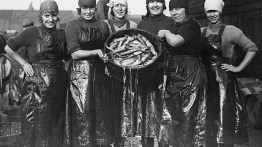
Fish stories come in two varieties: the micro-version of a hundred riverside bars, blokeish boastings of rod-and-line tussles with individual fish in which man and beast are fairly evenly matched. Then there is the macro-version, the one that tells of the fate of entire stocks — the cod of the Grand Banks, the European hake, the bluefin tuna of the Mediterranean, the haddock of the Atlantic, the whale everywhere. In this version, technology and greed have the upper hand and the narrative invariably moves from scenes of boundless plenty to ones of catastrophic scarcity. Donald S. Murray’s Herring Tales is one of these. As a native of Lewis, a Gaelic speaker, he recalls Stornaway crammed with herring boats; you could cross the harbour on their decks.

A myth is as good as a mile

From our UK edition

We live in disenchanted times. We barely do God, most of us don’t do magic and frenzied consumerism occupies our minds more than any local spirit of place. At first glance it looks as though the supernatural folktales of old — those witches and giants who lend their names to pools or hilltop crags in Britain’s remoter spots — are all but lost. From this premise, the medievalist Carolyne Larrington examines the stories that characterise some of Britain’s place names, and considers how the mythological patterns of fairy brides and rampaging dragons might have shaped the way our ancestors saw both the places they inhabited and the world at large.

Marvellous, murderous city

From our UK edition

When Stefan Zweig first arrived in Rio de Janeiro in 1936, he was overwhelmed not only by the city’s magnificent landscape but also by its ordered architecture and city planning. This encounter he would later describe as being ‘one of the most powerful impressions of my whole life’. In his Brazil: Land of the Future, a book that was an exercise in wish-fulfilment masquerading as travelogue, Zweig believed the country to be the embodiment of ‘future civilisation and peace in our world’. Over 70 years later Brazil held the world’s worst record for homicidal violence: for every ten people killed, one was a Brazilian. Rio, the cidade maravilhosa (marvellous city), may have retained its beauty in spite of being hemmed in by favelas, but it was now damned.

When the boys come home

From our UK edition

Matthew Green, former Financial Times and Reuters correspondent, remains unimpressed by officialdom’s response to casualties who aren’t actually bleeding: Ever since October 1914, when ‘Case One’ arrived in Myers’s care, the system for tending to the mental wellbeing of soldiers has grown up in a piecemeal and ad-hoc fashion, overshadowed by the Army’s stubborn ambivalence towards psychological injury (Dr Charles Myers was the Cambridge psychologist seconded to the Royal Army Medical Corps who first used the term ‘shell shock’.) Green acknowledges that ‘experience teaches that the psychological wounds of war have proved stubbornly difficult to treat’.

A hero of our time

From our UK edition

I have met Dr Kissinger, properly, only three times. First, in Cairo, in 1980, when, as a junior diplomat escorting Edward Heath, I had to secure for an almost desperate former British prime minister a meeting with the former US secretary of state, also in town. Once with Kissinger, Heath promptly subsided into a deep slumber. I had the alarming experience of trying to keep the conversation going. The other occasions were more recent, but almost as scary. My hostess at the ‘secret’ (but much publicised) transatlantic talkfests which Kissinger (92 this year) still attends twice summoned me to sit beside the great man at dinner. On each occasion I felt like the luckless passenger in the Economist’s vintage television commercial.

For better, for worse | 17 September 2015

From our UK edition

Before I read this book, I wasn’t aware that I was a creationist. But Matt Ridley tells me I am, in his broad sense of someone who foolishly believes that any good can come of ‘human intentionality, design and planning’. With no little intellectual chutzpah, he offers to treat us to a ‘general theory of evolution’ of everything, surpassing Charles Darwin’s ‘special’ one that applied only to living organisms. According to the author, ‘top-down’ is always bad, ‘bottom-up’ is always good. By what evolutionary method he avoided consciously designing this book itself remains a mystery to the end. The book’s many short chapters are determined to find evolutionary virtues in different arenas.

The house that Alfred built

From our UK edition

This is a book about boundaries — and relationships. At its heart is the eponymous house by the lake, which in 1927 was the first of many small wooden summer houses to be built in the village of Gross Glienicke. Both its situation, just outside Berlin in the lakeside area that would later abut Gatow airport, and its many occupants, from well-established German Jews to partying neo-Nazis, would expose the property to the more tidal waters of modern German history. But the house has not just provided a stage for human drama; arguably it has been integral to the action itself, helping to shape lives, just as it was itself transformed by Germany’s changing politics.

A terrible beauty

From our UK edition

Good pottery appears to be cool and silent — something vulnerable that, with luck, can outlast many human generations. A white porcelain dish seems calm and decorous; one knows that skill went into its evenness, into the exact whiteness, into its lightness. But when I began to think about pots I had no idea of the extreme violence, happenstance and risk that are an intrinsic part of the maker’s art. The chemistry is complex; the potter needs to study it intimately — the composition of different clays, of glazes, of rare and valuable pigments (cobalt for instance), and of the firewood that makes the fire. Pottery-making can be poisonous from fumes, and tasting deadly dyes. The history of the art is littered with terrible disasters.

Waiting for Utopia

From our UK edition

The Soviet Union was a nation of bus stops. Cars were hard to come by, so a vast public transport network took up the slack. Buses not only bore workers to their labours, but also breathed life into the ‘union’ itself by taking travellers from town to taiga to desert to seaside. In remoter parts of the country, bus shelters mattered even more than buses, providing convenient places for people to gather, drink and socialise. They were caravanserai for the motor age, and while the empire they served no longer exists, most of them stand right where it left them. If they are in various stages of ruin now, they are all the more attractive for it.

The brutal mask of anarchy

From our UK edition

In September 1939 Britain went to war against Germany, ostensibly in defence of Poland. One big secret that the British government didn’t know at the time — and not until much later — was that while the Anglo-Polish alliance treaty was being negotiated during the previous months, the Poles had been actively training and arming terrorists to kill British troops in the Middle East. I don’t normally believe in convoluted conspiracy theories, but this one happens to be true. In the 1930s the anti-Semitic government in Warsaw wanted rid of 3.5 million Polish Jews. Initially they tried to pack them off to Madagascar. But then the Poles hit on the idea of helping Jews create their own state in British-occupied Palestine.

Humour and horror for children

From our UK edition

In the Californian town of San Bernadino, children are going missing; smiling faces grace a gallery of milk cartons. One September evening in 1969, Jim Sturges’s brother Jack rides under a bridge and never comes out. All that’s left is his Sportcrest bike, its front wheel spinning. Forty-five years later, 15-year-old Jim Junior lives in a state of reluctant siege. Traumatised by loss, his father has armour-clad their home, calling the cops if Jim gets home seconds after sunset. Jim has other problems, too; he and his friend Tub have caught the eye of Steve Jorgensen-Warner, the school bully. And now something nasty seems to be emerging from the sewers.

The powers that were

From our UK edition

Ivan Maisky was the Russian ambassador in London from 1932 to 1943, and his knowledge of London, and affection for it, went back to his time there as a political exile from 1912 to 1917. Even after the multitude of books published on the subject, these diaries throw new light from a fresh angle on the lead-up to 1939, and the subsequent course of the war. Maisky’s commitment to communism was total. On 4 November 1934 he writes: Today, any man, even an enemy, can see that Lenin is an historical Mont Blanc… a radiant guiding peak in the thousand-year evolution of humanity, while Gandhi is just a cardboard mountain who shone with a dubious light for some ten years before disintegrating.

Foaming with much blood

From our UK edition

According to Francis Bacon, the House of York was ‘a race often dipped in its own blood’. That being so, one wonders what Bacon made of Rome’s Julio-Claudian dynasty, the gore-spattered family that gave the empire its first five rulers, and the subject of Tom Holland’s latest popular history of the ancient world. Recounting one of the era’s many fratricidal civil wars, Holland rightly observes: ‘The aptitude of the Roman people for killing, which had first won them their universal dominion, was now unleashed upon themselves.’ And no one was more adept at such incestuous slaughter than the imperial family itself.

Things left undead

From our UK edition

In the afterword to this sixth book, Aleksandar Hemon dedicates a word of thanks to his agent for keeping a straight face ‘when I told her I’d written a book she’d known nothing about’. I doubt she kept it for long, because one of the many ways in which The Making of Zombie Wars differs from Hemon’s other work is that it is dreadfully, wrigglingly, antisocially funny: the sort of book that’s difficult to read in public without undignified honks of laughter.

A karaoke version of Kafka

From our UK edition

The Blue Guitar is John Banville’s 16th novel. Our narrator-protagonist is a painter called Oliver Orme. We are in Ireland, but it’s hard to say exactly where, or exactly when. There are telephones and cars, but the dress code is antiquated: hats, canes, pocket watches. This is ‘the new-old world that Godley’s Theorem wrought’: people have ‘learned to harvest energy from the oceans and out of the very air itself’. Godley, presumably, is not the real-life economist Wynne Godley but the fictional mathematician Adam Godley of Banville’s The Infinities (2009), whose discoveries supplant relativity and quantum physics. So, the world of The Blue Guitar is a version of steampunk, straight out of genre fiction.